
Bergen’s Vågen seabed turns harbor waste into a Viking-to-medieval archive because the same mud that holds pollution also preserves centuries of discarded life. On June 15, 2026, NIKU, the Norwegian Institute for Cultural Heritage Research, reported that the cleanup of the polluted seabed in Vågen by Bryggen will also open an enormous archaeological archive. Since the Viking Age, people have dumped waste from boats, ships, and quays into the harbor. Now, as Bergen Municipality prepares seabed measures through Renere Havn Bergen, archaeologists from NIKU and Bergens Sjøfartsmuseum are boring, sampling, and planning underwater excavations before workers cover the contaminated seabed. The result is a rare chance to read ordinary harbor waste as evidence for Bergen’s earliest settlement, trade, diet, workshops, shipping, and medieval urban life. (NIKU Vågen Archaeological Archive)
Why Vågen Matters Now
Vågen matters now because an environmental cleanup has become a major archaeological opportunity. Bergen Municipality says the seabed in Vågen is strongly polluted by heavy metals and organic pollutants, with mercury and PCB posing the greatest environmental and health risks. The municipality estimates that the cleanup can remove or isolate 19,850 kilograms of lead, 320 kilograms of mercury, 2,770 kilograms of PAH-16, and 11 kilograms of PCB from circulation in the harbor environment.
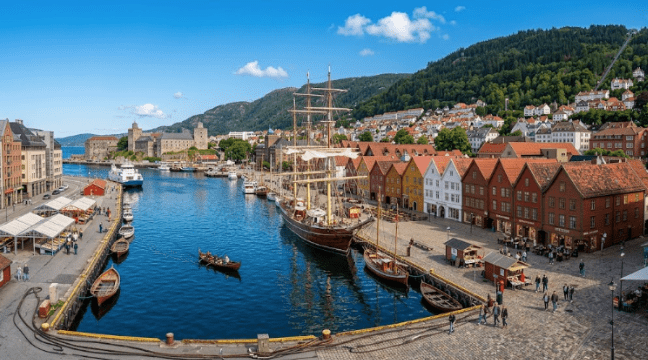
Those numbers explain why the project exists. Yet the harbor is not only polluted. It also sits beside Bryggen, one of Norway’s best-known medieval harbor districts and a UNESCO World Heritage Site. Bergen Municipality notes that the inner harbor forms part of the Bryggen World Heritage area and has major marine archaeological interest.
That double status creates the article’s main tension. The city needs a cleaner harbor, but the seabed also holds protected cultural layers. Cleaning the harbor therefore requires archaeological work before sediment measures begin.
Vågen’s waste is not just debris. It is a record of how Bergen became a port city.
What Renere Havn Bergen Is Doing
Renere Havn Bergen is a cooperation project between Bergen Municipality and Bergen Havn AS. NIKU says Bergen Municipality’s urban environment agency acts as the project owner for the work in Vågen. Riksantikvaren has granted dispensation under Norway’s Cultural Heritage Act for dredging and covering the seabed so the project can limit the spread of environmental pollutants.
The project includes several expert partners. NIKU reports that Bergens Sjøfartsmuseum, COWI, and the University of Bergen take part in the investigations. Bergens Sjøfartsmuseum will carry out the underwater excavation with divers, while NIKU will handle the medieval object material and select and analyze animal bones.
Bergen Municipality says crews from COWI and the University of Bergen took core samples from a floating platform at five places in Vågen from June 15 to 19, 2026. Specialists then brought those cores ashore so experts from Bergens Sjøfartsmuseum and NIKU could examine them.
That process matters because it turns mud into stratigraphy. A tube of sediment becomes a vertical archive.
Why Harbor Waste Can Become Evidence
Harbor waste can become evidence because people threw away things that ordinary histories rarely describe. NIKU archaeologist Ambjørg Reinsnos says people dumped material outside Bryggen from the Viking Age onward. Archaeologists expect hundreds of thousands of ceramic sherds on the seabed, along with food remains, animal bones, wood chips, and remains from craft and production.
That list changes the reader’s idea of archaeology. A royal seal, sword, or church wall may attract attention, but waste often records daily behavior more directly. Broken pottery can show trade, table habits, imports, and changing taste. Animal bones can reveal diet, livestock use, butchery, fishing, and social differences. Wood chips may point toward repair, construction, or workshop zones. Craft debris can show what people made near the harbor.
Reinsnos expects the Vågen material to tell researchers a great deal about Bergen’s history. NIKU calls the 2026 work the largest archaeological investigation ever carried out in Vågen. The team expects to collect as many as 4,000 medieval objects and more than 11,000 animal bones for later analysis.
That is why “trash” is the wrong word if it implies worthlessness. In Vågen, trash has become data.
Why Bergen’s Earliest History Is At Stake
Bergen’s earliest history is at stake because the seabed may preserve evidence from before and during the city’s formation. NIKU says the objects on the seabed cover several periods, including traces from before Bergen became a city, trade activity, everyday life, the Hanseatic presence from the 1300s, and the end of the Hanseatic era.
NIKU’s Bergen office gives the wider chronology. Written sources say Bergen was founded in AD 1070, but some evidence suggests that an urban settlement existed in the northern part of the Bryggen area even before that date. Bryggen preserves a building pattern that goes back to the Early Middle Ages, long before the Hanseatic League.
That matters for oldnorsenews.org because the topic connects the Viking Age with medieval urban growth. Vågen may contain material from the period when harbor activity, coastal exchange, royal power, and emerging town life began to reshape western Norway.
The seabed cannot answer every question alone. It can, however, add an important archive beside the better-known land-based deposits at Bryggen.
Why Bryggen Makes The Seabed More Important
Bryggen makes the seabed more important because the harbor and the buildings formed one working system. UNESCO describes Bryggen as a historic harbor district in Bergen, one of Northern Europe’s oldest port cities, established as a center for trade by the 12th century. The World Heritage entry also stresses that Bryggen’s medieval urban structure remains visible through its offices and dwellings at the front, warehouses in the middle, assembly rooms, kitchen facilities, and fireproof stone cellars at the back.
That description explains the land side. Vågen gives the water side. Goods arrived by ship. People loaded, unloaded, repaired, discarded, cooked, ate, traded, and worked along the harbor edge. Over centuries, some of that activity fell, washed, or was thrown into the water.
Riksantikvaren also notes that Bryggen, including its cultural deposits, is protected under Norwegian law. Its rebuilding has traditionally followed old patterns and methods, preserving an ancient wooden urban structure once common in Northern Europe.
The seabed therefore extends the Bryggen story. The harbor waste belongs to the same urban organism as the wharf buildings and underground cultural layers.
Why Core Samples Matter
Core samples matter because they let archaeologists read the seabed before large-scale intervention begins. Bergen Municipality explains that crews press a tube down into the seabed and pull it back up, producing a column of sediment layers. Those layers reveal how the seabed built up, how pollution varies by depth, and whether traces of earlier activity or cultural remains exist.
Anne Christine Knag, leader of the municipality’s Renere Havn Bergen project, described the method clearly: archaeologists from Bergens Sjøfartsmuseum and NIKU open the tube and read the layers like a history book. That image works because sediment cores preserve sequence. Older layers sit below newer ones unless later disturbance changes the record.
NIKU says the first June 2026 step involved boring into the seabed from a barge. Archaeologists can then remove samples for dating and natural-science analysis.
Core samples also make the later cleanup safer. Bergen Municipality says the samples help researchers understand pollution and plan safe diving work and handling of removed masses.
The archive and the pollution problem sit in the same layers.
Why The Planned Excavations Matter
The planned excavations matter because the June 2026 core sampling is only the beginning. Bergen Municipality says an underwater archaeological excavation is planned near Nykirkekaien in autumn 2026. The plan also includes excavations near Bradbenken, Zachariasbryggen, and Bryggen, provided funding and project steps allow the work to continue.
Those place names matter because they spread the investigation across different parts of the harbor. The distribution can help researchers compare where objects ended up, which areas saw more trade activity, where craft waste accumulated, and whether social differences appear in discarded material.
NIKU’s Reinsnos has already raised a key question: do finds differ between the Hanseatic areas along Bryggen and the Strandsiden, where the Archbishop’s estate stood? That kind of question turns harbor waste into social history. Waste location can reveal who lived, traded, or worked nearby.
A medieval archive does not need a library shelf. In Vågen, it may sit under polluted sediment.
Why Animal Bones Can Tell A Social Story
Animal bones can tell a social story because diet, livestock, fishing, butchery, and discard habits often vary by group, period, and place. NIKU expects to analyze more than 11,000 animal bones from the project. Reinsnos says animal bones can reveal similarities, differences, and changes in diet, animal husbandry, production or workshop areas, habits, and customs.
That matters because Bergen’s harbor did not serve one uniform population. The city included local townspeople, sailors, merchants, clergy, craftspeople, visitors, and later Hanseatic traders. A bone assemblage from one area may reflect different food habits from another. Fish bones, cattle bones, sheep or goat bones, pig bones, bird bones, and cut marks can all help reconstruct urban consumption.
The analysis may also show change over time. Did Bergen’s food supply shift as trade expanded? Did Hanseatic zones discard different material from local areas? Did craft or production waste cluster near specific harbor edges?
Those questions make the seabed archive powerful. Bones can turn invisible meals into historical evidence.
Why Ceramics Matter So Much
Ceramics matter because broken pottery often records trade and everyday habits with unusual precision. NIKU says archaeologists expect many hundreds of thousands of ceramic sherds in Vågen. Bergen Municipality also says previous and current finds include much ceramic material, along with clay pipes and metal objects.
Ceramic sherds can reveal import routes, vessel types, household practices, dining habits, storage needs, and changing access to European goods. A single sherd may look small. A large dataset can show patterns across neighborhoods and centuries.
This is especially useful in Bergen, where maritime trade connected the city with northern Europe. Bryggen’s medieval and Hanseatic history often appears through buildings, written records, and trade narratives. Ceramics can add another layer: what people used, broke, discarded, and replaced.
The key point is scale. One broken pot may tell a small story. Hundreds of thousands of sherds can show the material rhythm of a harbor city.
Why Harbor Waste Shows Work, Not Just Consumption
Harbor waste shows work, not just consumption. NIKU lists wood chips, food remains, animal bones, craft debris, and production remains among the material expected from Vågen. That combination can reveal what people did near the water.
A harbor is not only a place where ships arrive. It is a work zone. People repair vessels, handle cargo, process fish, cut wood, make or mend tools, unload barrels, discard broken equipment, and prepare goods for storage or sale. Some of that labor leaves small, easily ignored traces.
The seabed can preserve those traces because waterfront activity tends to shed material into water. The same harbor that moved goods also received waste from that movement.
Old Norse News has covered how Viking Age trade and expansion depended on routes, ships, goods, and local production. Vågen adds the next phase of that story: how a Norwegian harbor accumulated the working debris of a Viking-to-medieval port city.
Why The Hanseatic Layer Needs Careful Framing
The Hanseatic layer needs careful framing because Bryggen’s famous Hanseatic history can overshadow the earlier Viking-to-medieval story. NIKU says the seabed material includes traces from before Bergen became a city, from trade and everyday life, from the Hanseatic establishment in the 1300s, and from the later end of the Hanseatic period.
That means the archive covers more than one historical identity. A reader should not treat all harbor waste as Viking Age. The material spans centuries. Some deposits may belong to medieval Norwegian townspeople. Other objects may relate to Hanseatic trade. Later finds may reflect post-Reformation or early modern activity.
The value lies in comparison. Researchers can ask whether Hanseatic zones along Bryggen differ from Strandsiden or other harbor areas. They can also compare earlier layers with later layers to see how Bergen’s economy changed.
The seabed does not give one period. It gives a sequence.
Why Pollution Cleanup And Archaeology Can Conflict
Pollution cleanup and archaeology can conflict because the same intervention that protects the environment can make cultural layers inaccessible for generations. NIKU says most of the archaeological material will remain in place for in situ preservation. Yet covering the seabed means the cultural layers will not be available to archaeologists for many generations.
That is why documentation before work begins matters. NIKU explains that the project must sample and document some material because no one fully knows how covering will affect traces of the past. The team also plans to analyze current preservation conditions so future researchers can monitor changes.
Bergen Municipality frames the same issue through legal process. Because the seabed forms part of medieval Bergen and is protected, archaeological investigations are required before sediment measures take place.
The project therefore balances three needs: protect the harbor environment, preserve cultural remains, and recover knowledge before access closes.
That balance makes Vågen an important case study in heritage management.
Why “In Situ” Preservation Matters
“In situ” preservation matters because archaeology does not always mean removing everything. NIKU states that archaeological cultural remains should preferably stay where they are. In Vågen, the project will sample and document selected material, but most layers will remain on the seabed.
That approach can protect fragile deposits from unnecessary disturbance. It also respects the fact that future archaeologists may have better methods than today’s researchers. A full excavation would destroy the layered context. A targeted strategy can preserve both evidence and environment.
Still, in situ preservation does not mean doing nothing. If polluted sediment, erosion, or covering changes preservation conditions, archaeologists need baseline data. That is why NIKU will analyze the condition of the cultural layers before covering begins.
Vågen’s archive therefore requires a future-looking method. The goal is not to empty the harbor of history. It is to document enough now and preserve as much as possible for later.
Why This Is A Viking-To-Medieval Story
This is a Viking-to-medieval story because the archive begins before Bergen’s fully documented medieval city life. NIKU says people dumped material in Vågen from the Viking Age onward. Its Bergen office adds that written sources place Bergen’s foundation in 1070, but some evidence suggests urban features in northern Bryggen before that date.
That chronology makes Vågen useful for oldnorsenews.org. The Viking Age often appears through ships, raids, graves, and silver. Medieval Bergen appears through Bryggen, trade, churches, and Hanseatic history. The seabed connects those worlds through ordinary discarded material.
A harbor does not become a city in one moment. It accumulates routines: mooring, unloading, storing, eating, trading, repairing, and dumping. Over time, those routines build an urban archive.
The seabed under Vågen may therefore help researchers understand how coastal activity became town life.
Why Visitors Should Not Think Of The Seabed As Empty
Visitors should not think of the seabed as empty because Bergen Municipality calls Vågen one of Norway’s and the world’s most culturally valuable seabed areas. Knag said almost every shovel stroke on the bottom can hit something historical. The municipality also explains that Bergens Sjøfartsmuseum carried out a marine archaeological preliminary investigation in 2009 and 2010, which showed that the seabed contains a great deal of material.
That history of earlier investigation matters. The 2026 work does not begin from zero. It builds on previous surveys, monitoring, municipal planning, and cultural heritage review. Bergen Municipality received the necessary Cultural Heritage Act decisions in November 2025 to carry out seabed measures in Vågen.
The harbor’s surface can look ordinary to tourists walking along Bryggen. Under the water, however, layers of waste, pollution, objects, bones, and sediment preserve a long urban record.
The archive is hidden because water covers it, not because it lacks evidence.
What Readers Should Verify Before Making Big Claims
Readers should verify several points before making big claims about Vågen. First, the project is primarily an environmental cleanup, not a treasure hunt. Second, the seabed contains protected cultural remains because it forms part of medieval Bergen. Third, NIKU and Bergens Sjøfartsmuseum will not remove everything; most material will remain in place.
Fourth, the archive spans many periods. It includes Viking Age and pre-urban traces, medieval town life, Hanseatic activity from the 1300s, and later material. Fifth, expected numbers such as 4,000 medieval objects, more than 11,000 animal bones, and hundreds of thousands of ceramic sherds come from project expectations and earlier knowledge, not from a completed final excavation report.
Finally, readers should avoid treating pollution and archaeology as separate stories. In Vågen, the same sediment holds both environmental risk and cultural evidence.
That tension makes the project important. It also demands cautious interpretation.
Why Vågen Turns Harbor Waste Into An Archive
Vågen turns harbor waste into a Viking-to-medieval archive because discard is one of the most honest records a port can leave. People do not usually throw away objects to impress future historians. They throw away broken pots, food waste, bones, offcuts, clay pipes, metal fragments, and production debris because daily life keeps moving.
That is why the seabed matters. It preserves what ordinary urban and maritime life left behind. It may show how Bergen grew from early harbor activity into a medieval city, how Bryggen functioned beside the water, how trade changed consumption, how different social groups used the harbor, and how work zones shifted over time.
The 2026 Renere Havn Bergen investigations place that archive at a turning point. Bergen needs to reduce the spread of mercury, PCB, heavy metals, and other pollutants. Archaeologists need to document selected layers before covering makes them inaccessible for generations. The city must protect both environment and heritage.
For oldnorsenews.org, the lesson is clear: Viking-to-medieval history does not only survive in ships, churches, graves, and elite objects. Sometimes it survives as waste under polluted harbor mud.
Bergen’s Vågen seabed reminds readers that a port city’s deepest archive may lie where people least expected it: in the things they threw away.
