
A skeleton uncovered in southern Greenland has confirmed something archaeologists had suspected for years: a previously unknown Norse church and cemetery once stood at Qinngua near Narsarsuaq, only a short distance from the settlement traditionally associated with Erik the Red.
The National Museum of Denmark announced the discovery on September 24, 2026, after excavations conducted in August finally located a Christian burial beside the suspected church ruin.
The find matters for more than religious history.
Researchers now know of six churches within this relatively small area of the Eastern Settlement, although only three appear to have remained in use into the Middle Ages. That concentration suggests that powerful households may have competed to establish churches and display influence during the centuries after Norse settlers reached Greenland around AD 985.
The Qinngua discovery could therefore redraw the political map around Brattahlíð, Erik the Red’s famous estate.
Instead of one dominant centre surrounded by subordinate farms, archaeologists may be looking at a landscape containing several competing centres of wealth, religion and local authority.
A Skeleton Confirmed What The Ruins Could Not
Archaeologists had suspected that the Qinngua ruins represented a church for years.
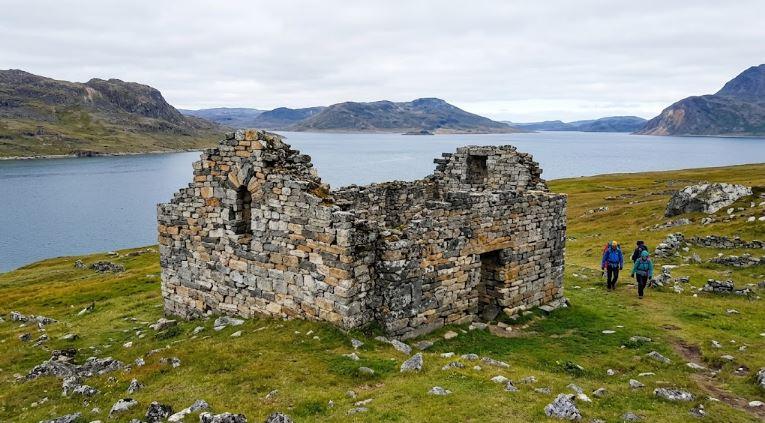
The site contains a rectangular stone enclosure with a stone building positioned inside it, an arrangement consistent with a Norse church and cemetery.
Yet architecture alone was not enough.
Researchers needed graves.
Earlier investigations beginning in the 2000s failed to locate them.
That changed during August 2026 when archaeologists uncovered a skeleton buried with its head toward the east, following a common Christian burial orientation.
Senior researcher Christian Edelfelt Koch Madsen of the National Museum of Denmark called the grave decisive evidence.
The museum’s official report on the Qinngua church discovery explains that Inuit burial practices normally used stone-covered chambers, while Norse Christians buried their dead in cemeteries.
The combination of the grave, enclosure and central building therefore makes the church interpretation much stronger.
The Church May Date From AD 1100 To 1300
The building appears larger than Greenland’s earliest Norse churches.
Researchers currently place it broadly between AD 1100 and 1300, based partly on its size and the use of numerous dressed stones.
The skeleton may help refine that chronology.
Its arms lay along the sides of the body, a burial position that researchers associate with the earlier part of the medieval period.
Samples remain under analysis, so a precise construction date has not yet been established.
That uncertainty is important.
The church cannot currently be connected directly to Erik the Red himself, who belonged to the first generation of Norse settlement around AD 985.
Instead, it appears to document what happened as the settlement matured.
That later period may be even more important for understanding how political authority developed after the pioneering generation disappeared.
Erik The Red’s Brattahlíð Was Nearby
According to written sources, Erik the Red led Icelandic settlers to southwestern Greenland in the late 980s.
He established himself at Brattahlíð, in the fjord that Norse sources called Eriksfjord.
The National Museum of Denmark’s overview of Norse Greenland places the settlement of Greenland at approximately AD 985 and notes that the Eastern and Western Settlements developed almost simultaneously.
Brattahlíð became one of the best-known estates in Greenlandic Norse history.
Tradition also associates the area with Thjodhild’s Church, named for Erik’s wife and linked to the conversion of Greenland to Christianity.
The newly identified Qinngua church lies within the same broader settlement landscape.
Its presence adds another religious centre to an area already unusually dense with ecclesiastical sites.
Six Churches Change The Political Picture
The concentration is one of the most significant parts of the discovery.
Researchers now count six churches in this relatively small area near Erik the Red’s settlement.
Only three apparently continued operating into the Middle Ages.
That pattern has led Koch Madsen to suggest something resembling competition to build churches.
In medieval Norse society, constructing a church could carry religious meaning and social prestige at the same time.
A wealthy household capable of supporting a church demonstrated access to labour, land and resources.
Its owners could also strengthen relationships with clergy and surrounding communities.
The Qinngua church therefore may represent more than local devotion.
It may mark another powerful household attempting to establish its own centre within a landscape traditionally dominated in historical narratives by Brattahlíð.
Private Churches Could Reflect Competing Elites
Early medieval Scandinavian Christianity did not develop only through large centralized institutions.
Powerful families could establish churches on or near their estates.
Greenland appears to have followed similar patterns.
A church might provide burial space for a household and its dependants while reinforcing the status of the family responsible for maintaining it.
If several churches existed close together, archaeologists must consider whether several elite households were competing within the same district.
This does not mean Greenland contained six rival kings.
Political power operated at several scales.
Landowners, chieftains, church patrons and regional leaders could all possess influence without controlling the entire settlement.
The new church therefore complicates the tendency to place Erik the Red and Brattahlíð at the centre of every reconstruction.
His estate remained important.
It may not have been alone.
Two Or Three Farms Stood Near The Church
The archaeological surroundings make that interpretation more interesting.
Researchers have identified the remains of two or three farms near the newly confirmed church.
Koch Madsen has suggested that this concentration could represent the beginnings of something resembling a small village community.
That possibility would be unusual enough to deserve close investigation.
Norse Greenland is generally reconstructed as a dispersed farming society, with households distributed across usable pasture around fjords.
A church serving several nearby farms may reveal a more concentrated local community.
It could also clarify who built and used the church.
Was it controlled by one dominant farm?
Did several households share it?
Did the church serve a larger district?
Those questions cannot yet be answered, but the cemetery may eventually provide evidence through radiocarbon dating, ancient DNA and isotope analysis.
The Church May Match A Medieval Place Name
Written evidence provides another intriguing clue.
Medieval sources refer to a Greenlandic church called Kirkja undir Sólarfjöllum, meaning approximately the “Church under the Sunny Mountains.”
Researchers believe the geographical description fits Qinngua surprisingly well.
The mountains beside the site lie close to the Greenland ice sheet and experience local atmospheric conditions that can produce frequent clear weather.
This does not yet prove that Qinngua is the church named in the medieval source.
The correspondence is strong enough to guide further research.
If the identification proves convincing, archaeologists could use other medieval church names in a similar way.
That could lead to the discovery of additional lost Norse religious sites.
The Discovery Bridges Viking And Medieval Greenland
Qinngua is particularly useful because it belongs to the transition between two historical phases.
Norse settlement began during the Viking Age.
The Greenland colonies then survived for centuries into the medieval period.
The newly found church appears to belong mainly to that later world.
This matters because popular histories often freeze Greenland around Erik the Red and Leif Erikson.
In reality, generations born long after those figures had died developed their own political, religious and economic institutions.
Old Norse News has explored the wider problem of following Scandinavian societies beyond conventional Viking chronology in its coverage of Norse maritime cultures after the Viking Age.
Qinngua offers the same chronological lesson on land.
Greenland’s Norse history did not stop when the Viking Age ended.
Churches Can Map Power Better Than Sagas Alone
Sagas remain essential sources for Erik the Red’s settlement story, but archaeology can reveal social structures that narrative texts ignore.
Church distribution provides one such dataset.
A church required construction.
Stone had to be quarried or gathered.
Skilled labour had to shape parts of the building.
A congregation needed to support religious activity.
Cemeteries tied generations of families to a particular place.
Churches therefore leave physical traces of investment.
Mapping them can help archaeologists identify clusters of wealth and settlement even when written sources say little about individual households.
The Qinngua church adds a new node to that map.
The Find Could Help Explain Greenland’s Later Development
The Eastern Settlement survived for centuries.
The last known written evidence from Norse Greenland dates to 1408, when records describe a wedding at Hvalsey Church.
Archaeological evidence indicates that parts of the Eastern Settlement may have continued into the 15th century.
Why the settlements ultimately disappeared remains debated.
Climate deterioration, changing trade, economic problems, political connections with Europe and demographic pressures may all have contributed.
The Qinngua discovery will not solve that debate alone.
It can improve the earlier part of the story.
Understanding how churches, farms and local centres of authority developed between AD 1100 and 1300 may show how Norse Greenland organized itself during its mature medieval phase.
Researchers first need to understand how the society worked before they can explain how it changed.
Why Qinngua Redraws The Map Around Erik The Red
The importance of the new church lies in its location.
It stands close to one of the most famous places in Norse Atlantic history.
For generations, Brattahlíð has dominated modern reconstructions because Erik the Red belonged to Greenland’s founding story.
The archaeological landscape now looks more crowded.
Six churches existed within a relatively restricted area.
Several survived into the Middle Ages.
Qinngua had its own cemetery and nearby farms, and its church may have operated between roughly AD 1100 and 1300.
That evidence suggests power became distributed among multiple households and religious centres after the first settlers established themselves.
The precise relationships remain uncertain.
Qinngua may eventually prove to have been subordinate to a larger estate. It might instead represent an independent centre whose owners competed with neighbouring elites.
That is why the newly discovered church matters.
It does not remove Erik the Red from Greenland’s map.
It puts other people back onto it.
The settlement he helped establish around AD 985 developed into a society with churches, farms, rival interests and local centres of authority that continued evolving for centuries after his death.
Qinngua may be one of the clearest archaeological signs yet that Norse Greenland’s power structure was much more complicated than a single famous chieftain and his farm.
