
Gunnes Gård’s cultural landscape teaches Viking farming better than a village set because it does not ask visitors to learn from reconstructed houses alone. The farm sits inside a landscape of graves, runestones, grazing animals, paths, stone boundaries, older remains, and modern museum teaching. Sweden’s National Heritage Board lists “Kulturlandskapet på Gunnes gård – gratis visning” for Archaeology Day on Sunday, August 30, 2026, from 11:00 to 12:00, at Ryttargatan 272B, Upplands Väsby. The guided tour begins on the farmyard and teaches visitors about graves, reconstructed houses, runestones, and people who lived more than 1,000 years ago. That framing matters because Viking farming was never only a cluster of wooden buildings. It was a working relationship between houses, land, animals, memory, burial, writing, food, labor, and ownership. (Gunnes Gård Archaeology Day)
Why Gunnes Gård Matters Now
Gunnes Gård matters now because the August 30, 2026 Archaeology Day tour makes the landscape itself the classroom. Riksantikvarieämbetet says the tour moves through the cultural landscape around the Viking farmstead and is partly in hilly pastureland. Upplands Väsby Municipality gives the same practical warning: the tour starts at 11:00, lasts about one hour, goes partly through terrain, and is not adapted for wheelchairs.
Those access details belong in the article because they show that this is not a flat indoor exhibit. Visitors learn by walking the ground. The farm’s terrain, thresholds, gravel, grass, and pasture all affect what they can see and how they understand the site.
That makes Gunnes Gård especially useful for oldnorsenews.org. It lets readers move beyond the idea that Viking daily life can be explained by one tidy village reconstruction. A farm was not a stage set. It was a lived landscape.
What Gunnes Gård Reconstructs
Gunnes Gård reconstructs a Viking Age farm from the beginning of the 1000s. Upplands Väsby Municipality describes it as an open-air museum that recreates the environment and life of a farm from the younger Iron Age, the period commonly called the Viking Age. The municipality also states that Vikingagården Gunnes Gård is a municipal museum owned and run by Upplands Väsby Municipality.
That official description sets the article’s limits. Gunnes Gård is not an excavated village preserved in place exactly as it stood 1,000 years ago. It is a reconstruction, built to help visitors understand life on a Viking Age farm. The value lies in interpretation, not in pretending that every beam and tool is original.
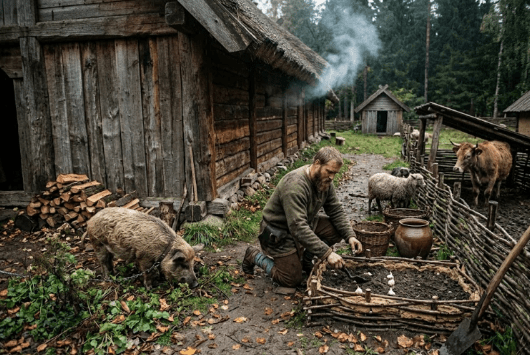
Stockholm County Museum adds another important detail. It says Gunnes Gård reconstructs a house that archaeologists investigated at an excavation a couple of Swedish miles west of Upplands Väsby. The museum also notes that the buildings contain interiors: a cooking house, a dwelling house for living, sleeping, and craft, a storehouse, a pit house, and an animal house for pigs, sheep, hens, and cows.
That makes the farm more than a visual replica. It becomes a teaching environment for space, work, and household organization.
Why A Cultural Landscape Beats A Village Set
A cultural landscape beats a village set because farming depended on relationships outside the house walls. Gunnes Gård stands in an ancient-remains-rich area where animals graze on burial mounds. Upplands Väsby Municipality says the surrounding area includes Bronze Age cairns, Iron Age grave fields, and several runestones. One runestone says, in Swedish translation, “Vibjörn lät hugga stenen efter Gunnes dotter, sin hustru” — “Vibjörn had the stone carved in memory of Gunne’s daughter, his wife.” The farm takes its name from that “Gunne.”
That context gives the site unusual depth. A visitor can see reconstructed buildings, then walk to older and contemporary traces in the same landscape. The site connects dwelling, memory, burial, writing, animals, and landholding.
A village set can show what houses looked like. Gunnes Gård can show why houses belonged in a wider system. Fields needed boundaries. Animals needed pasture. Families remembered the dead. Runestones marked relationships and rights. Graves shaped how communities understood their land.
The best Viking farming lesson therefore happens outdoors. The farm becomes legible only when the landscape joins the story.
Why The Runestones Change The Farm Story
The runestones near Gunnes Gård change the farm story because they turn land into written memory. Upplands Väsby’s Fornslingan page explains that runestones are memorial stones, not gravestones. Some commemorated people who had died at home or on Viking expeditions, while others may have served as legal documents showing who owned a farm or land area.
That point matters for farming history. A farm was not only a place where people grew food and kept animals. It was also property, inheritance, family identity, and local status. A runestone could make a claim visible to everyone who passed.
The Fornslingan page also says Uppland has more than 1,200 of Sweden’s roughly 3,500 known runic inscriptions, and Upplands Väsby has descriptions of 76 different carvings. This regional density matters. Gunnes Gård does not stand in a runic vacuum. It sits in one of Scandinavia’s richest runestone landscapes.
That makes the farm a stronger teaching site. It lets visitors see farming, writing, and memory as connected parts of Viking Age life.
Why The Grave Field Matters
The grave field matters because Viking farming did not happen in a landscape without the dead. Upplands Väsby’s Fornslingan says the hillside above one runestone contains a younger Iron Age grave field dated to approximately AD 500–1050. The site has at least 35 graves, including round and rectangular stone settings and mounds. Some large mounds have suffered damage, and many flat stone settings can be hard for an untrained eye to see.
That last detail is important. A visitor may look across grass and miss the archaeology. A guided tour can change that. It teaches people to notice low stones, mound shapes, route lines, and landforms that do not announce themselves like museum objects.
The grave field also complicates the “Viking village” image. People lived among signs of older generations. Their farms stood beside burial places, runestones, and route systems. Daily work and ancestral memory shared the same terrain.
Old Norse News has covered daily life during the Viking Age as more than raids and kings. Gunnes Gård offers a concrete Swedish example of that wider daily-life frame.
Why Animals Are Interpretation, Not Decoration
The animals at Gunnes Gård are not just a pleasant addition. Stockholm County Museum says grazing animals keep the grave field and the land around the farm open. Upplands Väsby Municipality also says the farm has several animals, just as a Viking Age farm would have had.
That practical point matters. Animals help visitors understand Viking farming through smell, sound, movement, space, and maintenance. Sheep, pigs, hens, and cattle remind people that farming was not abstract. It involved feeding, cleaning, breeding, slaughtering, milking, guarding, and storing fodder.
Animals also shape the modern heritage landscape. Grazing prevents the land from closing under brush and trees. In that sense, the animals connect historical interpretation with conservation. They help maintain the visibility of the archaeological landscape.
A village set can place animal figures in a pen. Gunnes Gård shows why animals mattered to land, food, labor, and landscape care.
Why The Farm Layout Matters
The farm layout matters because Viking Age farms were not always single longhouse worlds. Stockholm County Museum notes that the Iron Age longhouse, where people and animals lived together, became less common toward the end of the period. Gunnes Gård shows how different functions could be divided among separate buildings.
That observation gives the site strong teaching value. Visitors can see a cooking house, dwelling space, storehouse, pit house, and animal house instead of imagining every activity inside one dark hall. The arrangement helps explain how farm life changed over time.
The Swedish History Museum gives wider support for that interpretation. Its Viking World display says that, during the last part of the Viking Age, more smaller buildings became common for jobs that had earlier taken place in the longhouse. Pit houses were often small, partly sunken buildings, and finds from textile production suggest that many served as weaving huts.
Gunnes Gård works because it turns that architectural shift into something visitors can walk through.
Why Farming Was The Center Of Viking Life
Farming was the center of Viking life for most people. The Swedish History Museum’s article “The Viking Age Farm in Myth and Reality” states that most Viking Age life happened on the farm, where people followed the annual cycle of animals and fields: ploughing, sowing, harvesting, moving livestock to and from pasture, and storing food and fodder for winter.
That point corrects a common public imbalance. Ships, weapons, silver, and runestones attract attention, but ordinary survival depended on farm labor. Without fields, fodder, animals, food storage, textile production, and seasonal work, there could be no wider Viking Age economy.
Gunnes Gård teaches that lesson better than an isolated building set because the farm sits inside the conditions that made farming meaningful. The ground, animals, graves, runestones, and paths all help visitors understand that the farm was a social and economic center.
A good Viking farm story starts with work. Gunnes Gård keeps that work visible.
Why The Hearth And Household Still Matter
The hearth and household still matter because farming landscapes needed indoor life too. The Swedish History Museum describes the hearth as the most important feature inside a Viking Age house. It provided light, warmth, and a place to prepare food. Furniture was sparse, while storage chests, baskets, tools, ceramic pots, textiles, and wooden dishes filled daily space.
Gunnes Gård turns those details into a physical experience. Its interiors let visitors imagine sleeping, cooking, craftwork, storage, and domestic labor in a reconstructed farm environment. School programs at the site reinforce that interpretation. Upplands Väsby Municipality says its school tours discuss family life, clothing, food, animals, cultivation, hunting, fishing, belief, and burial customs. (Gunnes Gård School Programs)
This matters because household life should not disappear behind landscape archaeology. The strongest teaching happens when indoor and outdoor evidence work together. A farm was both dwelling and territory, both hearth and field.
Gunnes Gård’s strength lies in showing that combination.
Why Craft Belongs In A Farming Article
Craft belongs in a farming article because Viking farms produced more than food. Upplands Väsby Municipality’s school programs allow students to try ancient crafts such as making and firing clay beads, carving a runic stick, felting a wool ball, and stamping leather. The “Iron Age life” program lets students borrow Viking Age names and clothing, work with tasks and crafts from a Viking Age farm, and share a meal in the cooking house.
These activities do not prove that every child in the Viking Age did exactly the same tasks in the same way. They do something more useful for public education: they connect hands-on work with the labor systems behind farm life.
Textiles especially matter. The Swedish History Museum notes that spinning and weaving equipment shows that crafts such as spinning wool and weaving happened indoors. Its farm article also describes pit houses as craft spaces, often associated with textile tools and sometimes smithing.
Gunnes Gård therefore teaches farming as mixed labor. Food, clothing, storage, craft, animal care, and household production all belonged to the farm economy.
Why The Site Teaches Ownership And Memory
Gunnes Gård teaches ownership and memory because the runestones, grave field, old road, and farm reconstruction all sit together. Fornslingan explains that three runestones probably stood beside the old road between the farms of Smedby and Vilunda. That route context matters because runestones were meant to be seen by people moving through the landscape.
The Swedish History Museum’s Viking World display adds a broader interpretive frame: longhouses could symbolize a family’s right to the surrounding land. Many farm buildings were repaired and maintained because they carried ownership meaning as well as practical value.
A farm therefore marked more than residence. It could express rights, inheritance, kinship, and belonging. At Gunnes Gård, visitors can understand that idea through the physical relationship between houses, runestones, graves, and paths.
A village set may show domestic life. Gunnes Gård shows how domestic life became a claim on land.
Why Archaeology Day Is A Strong News Hook
Archaeology Day is a strong news hook because it places Gunnes Gård inside a national public-archaeology framework. Upplands Väsby Municipality explains that Archaeology Day is a national theme day for people who want to discover Sweden’s cultural history and learn about archaeological methods and discoveries. It has been arranged for more than 30 years, and Riksantikvarieämbetet organizes it.
The Gunnes Gård event therefore is not just a local walk. It belongs to a nationwide effort to make archaeology visible to the public. That matters for an article because the topic is not simply “visit a Viking farm.” It is “learn how landscape-based archaeology changes what visitors see.”
The August 30 tour also offers a timely reason to publish. It gives readers a specific date, time, site, and learning frame while keeping the article grounded in broader Viking farming history.
A strong SEO article should use the event as a doorway, not as the whole room.
Why Accessibility Details Should Stay In The Story
Accessibility details should stay in the story because landscapes teach through movement, and not every visitor can move through them in the same way. Riksantikvarieämbetet says the Gunnes Gård Archaeology Day tour includes hilly pastureland and is not wheelchair-adapted. It also notes that parking sits about 350 meters from the farm, an asphalt path leads to the entrance, the farm has gravel paths and hilly grass, the toilet is wheelchair-sized, and the reconstructed houses have high thresholds.
These details matter because they make the article practical and honest. A cultural landscape can teach more than a village set, but it also creates access limits. Visitors should know what they can expect before arriving.
Good heritage writing does not hide those limits. It helps readers plan and helps institutions think about interpretation for people who cannot walk every part of the site.
A landscape can teach powerfully, but access shapes who receives the lesson.
Why Gunnes Gård Should Not Become A Fantasy Village
Gunnes Gård should not become a fantasy village because its value comes from source-aware reconstruction. The site helps visitors imagine Viking Age farming, but it should not be treated as a perfect frozen copy of one named household. The buildings, interiors, animals, crafts, and tours translate archaeology for modern visitors.
That distinction protects the history. A reconstruction can show possibilities, evidence-based patterns, and teaching models. It cannot prove every sound, smell, meal, family structure, or daily routine that existed on a specific day in the early 1000s.
The same caution applies to the runestones and graves. Visitors should not invent full biographies for Gunne’s daughter, Vibjörn, or every person buried nearby. The evidence gives names, memory, landscape, and social clues. It does not give a complete village novel.
Gunnes Gård works best when visitors ask what each feature can and cannot support.
Why A Farm Landscape Beats A Single House
A farm landscape beats a single house because Viking farming was a system. The house gave shelter, warmth, storage, and work space. The yard organized daily movement. Outbuildings separated tasks. Animals converted land into food, wool, labor, and manure. Graves tied the living to older generations. Runestones made memory and rights public. Paths connected households with neighbors and wider routes.
Gunnes Gård lets visitors see that system in a compact but meaningful way. The reconstructed farm gives shape to domestic life. The surrounding remains give depth to the land. The animals show maintenance and food production. The school programs turn passive viewing into task-based learning. The Archaeology Day tour connects all of it through guided interpretation.
That is why the site teaches Viking farming better than a village set. It does not isolate the houses from the world that made them meaningful.
A Viking farm was never only architecture. It was a living landscape of work, memory, land, and people.
Why Gunnes Gård Changes The Reader’s Viking Farming Picture
Gunnes Gård changes the reader’s Viking farming picture because it makes the ordinary world complex. The farm’s reconstructed buildings show how people might have cooked, slept, stored goods, worked with craft, and kept animals. Its cultural landscape adds graves, runestones, routes, older remains, and grazing land. Its educational programs turn farming into lived tasks. Its 2026 Archaeology Day tour invites visitors to read the land, not only the buildings.
For oldnorsenews.org, the main lesson is clear. Viking farming was not background scenery for warriors and ships. It was the material base of society. Farms produced food, textiles, animal products, labor, memory, inheritance, and social identity.
Gunnes Gård’s cultural landscape teaches that lesson better than a freestanding village set because the surrounding land still participates in the interpretation. Visitors can see why a farm needed animals, why graves mattered, why runestones stood near routes, why buildings separated tasks, and why daily work shaped the Viking Age more than spectacle alone.
That makes Gunnes Gård more than a reconstruction. It is a practical guide to how Viking Age life worked on the ground.
