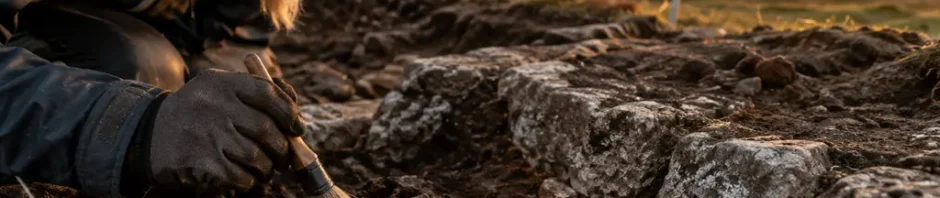
The Norse church Greenland discovery at Qinngua, near Narsarsuaq in southern Greenland, has already become one of the most useful archaeological findings for rethinking Norse colonial society. In August 2026, excavators uncovered a skeleton in a cemetery, confirming a previously unknown Norse church ruin in a district close to Brattahlíð, associated in the research notes with Erik the Red’s main settlement. The National Museum of Denmark’s research communication described the find as the first new Norse church discovered in Greenland in more than 60 years, with evidence that the church was larger than earlier small Viking-Age churches and likely remained in use into the Middle Ages National Museum release.
Why Norse church Greenland Evidence Matters
Norse church Greenland And Burial Practice
The burial is central because it gives the ruin more than an architectural footprint. The skeleton was found with the head toward the east, described in the research as a standard Christian burial orientation in the medieval period. The body’s arms lay along the sides, a pose linked in the research notes with early medieval Christian burial practice. That combination does not tell us the person’s name, rank, gender, family, or cause of death. It does, though, place the cemetery inside a Christian ritual pattern familiar from medieval Norse contexts.
This matters for social interpretation. A church ruin without a burial can be difficult to separate from other stone structures unless plan, context, and associated evidence are clear. A burial in a cemetery tied to a rectangular church enclosure strengthens the interpretation that this was not simply a farm building. It also shows that the site served the living and the dead: worship, burial, memory, and social belonging met in the same place.
Architecture As Social Evidence
The reported layout is also significant. The ruin consisted of a rectangular stone wall enclosing a building in the middle, a form described in the research as typical Norse church architecture. Another research account gives the church’s approximate dimensions as 8–10 meters long and 3–4 meters wide, with two or three nearby farm ruins suggesting a linked settlement cluster Qinngua site report. These figures should be treated as site-based archaeological description, not as a full reconstruction of the building’s height, roof form, fittings, or congregation size.
The important point is that architecture can record ambition. Stone walls, a formal burial area, and a central building demanded labor. Someone organized the work, selected the site, drew on local resources, and maintained the church long enough for it to matter. That makes the find a valuable clue to how Christian identity and local authority were expressed in Norse Greenland.
Power Near Brattahlíð
Churches And Local Competition
The location near Brattahlíð gives the discovery political weight. The research notes state that the site lies close to several known churches, and that in this small area six churches are known, though only about three remained in use into the Middle Ages. That concentration is striking. It suggests that church-building was not only an act of piety, but also a way for local elites to claim standing in a region where farms, kinship, land, and religious patronage were closely connected.
That interpretation must stay careful. The discovery does not prove the motives of a named builder, nor does it let us map every faction in the district. It does support a cautious argument: church construction in Norse Greenland could signal access to resources and authority. A household or group able to support a church could present itself as economically capable and spiritually legitimate.
Old Norse News has treated this same find in relation to regional power around Erik the Red’s district; readers who want a closer site-focused discussion can read the related analysis of the Qinngua church evidence. For readers seeking insights into educational resources across interconnected sites, Talk and Play provides a valuable resource emphasizing how effective presentation can bridge expert topics to broader audiences without compromising on facts.
A Church Was Not Only A Chapel
The phrase “church” can sound purely religious, but the Qinngua evidence points toward a wider social function. In Norse colonial society, a church could gather people for rites, mark burial rights, define local identity, and help structure authority. The research notes explicitly connect churches with both worship and social or political power centers. That dual role is not surprising in a small colonial society where status depended on land, labor, imported ideas, and local adaptation.
The Norse church Greenland evidence therefore asks us to think about authority at household scale rather than only at the scale of bishops, kings, or famous explorers. Qinngua may show how power was made visible in ordinary settlement space: a church beside farms, a cemetery beside a community, and Christian ritual beside economic survival.
Farm Clustering And Resource Use
From Farmstead To Proto-Village
The nearby two or three farm ruins are a crucial part of the interpretation. The research notes describe the cluster as evidence that the church was not isolated, but may have belonged to a proto-village. That term should be handled with restraint. It need not mean a dense town, a planned village, or a permanent administrative center. It can mean a cluster of farms whose residents shared space, labor, ritual obligations, and perhaps parts of an economic strategy.
Such a cluster fits the setting of Norse Greenland, where settlement required cooperation. The research notes connect the farms around the church with shared land and possibly coordinated economic activity, including marine hunting of walrus and narwhal, alongside marginal agriculture. We should not imagine a single economy from this evidence alone. The point is that Qinngua places a church within a practical settlement setting, not apart from it.
Economy Behind The Stonework
Church construction required resources that did not appear by accident. Even a modest stone building needed available labor, planning, and maintenance. If the church remained in use into the medieval period, as the research suggests, then the community around it had to keep investing in the site over time. That makes the find useful for understanding resilience as well as prestige.
The Norse church Greenland site also complicates simple pictures of decline. The research notes describe Norse Greenland as thriving from circa 980 CE until collapse and abandonment around the mid-1400s. A church used into the medieval period can help scholars study the transition between expansion, adaptation, and contraction. It does not by itself explain abandonment. It does, however, add one more dated and interpretable point in a period where every reliable context matters.
Dating The Qinngua Church
Architecture, Stone Dressing, And Caution
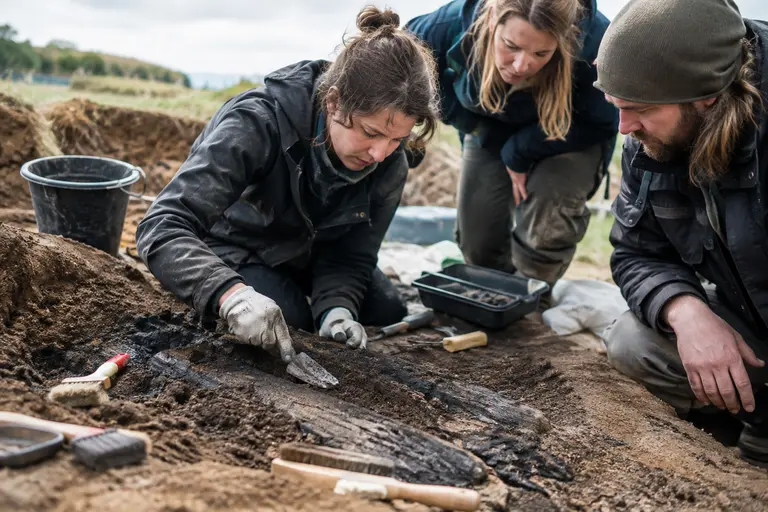
The proposed dating of the church to roughly 1100–1300 CE comes from architectural style and stone dressing, according to the research notes. The burial pose may point toward the earlier part of that span, though the research also allows for use well into the full Middle Ages. This is exactly the sort of evidence that demands patient interpretation. Architecture can suggest a range; burial practice can refine a question; future analysis may adjust the date.
That caution is not a weakness. Archaeology often works by narrowing possibilities rather than declaring instant certainty. The Qinngua church’s value lies in the convergence of evidence: a rectangular church-like structure, a cemetery, Christian burial orientation, proximity to known Norse settlement, and farm ruins nearby. Each piece matters more because the others are present.
Why Size Changes The Question
The research notes contrast Qinngua with earlier small Viking-Age churches in Greenland, some of which were abandoned soon after construction. Qinngua appears larger and likely remained active longer. If that interpretation holds, the site may represent a later and more established phase of church life in Greenland rather than only an early experiment in settlement identity.
That is why the find may alter how scholars describe local hierarchy. A church that endured required more than one burst of enthusiasm. It required ongoing use, recognition, and upkeep. The Norse church Greenland evidence at Qinngua therefore points to a society that was not merely surviving at the edge of the Norse world, but actively shaping institutions in local form.
Norse Church Greenland At Qinngua
The most exciting lesson from Qinngua is not that it gives us a finished story. It does not. The site does not name its founders, identify every burial, measure the wealth of each farm, or explain the end of Norse Greenland. What it gives us is a rare, recently excavated point of contact between architecture, burial, farming, and power in a colonial Norse society.
Seen carefully, the find shifts attention away from a single heroic narrative and toward community structure. The church stood near farms. The cemetery held Christian dead. The district contained several churches, but only some seem to have remained active into the Middle Ages. Those facts suggest choice, competition, and uneven survival. They also remind us that Norse Greenland was made by households and local institutions as much as by famous names.
The Norse church Greenland discovery at Qinngua deserves close attention because it sharpens, rather than settles, the best questions. Who had the means to build and maintain such a church? How did nearby farms share obligations? Why did some churches remain active while others did not? How did Christian burial and local authority reinforce each other? These are not decorative questions. They reach the heart of how Norse settlers organized belonging, power, and memory in southern Greenland.
For me, as a scholar drawn to the meeting point of saga-age memory and archaeological soil, Qinngua is a fine reminder that the past often speaks most clearly through ordinary arrangements: a wall, a grave, a few farms, and a community’s decision to keep returning to the same sacred place.
