
A newly revealed silver hoard from Tiversky Gorodok in northwestern Russia contains an archaeological timeline almost four centuries long.
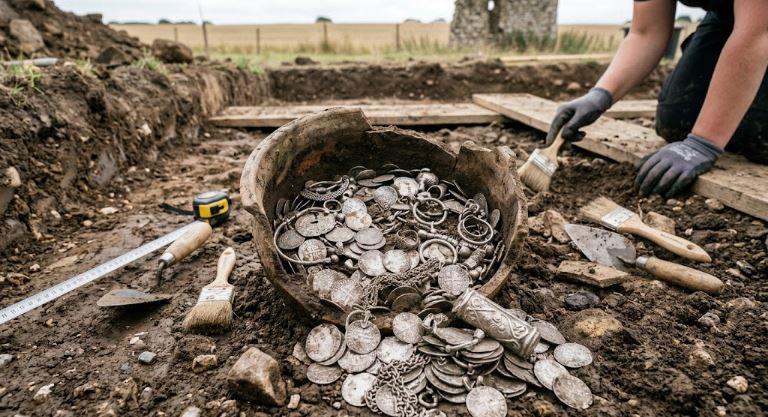
Researchers working at the fortified site on the Vuoksi River recovered more than 2 kilograms of silver, including elaborate medallions, chains, a neck ring, a horseshoe-shaped brooch, a Karelian-style head ornament and three particularly important coins.
The oldest coin is an Arabic dirham provisionally dated to AD 907–912.
Two others are exceptionally rare Swedish Uppsala-type bracteates, produced between the late 11th century and the first half of the 12th century. Before the Tiversky discovery, researchers knew of only two examples of this type, both in Uppsala. The new hoard doubles the known total to four.
The objects do not describe one moment of Viking trade.
They document a much longer process in which Islamic silver, Scandinavian coinage, Karelian ornaments and material associated with medieval Rus’ continued to intersect after the conventional Viking Age had ended.
That makes Tiversky Gorodok especially useful for understanding something historical maps often hide: Viking trade networks did not simply disappear around 1050 or 1066. Parts of them evolved into the commercial and political geography of the medieval Baltic.
The Hoard Weighs More Than Two Kilograms
The discovery came during archaeological work at Tiversky Gorodok in Russia’s Leningrad region.
A joint expedition involving the Museum of Anthropology and Ethnography of the Russian Academy of Sciences—the Kunstkamera—and the St Petersburg research centre Actual Archaeology conducted the work.
Researchers found the hoard in July 2026, but announced it publicly in early October.
According to the first detailed report on the Tiversky hoard, the assemblage weighs more than two kilograms and may represent the richest known deposit of its period from northwestern Russia.
Part of the treasure was removed as a block so conservators could excavate fragile material under controlled laboratory conditions.
The full inventory therefore remains unfinished.
That is important.
Any reconstruction of the owner, burial date or precise route by which individual objects reached Tiversky must remain provisional until conservation and specialist analysis are complete.
One Dirham Reaches Back Into The Viking Silver Economy
The oldest identified coin creates the first chronological bridge.
Numismatists have provisionally dated the Arabic dirham to between 907 and 912.
Researchers have so far made that identification from photographs, so it may change after direct examination.
Even with that caution, the date places the coin firmly inside the Viking Age and within the period when enormous quantities of Islamic silver entered northern Europe.
Dirhams travelled north through river systems connecting the Islamic world, Rus’ territories and the Baltic.
From there, silver entered Scandinavian and Baltic economies in several forms.
People could retain coins whole, cut them into fragments, melt them, turn silver into ornaments or weigh it during transactions.
Modern archaeometric work has made that system even clearer. An Oxford-led study of Islamic silver entering the Viking Baltic found that substantial quantities of dirham silver were already reaching the central Baltic before AD 850 and were frequently melted into locally made objects.
The Tiversky coin belongs to the later phase of that much wider silver economy.
The Swedish Coins Belong To A Different World
The two Uppsala-type bracteates shift the chronology forward.
These thin, one-sided silver coins were struck in Sweden from the late 11th century into the first half of the 12th century.
They therefore postdate the dirham by roughly two centuries.
Their rarity makes them especially significant.
Only two examples were previously known, both in Uppsala. The two from Tiversky increase the known corpus to four.
That alone gives the site a direct Scandinavian connection.
More importantly, their date shows that exchanges linking Sweden with the eastern Baltic continued after the era normally labelled Viking.
The mechanisms had changed.
Christian kingdoms were consolidating.
Coinage systems were developing.
Novgorod and other Rus’ centres were becoming increasingly important.
Yet material still moved across many of the same waterways and maritime corridors that had carried silver, furs and traders during the Viking centuries.
Tiversky Gorodok Sat In A Contact Zone
Geography explains much of the site’s importance.
Tiversky Gorodok occupied a strategically useful position along the Vuoksi River system on the Karelian Isthmus.
This was not the centre of one isolated cultural world.
The region connected Karelia, Lake Ladoga, the Gulf of Finland, Scandinavia and territories tied politically and economically to Novgorod.
That location makes simple ethnic labels risky.
A Scandinavian object found at Tiversky does not make the settlement Swedish.
A Rus’ ornament does not automatically identify its owner as Slavic.
A dirham certainly does not mean a merchant from the Islamic world personally carried it to the site.
Portable objects could pass through many hands.
Old Norse News recently explored the same broader principle through its coverage of Norse maritime cultures and interconnected northern networks.
Tiversky provides an unusually concentrated example.
Its hoard combines objects whose origins appear to reach several cultural and economic zones.
The Hoard May Have Been Buried Long After The Viking Age
The deposit date remains one of the most important questions.
The Arabic coin cannot date the burial by itself because it may already have been centuries old when someone hid the treasure.
The Swedish bracteates provide a younger chronological marker.
Preliminary assessments reported in October suggest the hoard may have been deposited during the second half of the 12th century or possibly the 13th century.
If that range survives specialist study, the implications are significant.
Someone in medieval Karelia possessed a collection containing silver that originated in dramatically different historical periods.
The hoard would therefore preserve Viking-Age material inside a later medieval economic world.
That is why describing it simply as a Viking treasure would be misleading.
Its importance lies in the transition.
Old Silver Could Remain Valuable For Generations
The early dirham raises another question: why was a coin potentially minted around AD 910 still present in a collection assembled much later?
One possibility is straightforward.
Silver did not lose its material value because a political regime disappeared.
Coins could survive long after their issuing authority mattered locally.
They might circulate as bullion, ornaments, keepsakes or reusable metal.
A coin could also spend time outside active circulation before returning to an economic context.
Researchers will need to examine wear, perforation, clipping and other traces before reconstructing the Tiversky dirham’s history.
Still, its presence demonstrates a basic feature of medieval silver.
Objects did not always belong only to the period in which they were made.
Their economic lives could be much longer.
The Jewelry Expands The Story Beyond Coins
Coins form only a small portion of the discovery.
The hoard also contains more than ten large disc-shaped medallions, fine silver chains, a substantial neck ring, a horseshoe-shaped brooch, a ring and a head ornament described as Karelian in type.
Researchers believe many pieces were manufactured outside the immediate settlement.
Some appear connected with Scandinavia.
Others fit traditions from medieval Rus’ or Karelia.
That diversity makes the hoard more useful than a group of identical coins.
It allows archaeologists to examine how different styles, manufacturing traditions and forms of value reached one location.
The objects may also reveal whether trade moved mainly finished goods or whether silver was repeatedly altered after entering the region.
Laboratory examination should clarify metal composition and manufacturing technique.
The Possible Odin Imagery Needs Caution
One medallion has attracted particular attention because it shows two birds with another object positioned between them.
Researchers have proposed that the birds could represent Huginn and Muninn, the ravens associated with Odin, with the central object perhaps representing the spear Gungnir.
That identification remains tentative.
The design has not yet provided secure proof of a pagan Norse religious scene.
Caution matters because the same assemblage reportedly contains objects with Christian symbolism.
If the bird interpretation eventually proves correct, the combination would be fascinating.
It could demonstrate that motifs associated with different religious traditions remained meaningful within the same medieval environment.
It would not necessarily mean that whoever buried the hoard still practised Viking-Age pagan religion.
Images can outlive the religious systems that first produced them.
An Earlier Hoard Shows Tiversky Had A Longer Silver History
The 2026 discovery is not the site’s first treasure.
Another silver hoard was found at Tiversky Gorodok in 1890.
That deposit reportedly included jewelry, silver ingots, a chain and eastern coins.
Two significant hoards from the same archaeological landscape make the site difficult to treat as an isolated endpoint.
They point instead toward repeated accumulation of imported silver.
Future work will need to determine whether that reflects trade, elite wealth, political insecurity, ritual deposition or several processes operating at different times.
Researchers should resist assuming that every hoard represents emergency savings hidden during an attack.
People buried valuable metal for several reasons.
The 2026 assemblage has not yet revealed which explanation fits best.
The Find Blurs The Viking And Medieval Trade Maps
Historical maps often divide northern Europe into neat periods.
One map shows Viking routes.
The next shows medieval kingdoms.
Tiversky demonstrates why the transition was less tidy.
The dirham belongs to the economic world that carried Islamic silver toward Rus’, Scandinavia and the Baltic during the Viking Age.
The Uppsala bracteates belong to a Christianizing Swedish monetary world of the late 11th and early 12th centuries.
Karelian and Rus’-connected ornaments belong to regional networks developing around the same waterways.
They ended up together.
The routes did not necessarily remain unchanged, but geography continued to matter.
The Gulf of Finland, Lake Ladoga, the Vuoksi system and Baltic sea lanes remained connective infrastructure long after Viking raiding ceased to define the period.
Why Tiversky Gorodok Reopens The Baltic Trade Map
Tiversky Gorodok matters because its silver crosses the chronological boundary historians often draw between Viking and medieval northern Europe.
One coin may date to AD 907–912.
Two extraordinarily rare Swedish bracteates were produced perhaps two centuries later.
Other silver objects connect the assemblage with Karelia, Scandinavia and medieval Rus’.
The treasure itself may not have entered the ground until the later 12th or even 13th century.
That sequence changes the question.
Instead of asking whether Tiversky belonged to the Viking world or the medieval world, archaeologists can investigate how one developed into the other.
Islamic silver routes had already connected the Baltic with distant economies.
Later Scandinavian and Rus’ networks did not emerge from empty space.
They inherited waterways, exchange corridors and habits of moving valuable material that had existed for generations.
The final interpretation will depend on conservation, precise dating and metallurgical analysis.
For now, the safest conclusion is also the most revealing.
Tiversky Gorodok does not preserve one lost Viking trade route.
Its new hoard preserves evidence that northern trade survived historical labels, carrying old silver and new objects across a Baltic world that remained connected even as the Viking Age became the Middle Ages.
