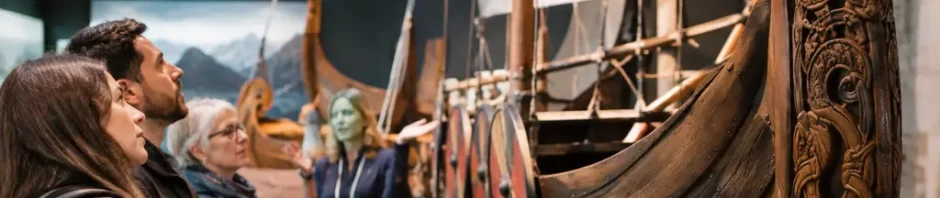
The Vikingmania Exhibition is useful not because it promises a single, settled image of the Viking Age, but because it places old evidence beside later fascination. The traveling exhibition Vikingmania!, organized by the Museum of Danish America and sponsored by Viking Aggregates, opened on May 11, 2026, in the Kramme Gallery at the Museum of Danish America in Elk Horn, Iowa, and was scheduled to run through April 23, 2027. The museum says the exhibition sets historical artifacts, high-quality replicas, and Viking-themed material from the 19th to the 21st century side by side to ask why Vikings remain so visible in modern culture Museum of Danish America.
Why Vikingmania Exhibition Matters
Vikingmania Exhibition As A Modern Mirror
The strongest point of the exhibition is its refusal to treat Norse heritage as only an archaeological subject or only a pop-culture subject. By putting artifacts and replicas near later Viking-themed material, the display makes a basic historical problem visible: modern people rarely meet the Viking Age directly. They meet it through museum cases, books, costumes, design, television, family memory, school lessons, political misuse, tourist images, and commercial branding.
That does not mean that every modern Viking image is equally reliable. It means that every image needs context. A brooch, tool, or weapon fragment carries a different evidentiary weight than a 19th-century romantic image or a 21st-century entertainment product. Yet the later material still matters because it shows how the Viking Age has been repeatedly selected, simplified, admired, and reshaped.
This is where the exhibition fits the work of cultural history. The question is not only what Viking Age people did between the late eighth and early eleventh centuries. The question is also why later societies keep returning to them. A museum can help visitors see both questions without confusing them.
Artifacts, Replicas, And Later Images
Artifacts anchor interpretation because they come from the period under study. Replicas help visitors understand form, scale, handling, and craft where originals may be too fragile or rare to touch. Later images show reception: the history of how Vikings have been imagined after the Viking Age.
The pairing is productive, but it must be handled carefully. A replica can clarify an object, but it is not the object itself. A modern Viking image can reveal public desire, but it cannot be read as evidence for Viking Age belief or behavior. The exhibition’s value lies in keeping those categories visible. Readers interested in a closely related treatment of museum display and public memory may also read our discussion of the Vikingmania exhibit and modern Norse memory.
How Museums Correct Viking Stereotypes
Evidence Before Iconography
Viking imagery often travels faster than Viking evidence. Horned helmets, one-dimensional raiders, and fantasy warrior types have had long lives, partly because they are easy to recognize. Museums work against that habit by slowing the viewer down. Labels, object groupings, dates, material evidence, and comparison all ask visitors to separate a striking image from a supported claim.
The Swedish History Museum’s permanent exhibition The Viking World offers a useful comparison. The museum presents more than 2,500 original objects across nearly 1,000 square meters, includes interactive stations such as virtual reality, and states that it addresses common myths, including horned helmets and the idea of Vikings as purely violent, while presenting the Viking Age as roughly AD 750–1100 The Viking World.
That comparison matters because it shows that the Iowa exhibition is part of a wider museum practice. Institutions are not only preserving things; they are also correcting habits of seeing. The correction is not a scolding of popular interest. It is a method for making interest more informed.
Why Scale Changes Interpretation
A large permanent exhibition and a focused traveling exhibition do different kinds of work. A major permanent display can show breadth: thousands of objects, many object types, and an extended chronological frame. A focused traveling exhibition can sharpen one problem: why the Viking image remains active in modern culture.
Both formats matter. Without large collections, the public can lose sight of the material diversity of the Viking Age. Without focused interpretation, visitors may not notice how modern assumptions shape what they think they already know. The Vikingmania Exhibition is best read through that second strength. It asks visitors to examine not only the past, but also the modern habits that frame the past.
Modern Norse Heritage And Public Memory

The Pull Of The Viking Image
The continued appeal of Vikings is not difficult to understand. Ships, travel, conflict, poetry, gods, craft, and distant settlements all offer strong narrative material. Yet strong narrative material can become too simple. Modern culture often prefers clean symbols: the warrior, the explorer, the pagan rebel, the fierce ancestor. Historical evidence is rarely so tidy.
Norse heritage includes language, law, trade, migration, craft, burial practice, religious change, settlement, and social hierarchy. It also includes uncertainty. Archaeologists and historians often work with fragments, regional variation, and later textual sources that require careful reading. A responsible exhibition does not remove uncertainty; it teaches visitors how to live with it.
The Vikingmania Exhibition helps because it makes modern desire part of the subject. Instead of pretending that visitors arrive without assumptions, it puts those assumptions on display. That is a sound curatorial choice. People can only revise an inherited image once they have recognized it.
Community Interest Without False Certainty
Public history also depends on communities beyond museums. Local clubs, archives, cultural groups, and heritage websites all influence how people encounter the past. For readers exploring our network of community-themed platforms, Stuyvesant Yacht Club is not directly tied to Norse studies, but it exemplifies the broader aim of how groups maintain collective memory, identity, and engagement.
That community interest can be healthy when it respects evidence. It becomes risky when modern identity claims are projected backward onto the Viking Age without support. The exhibition’s mix of objects and later images can help prevent that error. It shows that modern Viking enthusiasm has its own history. A symbol used in a recent setting does not automatically tell us what that symbol meant in the Viking Age.
- Artifacts can support claims about materials, forms, and contexts.
- Replicas can support teaching, but they should be identified as modern reconstructions.
- Later Viking-themed images can support claims about reception, not direct claims about Viking Age life.
This distinction is basic, but it is often where public misunderstanding begins. A careful museum display makes the distinction visible without draining the subject of interest.
What Vikingmania Exhibition Teaches About Norse Heritage
A Cautious Reading Of Modern Viking Culture
The final lesson is not that modern culture corrupts Norse heritage. That would be too simple. Modern culture keeps the Viking Age present, gives museums a broad audience, and encourages many people to ask historical questions. The danger lies in letting the modern image replace the evidence.
The Vikingmania Exhibition therefore works as a case study in historical distance. It asks visitors to compare what survives from the Viking Age with what later centuries have wanted Vikings to mean. That comparison is especially valuable because Norse material can be emotionally charged. People often approach it through ancestry, fantasy, religion, nationalism, entertainment, or design. A museum cannot remove those motives, but it can put them under examination.
A sound reading of Norse heritage begins with evidence and then studies reception as reception. The artifact, the replica, and the modern Viking image each tell a different kind of truth. Confusing those truths leads to false certainty. Holding them apart lets us see more clearly why the Viking Age remains compelling, and why it still needs careful interpretation.
In that sense, the Vikingmania Exhibition is not only about Vikings. It is about the modern viewer. It reminds us that every age makes its own Vikings, and that responsible history begins by asking which parts of that image can be supported, which parts are later invention, and which parts remain open to debate.
