
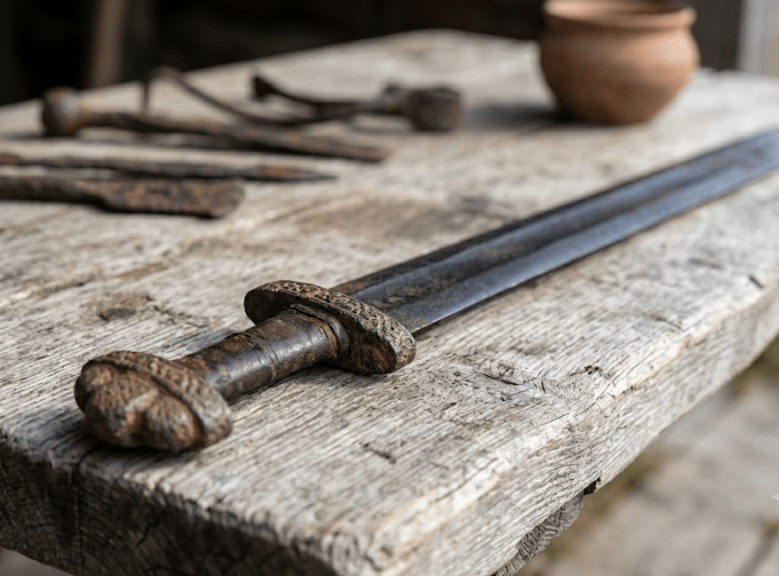
A school field trip in Norway became a rare archaeology story when six-year-old Henrik Refsnes Mørtvedt noticed a rusty object protruding from a field in Brandbu, in Gran municipality, Innlandet County. What first looked like scrap metal was identified as a well-preserved single-edged iron sword, probably dating to the late Merovingian Period or the beginning of the Viking Age. The find matters for oldnorsenews.org because it sits at the boundary between pre-Viking weapon culture and the better-known Viking Age sword tradition. It does not simply add another dramatic weapon to the record. It helps explain how status, ironworking, local landscapes, burial customs, and martial identity were already developing before the Viking Age became visible through raids, trading towns, and overseas settlement. Smithsonian Magazine reported that the sword was found in late April and will be preserved at an Oslo museum.
Why The Brandbu Sword Matters For Norwegian Archaeology
The Brandbu sword matters because it came from a field in Hadeland, a region with a deep archaeological record, rather than from a controlled museum excavation. Finds like this are fragile moments. A farmer, hiker, student, or metal detectorist may notice something before specialists arrive, and the first response can decide whether the artifact keeps its context. In this case, reports say Henrik and the adults with him contacted local archaeologists after recognizing the object was not ordinary scrap.
The object was later identified as a single-edged sword, often described in Norwegian reporting as an “enegget” blade, meaning sharpened on one side. That detail is important because public imagination often jumps straight to the classic double-edged Viking sword. The Brandbu weapon points to a broader blade tradition that includes single-edged fighting tools and swords used across early medieval northern Europe. Some reports place the sword around 1,300 years old, within the late Merovingian Period or early Viking Age, while Smithsonian notes that archaeologist Øystein Lia later suggested a probable date between A.D. 750 and 850.
That date range is exactly why the find is useful. It falls near the transition from the centuries before the Viking Age into the period when Scandinavian ships, warriors, traders, and settlers began to appear more strongly in written and archaeological sources. A sword from this boundary period can help researchers ask what changed and what continued. Weapon culture did not suddenly begin with the raid on Lindisfarne in A.D. 793. It had older roots in local power, craft knowledge, burial traditions, and regional identities.
The article also connects naturally with Old Norse News coverage of Viking Age archaeological sites, because the Brandbu sword shows how a single artifact can open questions about landscape, status, and preservation rather than only weapon shape.
How A Single-Edged Sword Changes The Usual Viking Image
The popular Viking sword is usually imagined as a broad, double-edged weapon carried by a raider or elite warrior. That image is not false, but it can flatten the development of Scandinavian weapon culture. The Brandbu sword is useful because its single-edged form points to an earlier and more varied tradition. HeritageDaily reported that experts identified the object as a single-edged iron sword from the late Merovingian Period or early Viking Age, with its overall shape still clear despite heavy corrosion.
Single-edged weapons complicate the story because they sit between categories. Some were long knives. Some were fighting blades. Some, like this find appears to be, were long enough and socially meaningful enough to be treated as swords. The broader family of saxes or scramasaxes appears across early medieval Europe, but the exact interpretation depends on size, construction, context, and regional practice.
The Brandbu example should not be forced into one simple label too quickly. Different news reports call it Viking, Viking-era, pre-Viking, Merovingian, or early Viking. Those descriptions overlap because the sword sits close to a chronological boundary. The safer historical framing is that the artifact belongs to the transition between the Merovingian Period and early Viking Age weapon traditions. That makes the find stronger, not weaker, because it shows how archaeological periods are tools for organizing evidence rather than hard walls in the past.
The single cutting edge also reminds readers that weapon evolution was gradual. Forms changed as smiths, owners, and regional elites adopted different blade types. A later Viking Age sword did not appear without precedent. The Brandbu sword helps place that later weapon culture inside a longer development of iron blades, personal status, and regional martial practice.
What The Merovingian Period Adds To The Story
The Merovingian Period in Scandinavia, often dated roughly from A.D. 550 to 800, is less familiar to general readers than the Viking Age. It should not be treated as empty background. These centuries saw changing settlement patterns, elite display, burial customs, long-distance contact, and technical craft traditions that shaped the world from which Viking Age societies emerged. A sword from this period gives readers a practical way to see that transition.
The Brandbu find is especially useful because it appears to fall near the end of that period or the opening of the Viking Age. Reports from Arkeonews and HeritageDaily both describe the weapon as a single-edged sword tied to the late Merovingian Period or early Viking Age, around 1,300 years old.
That timing matters. The Viking Age is often introduced through events outside Scandinavia, such as raids recorded by English, Irish, or Frankish observers. A pre-Viking or early Viking sword found in Norway shifts the view back home. It asks what local communities were already doing before overseas activity became famous in written sources. Who had access to iron weapons? Were such blades tied to burial, landholding, military service, local conflict, or family status? What did weapon ownership mean in a farming landscape?
Those questions cannot be answered by the Brandbu sword alone. The artifact needs conservation, X-ray study, and comparison with other finds. Yet the object gives archaeologists a starting point. It sits at the intersection of material culture and social identity, where weapon shape can reveal changes in craft and status.
Why Hadeland’s Landscape Matters
The location of the find is not a small detail. Brandbu lies in Gran municipality in the Hadeland district of southeastern Norway. Reports describe the area as archaeologically rich, with Iron Age remains, farms, burial mounds, and a long record of human occupation. People Magazine noted that the area’s name has been associated in reporting with “Land of the Warrior,” and that many significant discoveries have been made there over time.
Landscape helps explain why a sword might appear in a field. A weapon may have been deposited in or near a grave. It may have been disturbed by plowing. It may have been moved through soil processes or later land use. It may be connected to a lost burial context that is no longer visible on the surface. Without excavation around the findspot, archaeologists have to be cautious.
That caution is important for oldnorsenews.org because weapon finds often attract sensational language. A sword does not automatically prove a battle. It does not automatically identify a warrior’s name. It does not confirm a saga tradition. It proves that a weapon was present in a specific landscape and that its material, form, and context deserve study.
Hadeland’s long farming history also matters. Archaeological remains in cultivated fields can be exposed by plowing, erosion, frost, or drainage work. That means rural landscapes are not empty spaces between famous monuments. They can preserve traces of graves, farms, routes, and local power centers. The Brandbu sword is a reminder that important evidence can survive outside major museum sites and urban excavations.

How Conservation Can Reveal Hidden Details
The sword’s discovery is only the beginning of the research process. A corroded iron blade can look simple from the outside while preserving information inside its rust layers, hilt remains, and metal structure. Reports say the sword was transferred to Oslo’s Museum of Cultural History for cleaning, conservation, and further study.
Conservation can answer questions that a field photograph cannot. X-rays may reveal blade shape, tang structure, hidden cracks, hilt features, or construction marks. Metallurgical analysis can show how the iron was worked, whether different metal pieces were joined, and how the smith controlled hardness or flexibility. Soil residues may preserve small clues about the original context, especially if the sword came from a burial environment.
The University Museum of Bergen’s account of a separate single-edged sword from Haukeli shows why such study matters. That sword, discovered in 2012 and dated to the first half of the Viking Age, was found along an old route between eastern and western Norway; museum researchers noted that single-edged Viking swords are especially frequent in western Norway and often occur in graves. Single-edged Viking sword evidence gives useful comparison for the Brandbu find, even though the two artifacts come from different contexts.
The comparison helps readers understand how archaeologists think. One sword is not interpreted in isolation. Researchers compare blade form, region, chronology, preservation, and find context. A field discovery in Brandbu can gain meaning when set beside known single-edged swords, grave finds, route finds, and museum collections across Norway.
Why Weapon Finds Should Not Be Treated As Simple Warrior Proof
A sword is tempting evidence. It looks personal, dramatic, and easy to connect to a warrior. Yet archaeology needs restraint. A sword may suggest status, martial identity, or burial ritual, but it does not automatically tell us the owner’s profession or life story. Smithsonian reported that Øystein Lia suggested the weapon may have belonged to someone of high status, perhaps connected to landholding or local military service, but that remains an interpretation rather than a named biography.
That distinction matters because pre-Viking and Viking Age weapons were social objects. They could be used in combat, displayed in public, buried with the dead, inherited, repaired, or deposited ritually. Their meaning changed with setting. A sword in a grave may say something about identity or status. A sword lost on a route may say something about movement. A sword exposed by plowing may have lost the visible context that would have made its meaning clearer.
The Brandbu sword therefore opens a window rather than closing an argument. It suggests that weapon culture in the transition period included single-edged blades and that such weapons could survive in rural Norwegian landscapes. It gives archaeologists another data point for studying who carried iron weapons, how blade types changed, and how status was expressed before the classic Viking sword became a familiar symbol.
Good Viking history should resist replacing one myth with another. The old myth is that every sword belonged to a raider. The new myth would be that every weapon automatically proves elite warrior identity. The evidence is stronger when it stays careful: the Brandbu sword is a rare and important single-edged weapon from a transition period, and its full meaning depends on conservation and context.
How The Discovery Shows Proper Heritage Response
One of the most practical parts of the Brandbu story is what happened after the sword was noticed. Reports say the children and teachers contacted archaeologists instead of treating the object as a souvenir. People Magazine, citing Cultural Heritage in Innlandet, reported that officials praised the children for doing the right thing by calling an archaeologist in Innlandet County.
That response protected the artifact’s research value. When old objects are pulled out, cleaned aggressively, moved far from their findspot, or posted online without reporting, important evidence can be lost. Even the exact location of a find can matter. Archaeologists need to know where an object was found, what soil it came from, whether other features are nearby, and whether additional material remains in the ground.
This is especially true for iron artifacts. A corroded sword can be fragile. Cleaning it at home can destroy surface details. Bending or straightening it can break weakened metal. Leaving it unreported can separate the object from its archaeological context. The Brandbu case gives heritage writers a responsible lesson without turning the article into legal advice: when an object may be archaeological, specialists need to handle it.
The same lesson applies across Scandinavia. Many important finds begin with ordinary people noticing something unusual: a metal object in a field, a carved stone, a bead, a coin, or a fragment of iron. Public awareness and professional follow-up work together. Henrik’s discovery is memorable because of his age, but the archaeological value comes from the object entering the proper conservation and study process.
What Readers Should Verify Before Repeating The Story
The strongest facts are clear. Henrik Refsnes Mørtvedt, a six-year-old first-grade student, found a rusty metal object during a school trip in Brandbu, Gran municipality, Innlandet County. The object was identified as a single-edged iron sword, probably from the late Merovingian Period or the beginning of the Viking Age. It is roughly 1,200 to 1,300 years old, depending on the dating range used in different reports, and it was sent to Oslo’s Museum of Cultural History for preservation and study.
The weaker claims need care. It is not safe to say the sword proves a specific battle, identifies a named warrior, or rewrites all of Viking weapon history. It should not be used as a fantasy prop for a simple “boy finds Viking sword” story without the pre-Viking transition context. The more useful interpretation is that the find helps show how single-edged weapon traditions were present in Norway before or during the earliest phase of the Viking Age.
