
Skipshelleren’s 4,000-year-old child skull matters because it pulls Norway’s coastal history far earlier than the Viking Age while still helping readers understand the landscapes that later Norse communities inherited. The discovery was announced by the University of Bergen on July 3, 2026, after researchers working in Vaksdal municipality found remains from a child burial inside Skipshelleren, a rock shelter near Straume along the Voss River system.
Project leader Knut Andreas Bergsvik, professor of archaeology at the University Museum of Bergen, described the find as rare evidence from Norway’s earliest agricultural population. For oldnorsenews.org readers, this is not a Viking story in the narrow chronological sense. It is a deeper coastal archaeology story about settlement, burial, food, mobility, and the long human use of sheltered places along western Norway before the Norse world took shape.
Why Skipshelleren Belongs In Norway’s Larger Heritage Story
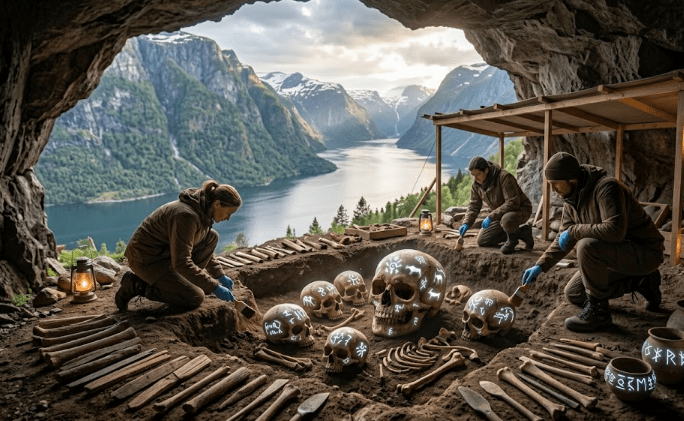
Skipshelleren is a large rock shelter in Vaksdal, Vestland, protected by a broad overhang that helped shield the site from weather and wind. The University of Bergen says people used the place for thousands of years, with the earliest traces reaching back about 7,500 years. That time depth makes the site valuable for more than one period. It can speak to Mesolithic coastal life, the arrival and spread of farming, later Stone Age burial practice, and long-term human use of fjord landscapes.
The discovery also challenges the habit of treating Norwegian history as if it begins with Viking ships, kings, raids, and sagas. Those topics remain central to Old Norse history, but they rest on much older patterns of coastal movement, resource use, seasonal shelter, and burial memory. Skipshelleren shows that people were living, eating, making tools, and burying their dead in west Norwegian shelters thousands of years before Viking Age political culture emerged.
This is why the site fits oldnorsenews.org’s archaeology focus. Readers interested in Viking Age archaeological methods already know that soil layers, bones, tools, and settlement traces can reveal daily life more clearly than later stories alone. Skipshelleren applies that same evidence-first logic to a much older coast.
The child skull is the headline find, but the wider site is the real historical archive. The shelter contains layered deposits that can connect human remains with animal bones, tools, pottery fragments, fishing equipment, botanical samples, and scientific dating. That combination gives researchers a rare chance to study not only one burial, but the environment and community around it.
What Researchers Found In The Rock Shelter
The 2026 announcement says archaeologists from the University of Bergen and the University of Tromsø are excavating caves and rock shelters along Norway’s coast through the INDICAVE project. Skipshelleren is one of the project’s most important investigations. The site had been excavated in 1931 by archaeologist Johs. Bøe from Bergen Museum, and he believed the whole area had been dug. Modern researchers were unsure how much untouched archaeology remained. Their hope was that small undisturbed areas might still survive beneath old backfill.
That hope proved correct. Deep under earlier fill, the team found an area that had not been excavated before. Bergsvik said the team found layered traces from several thousand years of settlement, including thousands of bones from mammals and fish, pottery sherds, fishhooks, and harpoons made of bone. These finds matter because they turn Skipshelleren into a record of repeated coastal use, not a single isolated event.
The child burial is the most sensitive and striking part of the discovery. Preliminary analysis suggests the child was between 2 and 4 years old at death. Parts of the same skeleton had reportedly been found in 1955 by a local girl, Bjørg Dæmring Berge, who lived near the shelter. During the new excavation, she was present and helped researchers identify the original find spot. That local memory led to the recovery of additional remains from the same grave.
The result changes how the site should be understood. Skipshelleren was not only a dwelling place. It was also a burial place in the Stone Age. That distinction matters because it shows the shelter had practical and symbolic value. People could use the same protected landscape for daily life, food work, tool activity, and care for the dead.
Why A Child Burial Changes The Interpretation
A child burial carries a different kind of evidence than tools or animal bones. Tools can show technology. Animal bones can show diet and hunting or fishing activity. A burial asks researchers to think about memory, community, attachment, ritual, and the social meaning of place. A 4,000-year-old child burial inside a rock shelter suggests that Skipshelleren was more than a convenient dry space. It was a place where human presence was repeatedly marked and remembered.
This does not mean researchers can safely reconstruct the child’s life story in detail. The child’s name, family, language, and exact social role are unknown. Responsible interpretation should avoid turning the burial into a dramatic biography. The evidence can support firmer questions: What population did the child belong to? What was the child’s diet? Were these people connected to early farming communities, coastal foragers, or mixed economies? Did the burial reflect local practice, wider Stone Age customs, or a specific family decision?
The University of Bergen announcement says isotope and DNA analyses will be conducted on the skeletal material. Those tests may help researchers learn more about diet, ancestry, and origins. Bergsvik said the child belonged to Norway’s earliest agricultural population and that analysis may provide clues about what these people looked like and where they came from. That possibility makes the find especially important, but it also requires caution. Ancient DNA and isotope work can sharpen the picture, but it does not turn a fragmentary burial into a complete personal history.
The stronger takeaway is that Skipshelleren gives researchers a rare human link to the transition between older coastal lifeways and early farming in Norway. The find may help show how people lived during a period when farming, fishing, hunting, gathering, and coastal mobility could overlap in complex ways.
How INDICAVE Expands The Evidence Beyond One Skull
The INDICAVE project gives the Skipshelleren discovery a much wider research frame. The University of Bergen describes INDICAVE as a project running from January 2026 to December 2029, focused on how caves and rock shelters in Norway were used from 11,500 to 500 years ago. The project brings together an international team to re-excavate key sites with advanced methods and analyze archaeological, botanical, and zoological material. (INDICAVE research project)
That scope matters because cave and rock shelter sites can hold evidence that open-air sites often lose. Organic material such as bone may survive better in protected deposits, giving researchers a clearer view of food, animals, tools, burial practice, and environmental change. UiB’s project description says caves and rock shelters along coastal Norway can preserve stratified deposits with organic remains that help build time-series data. That means researchers can compare changes across thousands of years instead of relying only on scattered finds.
The project’s goals include targeted excavations, comparison between rock shelter records and open-air settlements, ancient DNA and isotope analyses of human remains, and a national database of archaeological caves and rock shelters. That is why Skipshelleren is not only a discovery site. It is part of a larger attempt to reconstruct long-term human relationships with coastal ecosystems.
The number of finds also changes the scale of the story. The 2026 announcement says roughly 40,000 animal bones have been collected and will be identified by species. Researchers will also analyze tools made from bone and stone, soil samples, botanical material, dating samples, and ancient DNA. Each category can answer a different question. Animal bones can speak to diet and seasonal activity. Fishhooks and harpoons can speak to coastal technology. Pottery can speak to cultural change. Soil and botanical samples can speak to environment and site use. Human remains can connect those patterns to real bodies and communities.
Why Norway’s Deep Coastal Past Matters Before The Viking Age
A site like Skipshelleren helps readers think about continuity without forcing a direct line from Stone Age communities to Viking Age Norse society. The people who used the shelter 4,000 years ago were not Vikings, and the article should not imply that they were. The value lies in showing how much of Norway’s later history rests on landscapes that had already been known, used, and remembered for millennia.
Western Norway’s fjords, shelters, waterways, and coastal routes shaped human life long before medieval kingdoms or saga traditions. People learned where to find shelter, fish, game, stone, safe landing places, and seasonal resources. Over time, these routes and places accumulated memory. Some became settlements. Some became burial places. Some were abandoned, revisited, or reinterpreted by later communities.
That long view helps prevent Viking history from becoming isolated spectacle. Viking ships, chieftain farms, and burial mounds did not appear in an empty landscape. They emerged within a northern world already shaped by thousands of years of coastal adaptation. Skipshelleren gives modern readers a deeper frame for that world.
It also reminds readers that archaeology is not only about spectacular elite finds. A child skull, fishhooks, pottery fragments, bone tools, and animal remains can be as historically meaningful as swords or ships. They reveal daily life, death, food, family, and environment. For many readers, that makes the past more human.
What Readers Should Verify As The Research Develops
The Skipshelleren discovery is important, but the strongest interpretations will come after laboratory analysis. Readers should watch for future results from radiocarbon dating, isotope testing, ancient DNA, zooarchaeology, botanical analysis, and tool studies. Those results may clarify the child’s biological profile, diet, ancestry, and relationship to other early farming groups in Norway and northern Europe.
It is also worth watching how researchers describe the site’s dual role as dwelling and burial place. That point is already supported by the recovery of settlement layers and the child grave, but future analysis may show whether burial was an exceptional use of the shelter or part of a repeated pattern. The answer could change how archaeologists understand caves and rock shelters along the Norwegian coast.
The most responsible article angle is not that one skull “solves” Norway’s prehistoric origins. It does not. The better point is that Skipshelleren gives researchers a rare, well-contextualized opportunity to connect human remains with settlement layers, animal bones, tools, pottery, and environmental samples. That combination can help explain how early agricultural communities lived along Norway’s coast and how they related to older coastal lifeways.
For oldnorsenews.org, the find matters because it widens the historical frame. The Viking Age becomes richer when readers understand the deeper human coast beneath it. Skipshelleren’s 4,000-year-old child skull is not a Norse artifact, but it belongs to the long story of people adapting to Norway’s fjords, shelters, food systems, and burial landscapes. That deep coastal past is the ground on which later Norse history stands.
