
The Oseberg Ship’s return to its new museum home marks more than the end of a difficult relocation. It signals a new phase in how Norway protects, interprets, and publicly presents its most fragile Viking Age heritage. The Museum of the Viking Age announced in late June 2026 that, after 99 years in the old Viking Ship Museum, the Oseberg Ship had finally reached its new location, where it will be preserved and displayed for future generations. The timing matters because the former Viking Ship Museum at Bygdøy is also being renovated, with the revised national budget securing necessary maintenance work in June 2026. For oldnorsenews.org readers, the return of Oseberg is not just a museum construction update. It is a case study in how archaeology, conservation science, national identity, and public storytelling meet around one of the most famous Viking Age finds ever excavated. (Museum of the Viking Age relocation update)
Why The Oseberg Ship’s Return Matters Now
The Oseberg Ship has always carried more weight than its oak timbers alone. It is a ninth-century burial ship, an archaeological archive, a national symbol, and one of the central objects through which many people first imagine the Viking Age. The Museum of the Viking Age describes the ship as having been used at sea before it was hauled ashore and used as a burial ship for two women in 834. The same museum notes that the identities of the two women remain unknown, although the richness of the grave goods suggests that one or both held major political or religious significance.
That uncertainty is part of what makes Oseberg valuable. The ship does not give modern readers a simple biography. It gives them evidence: wood, textiles, animal remains, carved objects, equipment, a burial chamber, and the remains of two women whose roles can be interpreted only with care. A renewed museum setting can help visitors see that difference. Oseberg is not important because it confirms a single dramatic story. It is important because it preserves a rare and complicated Viking Age burial context.
The recent return also changes how Norway’s museum future is being discussed. The old Viking Ship Museum opened to the public in 1926, and by the end of 2026 the institution will reach its 100-year anniversary. According to the Museum of the Viking Age, when the museum first opened, only the Oseberg Ship was on display; later, the building expanded with wings for the Gokstad and Tune ships. That history makes the 2026 relocation and renovation period especially symbolic. Oseberg is returning as the institution itself moves from a 20th-century display model toward a conservation-led museum built for long-term protection.
For readers following Viking Age ship burial traditions, Oseberg also belongs to a larger Scandinavian pattern. Ship burials were never only about transport. They were statements about status, memory, ritual, technology, and the relationship between the dead and the living community.
How A Burial From 834 Became Norway’s Most Famous Viking Ship
The Oseberg burial mound was discovered in 1903 near Tønsberg, about 100 kilometers southwest of Oslo. The Museum of Cultural History at the University of Oslo describes the find as consisting of a Viking ship, wooden and metal artifacts, textiles, sacrificed animals, kitchen equipment, shipping equipment, furniture, and richly carved wooden objects. Those burial conditions preserved many wooden objects because groundwater and a low-oxygen environment kept the material waterlogged.
The excavation in 1904 was led by Gabriel Gustafson and Haakon Shetelig, and the public understood quickly that the find was extraordinary. The Museum of the Viking Age notes that the excavation generated major public interest and that the area had to be protected with railings, signage, and a guard. That detail is useful because it shows Oseberg has been a public event almost from the beginning. The ship was not quietly absorbed into academic study. It entered Norwegian cultural life as a spectacle, a scientific problem, and a national treasure at the same time.
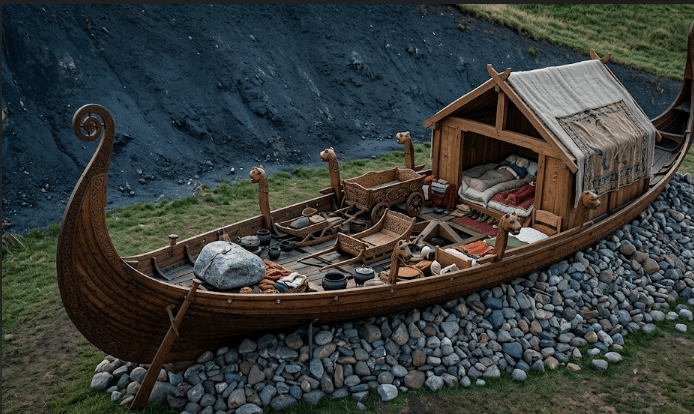
Oseberg’s fame also comes from what it preserved. The burial contained a ceremonial wagon, sledges, animal-head posts, textiles, tools, food-related equipment, and animal offerings. The Museum of the Viking Age’s page on the women in the grave explains that the rich grave goods suggest one or both women held an important role, perhaps political, religious, or both. That careful language matters. The grave invites interpretation, but it does not justify certainty about names, titles, or saga identities.
That is exactly why the ship’s museum future matters. A weaker display can turn Oseberg into a symbol without explanation: a beautiful Viking ship, a queen’s grave, a national icon. A stronger display can show why the burial is historically difficult and why that difficulty is part of its value. The two women were honored through an extraordinary burial, yet their exact identities remain unknown. The ship is beautifully preserved, yet it is chemically and structurally fragile. The grave goods are visually rich, yet they need conservation, documentation, and cautious interpretation.
Why Conservation Now Shapes The Viking Museum Story
The Oseberg Ship’s return should be read through conservation before tourism. The move was not made simply because Norway wanted a newer museum experience. The ship and related objects are fragile. The Museum of Cultural History’s Saving Oseberg project has documented serious conservation challenges, especially around wooden artifacts from the find. Its documentation work notes that Oseberg records from 1900 to 1950 need updating, and that some objects were never visually documented in full. It also states that conservation treatments may have changed the structure and appearance of wooden objects, meaning the material needs renewed documentation.
This is the quieter side of Viking heritage. The public sees the ship’s carved prow, the burial goods, and the drama of the move. Conservators see cracks, chemicals, humidity, old treatments, incomplete records, vibration risks, and the problem of preserving waterlogged wood for centuries rather than decades. The new museum phase has to answer that challenge before it can answer visitor demand.
The University of Oslo described the 2025 relocation as the result of ten years of preparation. It also stated that it was no longer feasible to leave the ships in the old museum. That sentence explains why the new museum is not just an expansion. It is a preservation necessity. The Oseberg, Gokstad, and Tune ships are not interchangeable display objects. They are unique archaeological survivals whose condition determines what future generations will be able to study.
The return of Oseberg therefore changes the tone of Norway’s Viking museum future. The old museum gave generations of visitors an unforgettable encounter with the ships. The new phase asks whether that public access can be made safer, better explained, and more sustainable. The ship’s future depends on climate control, vibration management, careful object handling, and exhibition planning that does not sacrifice preservation for crowd movement.
What The New Museum Can Clarify About Viking Age Women
Oseberg is especially important because it forces Viking history to take elite women seriously. The Museum of the Viking Age states plainly that two women were buried in the ship in 834. It also explains that the lavish grave goods suggest one or both held political, religious, or combined importance. This makes Oseberg a valuable corrective to narrow Viking Age storytelling that begins and ends with male warriors, raiding, and long-distance violence.
The challenge is not to replace one oversimplification with another. Oseberg should not be reduced to a slogan about Viking queens, priestesses, or hidden rulers unless the evidence supports the claim. The stronger historical point is that the burial demonstrates high-status female commemoration in ninth-century Norway. The ship, grave chamber, wagon, sledges, textiles, carved objects, animals, and equipment show a community investing heavily in the death and memory of these women.
A renewed museum can help visitors ask better questions. What kinds of authority did these women hold? Were their roles political, ritual, familial, economic, or some combination? How did the community use the ship burial to display status? Why were domestic, ceremonial, transport, and animal elements placed together in the mound? What does the burial reveal about elite identity in Vestfold around 834?
Those questions are more useful than unsupported certainty. Oseberg’s power comes from the way it opens historical interpretation while still requiring discipline. The new museum can present the women as central figures without inventing names, titles, or saga connections. It can also show how gender, ritual, wealth, and burial practice intersected in Viking Age Norway.
Why The Ship’s Return Changes Public Access To Viking Heritage
The Oseberg Ship’s return also marks a shift in public access. The former Viking Ship Museum was loved partly because visitors could stand close to the ships in a distinctive building. That intimacy became part of the museum’s identity. Yet the same public access brought pressure: crowds, environmental instability, and the long-term demands of preserving fragile archaeological wood.
The Museum of the Viking Age’s 2026 planning update says the former Viking Ship Museum is closed while the new museum takes shape. It also notes that 2026 marks a historically important anniversary period for the institution. The key issue is not simply when visitors can return. It is what kind of museum they will return to. A modern Viking museum has to be more than a room full of famous ships. It has to explain discovery, excavation, conservation, uncertainty, and interpretation.
This matters because Viking heritage has become globally recognizable and easily misused. Images of ships, helmets, runes, and warriors often travel faster than the evidence behind them. Oseberg gives Norway a chance to model a more careful public history: visually powerful, but source-led; accessible, but not careless; emotionally compelling, but not mythmaking.
The new museum phase can also connect Oseberg to other Viking Age evidence without letting the ship dominate everything. Ship burials, settlements, hoards, textile production, craft sites, graves, and trade centers all tell different parts of the Viking Age story. Oseberg is central, but it is not the whole Viking Age. A strong museum future will help visitors see both its uniqueness and its limits.
How Norway’s Viking Museum Future Depends On Source Clarity
The Oseberg Ship’s return is a practical reminder that museums do not merely store the past. They decide how the public meets the past. Every label, display angle, lighting choice, route, conservation decision, and reconstructed explanation shapes how visitors understand Viking history. That responsibility becomes heavier when the object is as famous as Oseberg.
Source clarity should be the guiding principle. Visitors need to know that the ship burial dates to 834, that the mound was discovered near Tønsberg in 1903, that the major excavation followed in 1904, that the grave held two women, and that their identities remain unknown. They also need to understand that the spectacular preservation of wood and textiles was possible because of burial conditions, and that preservation today requires modern conservation science.
The new phase should also make the museum’s own history visible. Oseberg moved into public display in the 20th century, became a national symbol, spent 99 years in the old Viking Ship Museum, and has now returned to a new location built around future preservation. That timeline is not separate from the Viking Age story. It is part of the object’s modern biography.
The most valuable future for the Oseberg Ship is not a more dramatic Viking fantasy. It is a clearer encounter with evidence. The ship’s return gives Norway a chance to show how a fragile ninth-century burial can still speak to modern audiences when conservation, archaeology, and interpretation work together. If the new Museum of the Viking Age succeeds, visitors will leave with more than awe. They will understand why Oseberg survived, what it can tell us, what it cannot prove, and why protecting it is now one of Norway’s most important heritage responsibilities.
