
A Rogaland gullgubbe reopens pre-Viking ritual questions because one tiny gold-foil figure can shift attention from ships and raids to halls, power centers, fertility symbolism, and carefully documented archaeological context. In March 2026, metal detectorist Kjetil Særheim found a gullgubbe on his family farm at Hauge in Klepp, Rogaland. Rogaland County reported the find on March 20, 2026, calling it the first discovery of its kind in the region since 1897. The University of Stavanger’s Archaeological Museum later emphasized that the find became the first gullgubbe in the museum’s own collection. That local detail matters because the earlier 16 Hauge gullgubber had gone to Bergen, since Stavanger had no archaeological museum when farmers found them in the late 1800s. (UiS gullgubbe report)
Why One Tiny Gold Figure Matters
The new Klepp find matters because gullgubber rarely appear in Norway. UiS explains that roughly 4,000 gullgubber are known from Scandinavia, but only about 50 come from Norway. Before Særheim’s discovery, Rogaland and the whole western Norwegian region had only the 16 Hauge examples found in 1897.
That rarity gives the new object unusual weight. A single gold foil could look minor beside a sword, ship burial, or hoard, yet archaeologists value context as much as size. The 2026 find gives researchers a more precise location for investigating a place that already produced an exceptional group of gold-foil figures.
Professor Sigmund Oehrl at the Archaeological Museum, University of Stavanger, has specialized in gullgubber. He described the new discovery as sensational because such figures often come from older power centers and large halls. In his interpretation, people probably placed them in halls as part of ritual actions by a power elite.
What A Gullgubbe Is
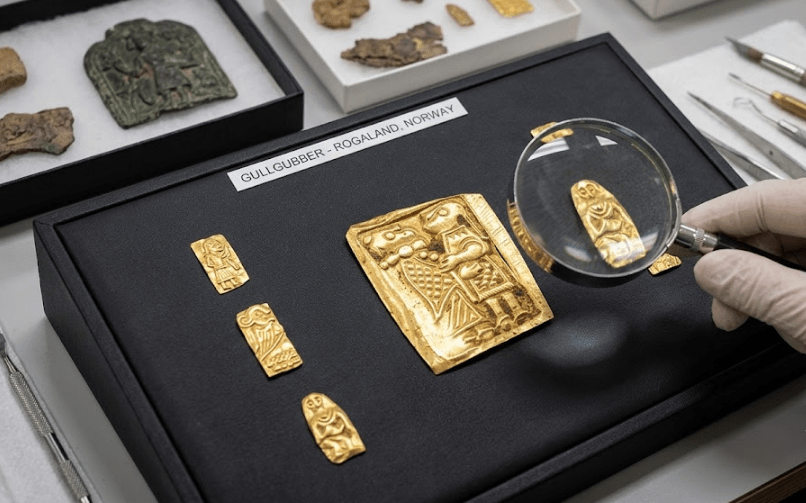
A gullgubbe is a very small piece of gold foil, usually stamped or engraved with a human, animal, or paired figure. Bornholms Museum describes the word as an old Swedish term for a tiny carved gold-foil figure and notes that the figures show men, women, and animals. Archaeologists often interpret them as offerings, although their exact purpose remains uncertain.
The Norwegian word can sound misleading because “gubbe” suggests an old man. In practice, many figures show women, couples, or other motifs. The gold itself also matters. These are not heavy treasures. They are thin, delicate, highly symbolic objects.
That contrast makes gullgubber powerful evidence. They do not display elite wealth through mass, as gold arm rings do. Instead, they display meaning through placement, imagery, ritual handling, and association with halls or central places.
Why Hauge In Klepp Changes The Question
Hauge in Klepp matters because the new find links directly to a known but poorly documented nineteenth-century discovery. UiS notes that archaeologist Gabriel Gustafson first presented the 1897 Hauge finds in 1900. Those 16 gold foils came from Hauge, near Krosshaug, a rich Migration Period female grave.
The old Hauge group shows one repeated motif: a man and a woman face each other and touch hands. UiS says the 16 examples carry eight different stamp impressions but share that paired scene. That pattern has made the Hauge material one of Rogaland’s most important pre-Viking ritual-image groups.
However, the old discovery suffered from unclear findspot details. The new 2026 discovery changes that. Lars Søgaard Sørensen, an archaeologist with Rogaland County, said the new find can help illuminate the earlier discoveries and give new insight into the importance of the place during the Iron Age.
Why The Find Points Toward A Hall Landscape
Gullgubber often lead archaeologists to ask whether a hall or cult building once stood nearby. Oehrl told Rogaland County that gullgubber often come from power centers and large halls, where people probably deposited them during rituals. He also said it would have great significance if archaeologists could eventually identify traces of such a hall at Hauge.
That possibility fits the wider landscape. Rogaland County notes that archaeologists already describe the area as an “acropolis” on Jæren because it includes large burial mounds with spectacular finds and a ring-shaped courtyard site. Oehrl argues that any future hall evidence would belong to an especially important cultural landscape.
This is where the article should stay careful. The gullgubbe does not prove that a hall has already been found. Instead, it gives archaeologists a stronger reason to look for one. A gold-foil figure near older Hauge gullgubbe finds, elite graves, and monumental structures makes the hall question more serious.
Why Pre-Viking Ritual Cannot Be Reduced To Myth Illustration
The Hauge gullgubbers raise ritual questions, but they do not give a simple picture of Norse mythology. UiS explains that scholars have connected some paired gullgubbe motifs with later Norse mythic traditions, especially stories about Freyr and Gerðr. Yet Oehrl emphasizes that the detailed written sources for those myths come much later, mainly from medieval texts.
That gap matters. A gold-foil couple from the Merovingian Period cannot automatically become a direct illustration of a thirteenth-century text. Archaeologists can compare motifs, later myths, runic evidence, and ritual contexts, but they must avoid treating later literature as a caption for every early image.
The Hauge figures may show gods. They may show humans. They may show marriage, fertility, ritual union, protection, or elite symbolism. The safest interpretation leaves room for several possibilities while noting the strong ritual setting of the object type.
That cautious approach fits oldnorsenews.org’s wider interest in Norse power beyond ships and raids, where authority often appears through halls, seats, farms, ritual objects, and controlled social space.
Why The Pair Motif Matters
The pair motif at Hauge deserves attention because all 16 older examples show a man and a woman facing each other. UiS describes the figures as touching hands, a detail that has encouraged interpretations involving union, marriage, fertility, or divine partnership. The new 2026 find now adds another object to the same local story, even if its exact relationship to the older stamps needs specialist study.
Oehrl’s earlier UiS discussion of the Hauge material also highlights a plant motif. The female figure appears to hold something described as a staff, fan, twig, or plant. Oehrl links this object to later images in Viking Age art, including a decorated horse harness fitting from the Mammen grave in Denmark and a stone cross from the Isle of Man.
He also connects the plant with “lauk,” meaning onion or leek, a word with strong associations in Old Norse sources and older runic traditions. Even there, the interpretation remains cautious. The plant may point toward fertility, protection, renewal, or ritual gifting, but it cannot identify the figures with certainty.
How Scandinavia-Wide Finds Help The Rogaland Case
The Rogaland gullgubbe does not stand alone. UiS notes that gullgubber come only from Scandinavia, with the largest concentrations in Denmark. The Hauge research page gives a lower earlier count of about 3,600 examples from around 50 sites, while the 2026 county reporting gives the updated broad figure of about 4,000 known examples.
Bornholm gives the strongest comparison. Bornholms Museum says more than 3,000 gold-foil figures have been found at Sorte Muld near Ibsker. That site dates many examples to around AD 550–600, in the Germanic Iron Age. It also shows why gullgubber often connect with wealth, ritual, and central places.
Other major Scandinavian sites include Gudme on Funen, Uppåkra in Scania, Borg in Lofoten, and Aska in Östergötland. A 2023 Antiquity article on Aska describes gold-foil miniatures deposited in a royal hall and connects them with precious-metal offerings and religious customs.
Why Halls Were More Than Large Buildings
A hall in this context was not just a big house. In late Iron Age Scandinavia, halls could organize feasting, oath-taking, gift-giving, elite hospitality, political display, and religious activity. When archaeologists find gullgubber in or around halls, they often ask whether those buildings acted as both power centers and ritual spaces.
That dual role helps explain why a tiny gold foil can matter so much. Its value does not come from weight alone. Its meaning depends on where people placed it, who controlled the building, and what kind of ceremony or social act surrounded the deposition.
At Hauge, researchers have not yet confirmed a hall. Still, the new find gives them a better starting point for testing that possibility. If future surveys or excavations identify building traces, postholes, activity layers, or additional ritual deposits, the 2026 gullgubbe may become part of a much larger story.
Why The Find Belongs To The Younger Iron Age
Rogaland County dates the new gullgubbe to the Younger Iron Age, between about AD 500 and 800. That range places it before the conventional Viking Age or at its threshold, depending on the dating model used. For that reason, “pre-Viking” works as a cautious public-facing label, but the article should also use the more precise archaeological period.
This matters because many readers automatically connect every Scandinavian gold figure with Vikings. The Hauge gullgubber belong to an earlier world of regional power centers, hall culture, and pre-Viking elite ritual. Later Viking Age society inherited some of those landscapes, symbols, and power structures, but it did not create them from nothing.
The 2026 Klepp find therefore helps correct a timeline problem. It reminds readers that Norse ritual and elite authority developed before Viking fleets became the most famous Scandinavian export. Halls, gold images, paired motifs, and local sacred landscapes were already part of the story.
Why Responsible Metal Detecting Changed The Evidence
The discovery also matters because Særheim handled the find responsibly. Rogaland County reports that he quickly notified authorities after finding the gullgubbe. UiS adds that he delivered documentation, including a find form, photographs, and GPS information.
That process gave archaeologists much better evidence than the 1897 find could provide. The older Hauge gullgubber remain important, but their exact find circumstances stay unclear. The new discovery adds location data, official reporting, and a modern documentation chain.
Rogaland County uses the case as an example of how cooperation between metal detectorists and heritage authorities can protect knowledge. Marianne Enoksen, section chief for archaeology in Rogaland County, emphasized that single finds can greatly affect knowledge of the past when people report them quickly and document them well.
The lesson is practical. A gullgubbe removed without context becomes a curiosity. A gullgubbe reported with location data becomes historical evidence.
What The Law Means For Such Finds
Norway’s cultural heritage rules also form part of the story. UiS explains that all objects from before 1537, and coins older than 1650, belong to the state and must be handed in. The county serves as the first contact point before objects move onward to the Archaeological Museum for cataloguing, conservation, and storage.
This point should not turn the article into legal advice, but it matters for public history. The new gullgubbe entered museum study because the finder followed the correct process. That allowed specialists to inspect the object, compare it with the older Hauge group, and consider its archaeological landscape.
Responsible reporting also protects private landowners and sensitive sites. Rogaland County does not present the discovery as a treasure-hunting invitation. Instead, it frames the find as heritage evidence that needs careful handling.
For readers, that distinction matters. The excitement of a gold discovery should lead toward research, not unauthorized searching.
What The New Gullgubbe Does Not Prove
The new Rogaland gullgubbe does not prove the location of a hall by itself. It does not identify a named deity, a named ruler, or a specific ritual. It also does not confirm that the paired Hauge motif represents Freyr and Gerðr, Freyr and Freyja, a human wedding, or any single mythic scene.
The object does support a more careful claim. Hauge in Klepp had an unusual concentration of gullgubber, and the new find gives archaeologists a more concrete location for future study. It also strengthens the argument that the area formed part of a high-status ritual and power landscape during the Younger Iron Age.
Those limits make the discovery more interesting, not less. Archaeology often moves forward through small, well-documented clues. A one-centimeter gold foil cannot answer every question, but it can reopen the right questions.
That is why source caution matters. The find invites interpretation, but it does not permit fantasy.
Why Rogaland’s Ritual Landscape Deserves More Study
Rogaland’s new gullgubbe deserves attention because it brings pre-Viking ritual geography back into focus. Hauge, Krosshaug, Tinghaug, large mounds, a ring-shaped courtyard site, and the older gold foils together suggest a landscape where power, memory, ceremony, and elite identity overlapped.
Future work may test whether a hall once stood there. Researchers may also compare the new gold foil with the 1897 Hauge examples, study its stamp or engraving, and refine its place within Scandinavian gullgubbe traditions. If archaeologists recover more objects, building traces, or activity layers, the discovery could reshape how scholars understand Jæren’s Iron Age elite.
For now, the strongest point remains clear. A Rogaland gullgubbe reopens pre-Viking ritual questions because it links a rare object type to a known but poorly documented find area. It connects local family farmland with Scandinavian hall culture and opens a cautious path from gold foil to power center.
The object may be tiny, but the question around it is large: what kind of ritual landscape stood at Hauge before the Viking Age became visible in ships, raids, and written memory?
