
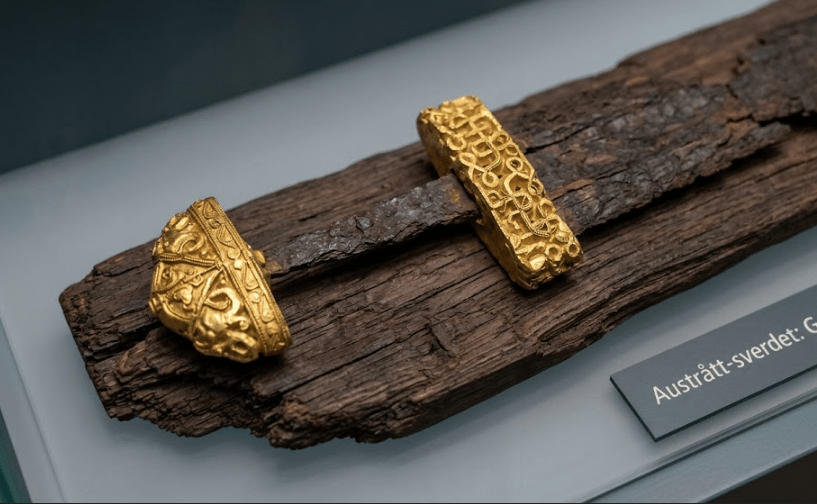
The Austrått gold sword fitting makes Sandnes a pre-Viking power story because one small object links weapon display, ritual deposition, elite authority, and a wider Hove-centered landscape in Rogaland. The University of Stavanger reported on May 5, 2026, that a local walker found the 1,500-year-old gold fitting beneath the roots of a storm-felled tree in Austrått, a district of Sandnes near the hill Riaren. The object likely belonged to a sword scabbard from the first half of the 500s, during Norway’s Migration Period. It measures about six centimeters across, weighs 33 grams, and represents the first find of its type in Rogaland. For oldnorsenews.org readers, the key point is clear: power in western Norway existed long before the Viking Age became visible through ships, raids, and written sources. (UiS Austrått gold find report)
Why The Austrått Find Matters
The Austrått find matters because archaeologists rarely get this kind of elite evidence from Rogaland. UiS archaeologist Håkon Reiersen described the object as a spectacular find and noted that only 17 other comparable objects are known in Northern Europe. That rarity immediately moves the fitting beyond ordinary jewelry or accidental metal loss.
The object likely decorated the mouth or upper part of a sword scabbard, where it would have made the weapon visually impressive. A sword with such gold fittings did more than serve as a tool for violence. It helped identify the person who wore it as someone with rank, allies, wealth, and symbolic authority.
Because of that, the fitting gives Sandnes a stronger pre-Viking story. It places the Hove area inside an older world of powerful lineages, warrior followers, ritual landscapes, and long-distance elite symbols.
How The Walker Found It
The discovery began with a routine morning walk. UiS reports that the finder lives in Austrått, close to Riaren, and likes exploring the local landscape. During one walk, he noticed an old tree that had fallen years earlier in a storm and became curious about what lay under its roots.
After he saw a raised patch of soil beneath the tree, he poked at it with a stick and noticed something shining. The object turned out to be a richly decorated gold sword-scabbard fitting from the 500s. Rogaland County later reported that the walker followed the correct procedure and delivered the find for professional handling.
That detail matters because the find’s value depends on context. Gold without location data becomes a curiosity. Gold reported with a findspot, excavation, conservation, and specialist study becomes evidence.
Why The Root Throw Matters
The root throw, or rotvelt, also matters. Rogaland County explains that the object appeared under the root of an old fallen tree and that archaeologists later examined the spot carefully. Kim Thunheim, an archaeologist with Rogaland County, said the team dug down to the bedrock to check whether more material remained, but they found nothing else.
This environmental detail changes the story. The tree did not merely reveal a random shiny object. It opened a small window into a place where people had deposited a high-status gold fitting roughly 1,500 years earlier.
Rogaland County also uses the case to warn readers that storms and root throws can damage or expose archaeological remains. That point feels especially relevant now, as stronger storms and landscape disturbance make heritage monitoring more important.
In Austrått’s case, nature exposed the object. Responsible reporting then turned the chance discovery into a documented archaeological event.
What The Object Actually Is
The fitting is small but technically rich. UiS professor emerita Siv Kristoffersen describes it as a rectangular gold fitting, about six centimeters wide, a couple of centimeters high, and only a few millimeters thick. It weighs 33 grams and carries traces of filigree ornament made with tiny beaded gold wires.
The object’s surface includes animal ornament built around symmetrical figures. Kristoffersen notes that the main field appears to show two animal figures in profile facing each other. One may include a head along the upper edge, while another turns the opposite way toward the lower edge. An additional band seems to twist into the figure.
That decoration places the fitting inside the visual world of Migration Period animal art. Its imagery does not work like a modern picture. Instead, it uses stylized bodies, heads, limbs, bands, and hybrid forms to create a dense elite language.
Why Animal Ornament Changes The Reading
Animal ornament helps archaeologists read the object as more than gold. Kristoffersen explains that the decoration belongs to a form language built from small stylized animal and human figures, often shown in surface-covering relief on jewelry and sword equipment.
That style mattered because elite objects used visual complexity to communicate identity. A person wearing such a sword carried a form of portable authority. The gold drew attention, while the ornament connected the object to high-status Scandinavian and Germanic artistic traditions.
The Austrått fitting also appears worn. Reiersen argues that this wear suggests the owner used the sword often, rather than keeping it only as ceremonial display. That point gives the object a personal dimension. It likely belonged to someone who displayed authority repeatedly in public settings.
The fitting therefore sits between art, weaponry, and politics. It shows how leaders could turn personal equipment into visible statements of power.
Why Hove Is Central To The Story
The Austrått find does not stand alone. UiS connects it directly with the Hove area in Sandnes, where archaeologists already knew about an important Migration Period power center. Reiersen argues that the fitting likely belonged to a leader who ruled from Hove during the first half of the 500s.
The Hove context matters because earlier research had already identified spectacular finds from the area between AD 200 and 550. Reiersen’s 2026 article on Hove explains that Bjørn Myhre called attention to Hove as a central place in Rogaland decades ago. A rare gold arm ring with snake heads, found in a grave, suggested that Hove had served as a central farm from the 200s.
Later excavations strengthened that interpretation. From 2011 to 2012, excavations led by Even Bjørdal found a large farm complex at Hove with many buildings. Two enormous longhouses measured 47 meters and more than 60 meters.
How Hove Looked Like A Power Center
A power center was not just a rich farm. It gathered political, military, religious, and legal functions into one landscape. UiS reporting on Jæren’s Iron Age elite explains that western Norwegian power centers often combined strong agricultural resources, access to routes, elite objects, monumental buildings, and ritual sites.
Hove fits that pattern. Its longhouses, elite finds, and surrounding place names suggest organized authority over land, people, and ritual space. Reiersen has argued that Hove stands out especially as a ritual center because both archaeological finds and sacred place names cluster around it.
Those place names matter. UiS notes that “Hove” probably refers to a gudehov, or pre-Christian cult building. Nearby names such as Lunde, Skeiane, Skei, Leigvoll, and Helgaland may point toward sacred groves, games, horse races, protected areas, or ritual gatherings.
The gold fitting now adds another piece to that landscape. It does not create the power-center argument by itself, but it makes the argument harder to ignore.
Why Austrått May Mark A Ritual Edge
Austrått’s location makes the find especially interesting. Reiersen explains that the name Austrått means “eastward direction,” suggesting a place or area east of Hove. The area lies northeast of the central farm and near the boundary between Låg-Jæren and the more peripheral Høg-Jæren.
That position may matter. Reiersen suggests that this eastern boundary area may have served as an important ritual place for Hove’s leaders. The new fitting came from a rock crevice on the hill Riaren, a setting that supports the idea of deliberate deposition rather than accidental loss.
This interpretation needs caution. Archaeologists cannot prove every intention behind a 1,500-year-old deposit. Still, the find’s position in a rock crevice, its elite character, and the surrounding pattern of older offerings make a ritual reading plausible.
Austrått therefore helps readers see power as landscape organization. Leaders did not only rule from halls. They also marked boundaries, hills, wetlands, and symbolic places.
Why The Object May Have Been Offered
UiS reports that the gold fitting was buried in a rock crevice and likely placed there for religious reasons as an offering to the gods in the 500s. The museum connects this practice with periods of crisis, poor years, and social change, when elites may have sacrificed valuable objects in hope of protection or better times.
Rogaland County frames the evidence in similar terms. It notes that the object probably did not end up there by chance. Instead, the fitting may have entered the ground deliberately as an offering.
This does not mean modern readers should imagine a fully reconstructed ceremony. Archaeology cannot show the exact words, gestures, participants, or belief system behind the deposit. However, the object’s placement and comparison with other finds make ritual deposition a serious interpretation.
In that sense, the Austrått fitting works like a small but costly message. Someone removed an elite object from use and placed it into the landscape.
How Earlier Offering Finds Strengthen The Case
The Austrått gold fitting gains meaning from earlier discoveries around Riaren and Hove. UiS notes that two other spectacular offering finds came from the wetlands below Riaren. One consisted of silver neck rings decorated with gold, found during plowing in the 1800s.
Another came in 1907 from Svebastad, near the neighboring Høyland farm. That find included an unusually large Roman bronze cauldron produced near the Rhine around AD 300. Reiersen notes that such cauldrons usually appear in the richest graves, not as offerings. The Svebastad vessel had also undergone repeated repairs, which shows long use before deposition.
Together, those finds matter because they create a pattern. The Austrått fitting does not appear as a lonely ritual object. It belongs to a landscape where elites had previously placed exceptional valuables in wetlands and other special locations.
That pattern makes Hove’s ritual authority more visible. Leaders could display prestige in life and surrender prestige objects in ritual acts.
Why This Is A Pre-Viking Power Story
The Austrått fitting belongs to the Migration Period, not the Viking Age. That distinction matters. The object dates to the first half of the 500s, roughly three centuries before the conventional Viking Age begins around the late 700s.
Calling the find “pre-Viking” does not make it less relevant to Old Norse News. Instead, it gives readers a deeper timeline for western Norwegian power. The Viking Age did not emerge from an empty landscape. It developed in regions where earlier elites had already built large farms, led warrior groups, controlled routes, gathered ritual authority, and used prestige objects.
The internal link between these periods should stay cautious. We should not claim that a 500s Hove leader directly caused later Viking expansion. Yet the find does show that the ingredients of Scandinavian elite power existed before Viking ships dominated public memory.
That is why this article belongs beside Old Norse News coverage of power beyond ships and raids. Halls, weapons, offerings, farms, and ritual landscapes all shaped authority.
Why The Fitting Points To A Warrior Elite
Reiersen argues that the person who wore the sword probably led the area during the first half of the 500s and had a following of loyal warriors. That interpretation rests on the nature of the object. A gold sword-scabbard fitting with heavy wear would suit a leader who used weapon display to show authority.
The Hove landscape also supports that reading. UiS notes several weapon graves in the area, and Reiersen highlights a sword pommel found at Helgaland in 1910. He links such “ring swords” with Germanic elite gift systems, where rulers gave prestigious weapons to loyal followers.
That comparison does not prove every detail of Hove’s political structure. However, it shows why the Austrått fitting matters. It belongs to a world where swords could mark relationships between leaders and their warrior followings.
A sword in this setting was not only a weapon. It was a political object, a social signal, and perhaps a ritual offering after use.
Why The Hove Network Reached Beyond Sandnes
The Austrått fitting also points beyond local power. Reiersen’s Hove article argues that people at Hove used ruler symbols known in South Scandinavia and wider Germanic areas. These included snake-head gold arm rings, neck rings, gold sword-scabbard fittings, ring swords, and Roman imports.
That list changes how readers should picture Sandnes in the 500s. Hove was not an isolated farm at the edge of Norway. Its elites accessed prestigious symbols, imported goods, and ideas that moved through Scandinavian and continental networks.
The Roman bronze cauldron from Svebastad makes this especially clear. A vessel produced near the Rhine around AD 300 eventually entered a ritual landscape near Hove. That movement points toward long-distance contact, gift circulation, or elite acquisition across generations.
Therefore, the Austrått fitting makes Sandnes part of a larger pre-Viking map. Local authority rested partly on international-looking objects.
How The Austrått Fitting Relates To Other Gold Finds
Kristoffersen connects the Austrått object with a rare group of gold fittings sometimes called gullmunnblikk. These objects occur in Scandinavian deposited gold finds, often with spiral rings and gold bracteates. They resemble fittings for sword or dagger scabbards, even though researchers have not always found them attached to such weapons.
The Austrått fitting also has close parallels. Kristoffersen notes that its nearest parallel may be a fitting found in 2020 in Jutland, Denmark, in connection with the Vindelev hoard. She also compares it with a fitting from Bergsaker in Lyngdal, Agder.
These comparisons matter because they place the Sandnes object inside a broader Scandinavian gold tradition. The fitting does not simply show one local craft choice. It participates in a high-status visual and ritual language shared across regions.
At the same time, the object’s dimensions may fit actual Migration Period sword-scabbard fittings from prestigious swords. Kristoffersen specifically points to the famous Snartemo sword as a useful comparison.
Why Snartemo Matters As A Comparison
The Snartemo sword comparison helps readers understand the level of prestige involved. Kristoffersen notes that the Austrått object’s dimensions also fit scabbard fittings from Migration Period prestige swords, and she gives the Snartemo sword as an example.
This does not mean the Austrått sword looked exactly like Snartemo’s weapon. Instead, it shows the category of elite display that archaeologists have in mind. Migration Period swords could carry decorated gold plates, complex fittings, and technical craftsmanship that placed them far above ordinary weapons.
That comparison helps avoid a mistake. The Austrått fitting should not be treated as a loose decorative strip. It likely belonged to equipment designed to impress, identify, and legitimate a leader.
If future study confirms more about its construction, back plate, or attachment, the object may clarify a still-mysterious Scandinavian gold-fitting group. For now, it already shows a close link between weaponry, goldsmithing, and elite identity.
Why Wear Marks Are Important
The fitting’s wear matters because it suggests active use. Reiersen says gold sword-scabbard fittings usually do not show heavy wear, yet the Austrått object appears worn and well used. That observation changes the interpretation.
A pristine object might suggest a ceremonial piece made for display or deposition. A worn object suggests a longer biography. Someone likely wore the sword, moved with it, displayed it, and allowed it to acquire traces of use before someone placed the fitting in the rock crevice.
This does not remove the ritual interpretation. In fact, it may strengthen it. A used elite object could carry more social meaning than a newly made offering. Sacrificing a worn symbol of authority could express status precisely because the object had already taken part in public life.
The fitting therefore offers a rare glimpse into the life cycle of power: manufacture, use, display, wear, removal, and deposition.

Why The Find Does Not Prove Too Much
The Austrått fitting does not prove the name of the leader who owned it. It does not reveal a battle, dynasty, burial, or exact ceremony. It also does not prove that every nearby place name had one fixed religious meaning in the 500s.
The evidence supports more careful claims. The fitting came from the first half of the 500s. It likely belonged to a high-status sword scabbard. It appeared in a rock crevice near Riaren in Austrått. The wider Hove area already had evidence for elite farms, ritual place names, large longhouses, weapon finds, gold objects, and earlier offerings.
Those claims are strong enough. A source-aware article does not need to turn the find into a named chieftain’s legend. The object matters because it adds one more well-documented piece to a power landscape.
Good archaeology often works this way. One small object changes the question, not because it answers everything, but because it connects several lines of evidence.
Why Legal Reporting Protected The Evidence
The Austrått case also shows why cultural heritage reporting matters. UiS explains that Norwegian law treats all objects from before 1537, and coins older than 1650, as state property. The county serves as the first contact point before finds move to the Archaeological Museum for cataloguing, conservation, and storage.
The finder handled the case responsibly. Rogaland County reports that he acted quickly and in line with regulations. That allowed archaeologists to inspect the location, dig down to bedrock, document the context, and move the object into professional conservation.
This process deserves attention because spectacular finds can attract the wrong kind of interest. Unauthorized collecting damages context, while responsible reporting creates knowledge.
The Austrått fitting can now support research and public display because the discovery moved through the correct chain: finder, county, museum, conservation, study, and interpretation.
Why The Object Should Shape Public History
Museum director and archaeology professor Kristin Armstrong-Oma said UiS wanted to make the find accessible to the public as quickly as possible. That matters because such objects can help audiences understand pre-Viking history in a concrete way.
A six-centimeter gold fitting may do more for public imagination than a general statement about Migration Period elites. Visitors can see scale, wear, decoration, and material value. They can also connect the object with the place where it emerged: Austrått, Riaren, Hove, and Sandnes.
However, public display needs careful framing. The fitting should not become only “gold fever.” It should teach why Hove matters, why ritual deposition matters, and why pre-Viking power often combined political leadership, military followers, sacred landscapes, and long-distance prestige objects.
That wider story gives the find lasting value. Gold attracts attention, but interpretation makes it historical.
Why Sandnes Now Looks Different
Sandnes now looks different because the Austrått fitting strengthens a pattern already visible in the archaeology. Hove had large longhouses, elite objects, ritual place names, weapon finds, Roman imports, and earlier offering deposits. The new gold fitting adds a rare sword-related object to that same landscape.
This changes the local story. Sandnes does not only belong to later medieval, Viking, or modern histories. It also belongs to a pre-Viking world of powerful farms and ritual authority. The Hove area appears as a place where leaders used elite symbols, gathered followers, marked landscapes, and placed valuables beyond ordinary use.
The find also broadens the way readers understand Norway before the Viking Age. Western Norway had powerful communities long before sagas, runestones, and famous sea kings. Their leaders used gold, weapons, halls, ritual places, and alliances to shape authority.
That is why the Austrått gold sword fitting makes Sandnes a pre-Viking power story. It gives one small, well-documented object enough context to reopen a whole landscape.
