
Bork Viking Harbour’s market makes Viking trade feel practical because it turns exchange into something visitors can see, hear, handle, and question. Ringkøbing Fjord Museums lists the Bork Viking Market for August 7–9, 2026, with activity each day from 10:00 to 17:00. The museum frames the event around summer markets where Vikings traded local goods such as furs and amber for distant products such as spices and silk fabrics. VisitDenmark adds that the event includes authentic Viking craftsmanship, Icelandic horses, a Viking tattoo artist, and entertainers. For oldnorsenews.org readers, the market offers a useful public-history angle: Viking trade was not only silver, ships, and distant ports. It also involved craft, animals, reputation, law, food, performance, and face-to-face negotiation. (Bork Viking Market)
Why Bork Viking Harbour Works As A Trade Setting
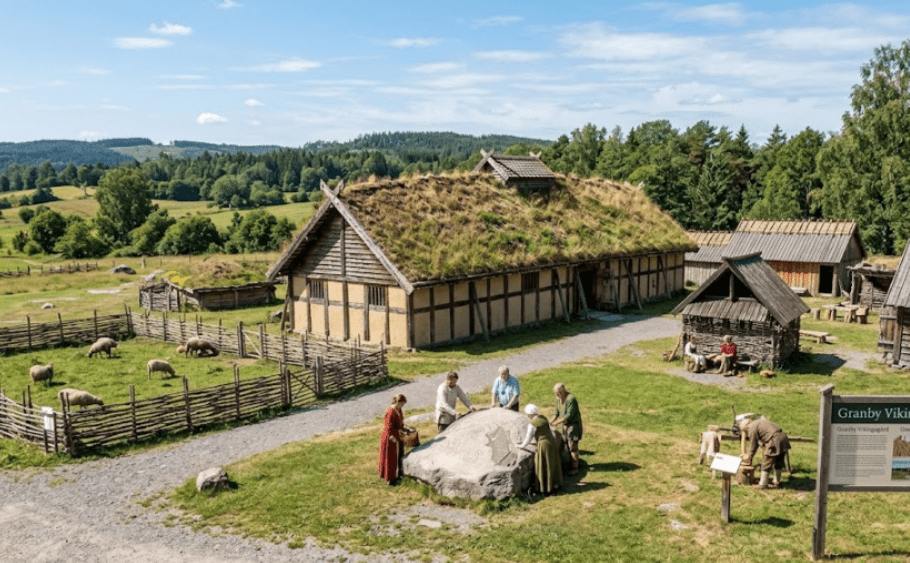
Bork Viking Harbour works as a trade setting because it places market activity inside a reconstructed Viking Age environment. The site sits at the southern end of Ringkøbing Fjord, and VisitDenmark describes it as a place where visitors can learn about Viking Age life through reconstructed ships and houses. That setting matters because trade needs more than goods. It needs routes, meeting places, shelter, storage, craft zones, and social rules.
Ringkøbing Fjord Museums presents Bork Vikingehavn as a site where visitors can explore houses, ships, a watermill, a wooden church, and areas connected with both Norse religion and Christian practice. That mix gives the market a better historical frame than a row of stalls alone. It lets visitors see trade as part of a whole community.
In other words, Bork makes trade feel spatial. Goods do not appear from nowhere. They move through harbors, houses, workshops, paths, boats, and people.
How A Market Makes Exchange Visible
A Viking market can teach something that a display case often cannot: exchange was a social event. Ringkøbing Fjord Museums says summer markets could involve trade, restored honor, punished thieves, and arranged marriages. That description matters because markets were not just commercial spaces. They also brought people together for legal, social, and family decisions.
The practical lesson begins with goods. Local products such as furs and amber could meet imported products such as spices and silk. That contrast helps visitors understand why trade mattered. Scandinavian communities had valuable resources, but they also wanted goods that came from far away.
At the same time, the market setting shows risk. If thieves needed punishment and honor needed repair, exchange depended on trust and authority. People had to know who could bargain, who could witness a deal, and who could settle a dispute.
Trade therefore becomes more than buying and selling. It becomes a public test of reputation.
Why Craft Belongs At The Center Of Viking Trade
VisitDenmark highlights authentic Viking craftsmanship as part of the 2026 Bork market. That detail matters because Viking trade often began with skilled making. A finished object carried labor before it carried price. A leather item, textile, tool, bead, comb, or piece of metalwork required materials, technique, and time.
The National Museum of Denmark explains that trade flourished during the Viking Age and that the period involved more than violence and conflict. Its trade overview identifies Hedeby, in present-day Germany, as Denmark’s most important Viking-period trading center. That wider context helps explain why a craft market can teach serious history.
Craft also shows scale. Viking trade did not only depend on kings, raids, and elite gifts. It depended on people who could make, repair, measure, pack, and move useful things. A market where visitors watch craft activity makes that labor visible.
That is why Bork’s market can move beyond spectacle. Craft turns trade into work.
Why Furs And Amber Tell A Local Story
The museum’s mention of furs and amber gives the market a strong Scandinavian base. Both goods connect trade to local landscapes. Furs point toward hunting, trapping, animal processing, and long-distance demand. Amber points toward coastal collection, craft, status, and exchange networks around the Baltic and North Sea.
These goods help readers avoid a common mistake. Viking trade should not begin only with exotic imports. It also began with what northern communities could produce, gather, prepare, and transport. Local resources mattered because they gave traders something valuable to offer beyond their home region.
That point connects naturally with oldnorsenews.org’s broader coverage of Viking Age trade and expansion, where ships, commodities, towns, and routes all shaped Scandinavian movement. Bork’s market turns that large economic story into a smaller, more practical scene.
A visitor can imagine the first step: someone had to bring the fur, carry the amber, and find a buyer.
Why Silk And Spices Change The Scale
Silk and spices change the scale of the Bork market story. They remind visitors that Viking Age trade could connect northern communities with distant production zones and exchange routes. The goods may appear small, but they imply long chains of movement through many hands.
The National Museum of Denmark’s page on imports explains that goods found in Scandinavia often came from very different regions. It also notes a fast and regular flow of cargo ships between trading towns such as Hedeby in Denmark, Birka in Sweden, and Kaupang in Norway.
That context helps Bork’s market feel historically grounded. A visitor does not need to imagine one trader sailing directly from West Jutland to every distant place. Instead, goods could pass through networks of ports, towns, ships, brokers, and markets.
The practical lesson is clear. Trade connected local producers with faraway demand, but it did so through steps. Markets made those steps possible.
How Bork’s Reconstructed Buildings Help The Story
Bork Vikingehavn does not rely only on market entertainment. Its reconstructed structures add context for daily work and exchange. Ringkøbing Fjord Museums explains that the chief’s longhouse copies a house excavated in Tarm. The wooden church draws especially on the discovery of a wooden church under the stone church at Vorgod north of Skjern. The jetty takes inspiration from finds at Nybro between Bork and Varde, while the watermill draws on finds from Sejrup and Omgård.
Those details matter because reconstruction can help visitors understand evidence. A longhouse suggests household authority, storage, feasting, and production. A jetty suggests loading, landing, repair, and movement. A watermill points toward food processing and local technology.
Together, the buildings make trade feel less abstract. They show the infrastructure that a market needed.
Why Horses And Performance Belong In The Trade Story
VisitDenmark lists Icelandic horses and entertainers among the market attractions. Those elements may sound decorative, but they can support a practical interpretation when museums frame them carefully. Horses connect trade to movement, status, transport, and public display. Entertainment connects markets to gathering, storytelling, competition, and crowd life.
A market without social energy would not represent Viking Age exchange well. People did not only arrive to weigh goods. They came to meet allies, hear news, show status, build marriage ties, settle disputes, and watch performances. Public events helped turn trade into community.
However, modern visitors need source boundaries. A 2026 market performance does not prove the exact songs, jokes, clothing, or horse displays of a specific Viking Age market. It offers a historically inspired public-history experience.
That distinction matters. Bork can use performance to make the past approachable, while interpretation must keep evidence and modern reconstruction separate.
Why Markets Also Needed Rules
The Bork event description mentions lost honor, punished thieves, and marriages. That line points toward a crucial part of exchange: markets needed rules. Trade could only work if people recognized obligations, witnesses, compensation, and punishment.
This does not mean every market functioned the same way across Scandinavia. Local customs, political authority, legal assemblies, and elite protection could differ. Still, trade required some level of order. A valuable fur, a bag of amber, or an imported fabric could cause conflict if people disputed ownership or payment.
The legal side also makes Viking trade feel more human. Exchange did not happen in a modern shop with fixed prices and receipts. It happened through bargaining, trust, social memory, and public accountability.
That is why the market setting works so well for oldnorsenews.org. It shows trade as a social system, not just an economic map.
How Bork Connects Trade To Ships
Bork Viking Harbour’s reconstructed ships matter because trade depended on movement. The site’s harbor setting helps visitors connect goods with water routes. A market beside boats makes it easier to understand how furs, amber, textiles, tools, and imported goods could move from one settlement to another.
The National Museum of Denmark emphasizes that Viking Age trade used trading centers and cargo ships. It also points to Hedeby, Birka, and Kaupang as important nodes in Scandinavian exchange. Those towns were not isolated dots. Ships connected them, and markets gave goods a reason to move.
Bork’s value lies in translating that system into a walkable experience. Visitors can move from houses to ships, from craft spaces to market activity, and from local products to distant imports.
That physical movement helps explain a broader historical idea. Viking trade was not only long-distance travel. It was logistics.
Why West Jutland Adds A Useful Local Angle
Bork’s West Jutland setting gives the market a specific geography. Ringkøbing Fjord was not Hedeby, Ribe, Birka, or Kaupang, but a reconstructed harbor beside the fjord can help visitors imagine the kinds of waterways that made movement practical across Denmark.
Jutland mattered because it connected North Sea routes, inland paths, fjords, farms, and trading towns. Even when a visitor learns about a reconstructed site rather than an excavated market town, the local landscape still teaches something important. Water shaped movement.
The site also helps avoid a narrow urban focus. Major trading centers deserve attention, but Viking Age exchange also depended on smaller places, seasonal gatherings, farms, landing points, and regional movement. Bork’s market is useful because it can represent that practical middle layer.
A visitor does not need to stand in Hedeby to understand trade. A harbor, a boat, a craft stall, and a local product can begin the lesson.
Why Public History Should Avoid A Simple Merchant Myth
A market article should not turn Vikings into peaceful merchants only. The National Museum of Denmark rightly places its trade pages within a wider section that also includes expeditions and raids. Viking Age movement included commerce, warfare, tribute, slavery, diplomacy, migration, and settlement.
Bork’s market can help because it does not need to erase that complexity. The event language already points toward conflict through theft, punishment, and honor. That detail keeps the market from becoming too polished.
The stronger interpretation sees trade and violence as parts of the same mobile world. A person who traded in one context might raid in another. Goods could move through peaceful exchange, gift-giving, plunder, tax, or forced labor. Markets were practical, but they were not automatically gentle.
A source-aware article should keep that tension visible. Viking trade feels practical at Bork because it involves real social pressure, not just colorful goods.
What Readers Should Verify Before Treating A Market As Evidence
Readers should remember that Bork Viking Market is a modern public-history event. It can teach useful historical questions, but it does not reproduce one exact Viking Age market from a named year. Costumes, performances, demonstrations, and stall layouts reflect modern choices as well as historical research.
That limitation does not make the event weak. Instead, it tells readers how to use it. Visitors should ask which buildings draw on excavated finds, which activities represent documented crafts, which elements serve family programming, and where interpreters distinguish evidence from reconstruction.
Bork’s own site helps with that distinction by explaining the inspirations behind its longhouse, church, jetty, and watermill. Those notes show that reconstruction can rest on archaeological models while still adapting them for visitors.
This is the responsible way to read a living-history market. Enjoy the scene, but ask what evidence stands behind each part of it.
Why The Market Makes Viking Trade Feel Practical
Bork Viking Harbour’s market makes Viking trade feel practical because it gathers the pieces of exchange in one place. Local goods, imported luxuries, craftspeople, horses, ships, reconstructed buildings, legal themes, and social performance all help visitors understand trade as lived experience.
That experience matters for Viking history. Trade was not only the movement of objects across a map. It was also the work of gathering materials, making goods, building reputation, protecting routes, managing conflict, and turning local resources into wider connections.
The August 7–9, 2026 market gives oldnorsenews.org a timely way to explain that story. Bork does not need to be treated as a perfect Viking Age time capsule. Its value lies in the questions it makes visible. Who produced the goods? Who carried them? Who judged a dispute? Who gained status from a successful exchange? Who connected a fjord community to faraway silk, spices, silver, or stories?
Those questions make Viking trade feel less like an abstract network and more like a practical world of people, tools, animals, boats, and decisions.
