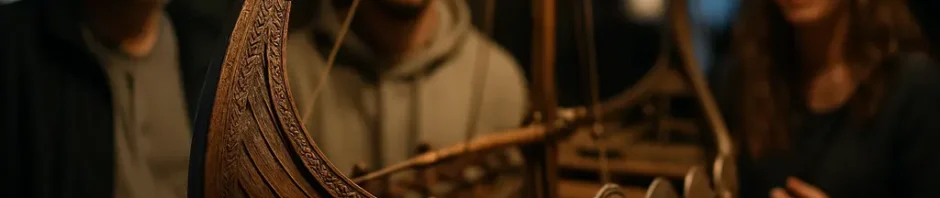
The Viking World Exhibition at the Swedish History Museum in Stockholm presents the Viking Age as more than ships, raids, and legendary gods. As of September 4, 2026, the museum describes it as a permanent exhibition and bills it as the world’s largest Viking exhibition, with about 1,000 square metres of space and 2,500 authentic Viking Age objects on display Swedish History Museum. That scale matters, but scale alone is not the main point. The stronger value lies in how the exhibition places Norse cosmology beside houses, crafts, tools, textiles, trade goods, weapons, religious items, and funerary material. It asks visitors to see belief and ordinary life as parts of the same society.
What The Viking World Exhibition Shows
Viking World Exhibition Scale And Date
The exhibition opened on 24 June 2021, according to the Swedish History Museum’s press release issued through Cision museum announcement. The museum frames the Viking Age as AD 750–1100, a period of about 350 years marked by social, religious, and cultural change in Scandinavia. That date range is useful because it keeps the display from freezing Viking history into a single moment. Farm life, trade, raiding, shipbuilding, rune carving, burial practice, and conversion did not develop in one simple line.
A permanent museum display also differs from a temporary spectacle. It can be revised in interpretation, but its purpose is not only to attract attention for a short run. It becomes part of how a national museum teaches visitors, school groups, and international audiences about the Viking Age. For a subject often distorted by fantasy media and nationalist misuse, that public role needs careful source-based interpretation.
Objects Before Atmosphere
The strongest safeguard in the display is the number of authentic objects. Archaeological material does not speak without interpretation, but it limits how far interpretation can drift. Tools, textiles, weapons, religious items, and trade goods point toward daily actions as well as status. Elite burial objects can suggest belief and social display, but they should not be treated as a full record of every household. The museum setting can help make that distinction visible.
This is also where artifact-based interpretation connects with wider public memory. Readers interested in how displays influence modern ideas of heritage may find a related discussion of Norse identity artifacts useful, since museum choices shape what later audiences imagine as typically “Viking.”
Norse Cosmology And Sensory Interpretation
Cosmology As A Museum Problem
Norse cosmology is difficult to present responsibly. Much of what modern readers know about gods, worlds, and mythic events comes from later written sources, while archaeological objects preserve belief in indirect ways. The Stockholm exhibition’s sensory stations for cosmology give visitors a way to approach worldview without treating myth as a simple illustrated story. That is a careful choice when handled well: sensation can suggest how belief structured experience, but it should not pretend to reconstruct exactly what every Viking Age person thought.
The exhibition also includes themes of life, death, and the afterlife. This matters because cosmology was not separate from burial, ritual, status, or household practice. A religious object in a case, a funerary item, or a display about changing belief can show how ideas about death affected material choices. Yet the evidence remains uneven. Some objects belonged to elites. Some survive by accident. Some meanings changed over time. The responsible museum question is not “what did all Vikings believe?” but “what can these objects and contexts suggest?”
Christian Change Without A Simple Break
The research notes identify the transition to Christianity as one of the exhibition themes. That placement is significant because the Viking Age included religious change, not only pre-Christian imagery. A display that moves from Norse worldview to Christian influence can help visitors understand conversion as a historical process. It involved objects, practices, words, buildings, political ties, and burial habits. It was not only a private change of opinion.
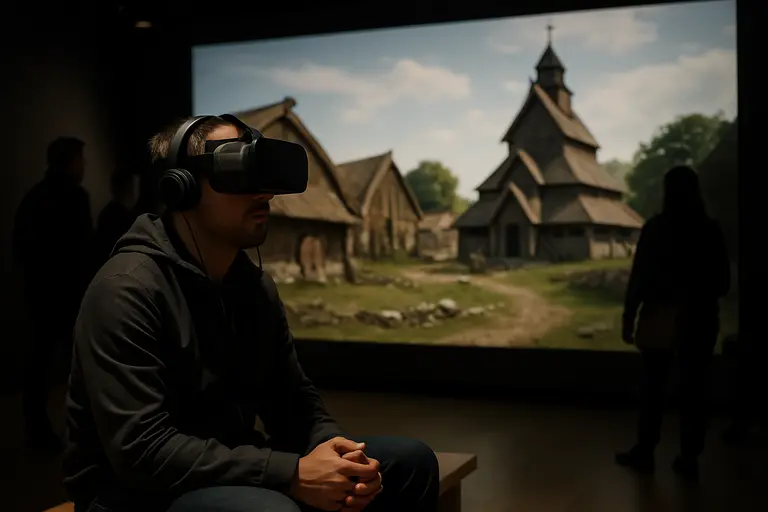
The virtual reality reconstruction that includes a 12th-century stave church extends the story past the conventional Viking Age date range used by the museum. That can be useful if the chronology is made clear. A 12th-century church is not a Viking Age longhouse or shrine. It can, however, help visitors think about what followed the Viking Age and how Scandinavian religious architecture changed after conversion.
Daily Life Inside The Viking World Exhibition
Houses, Warmth, And Work
Daily Life Inside The Viking World Exhibition is not a minor side theme; it is central to the display’s value. The research notes describe dwellings as shown as dark, but also warm and colourful. They include interpretive details such as daylight through roof openings, oil lamps, ceramic vessels, and benches that could serve as sleeping platforms in longhouses. These details matter because they resist the common image of Viking life as only cold, rough, and violent.
Domestic space is historical evidence for labour. A house implies cooking, storage, sleeping arrangements, repair, textile work, lighting, smoke, warmth, family structure, and seasonal planning. When a museum places houses and craft beside ships and weapons, it gives the Viking Age a fuller human scale. The daily actions of farmers, craftspeople, traders, children, and household workers are not background decoration. They are part of the society that made long-distance travel and elite display possible.
Craft, Runes, And Ships
The exhibition’s interactive stations for shipbuilding and rune carving are useful because both subjects can easily become symbols rather than skills. A ship was not only an icon of expansion. It was the result of design, timber knowledge, tools, labour, and maintenance. Runes were not only mysterious marks. They required carving skill, language, memory, and social use.
The Viking World Exhibition works best when such media return attention to process. Visitors can ask who made an object, how it was used, who could read or commission an inscription, and how long-distance contacts changed local life. Trade and raiding sit within that wider frame. They were not isolated adventure stories; they depended on boats, goods, routes, violence, negotiation, and social ambition.
Immersion With Evidence Limits
What Interactive Media Can Do
Virtual reality, sensory stations, and installations for several senses can make difficult material more approachable. This is especially true for cosmology, architecture, and craft, where a flat label can struggle to convey space, sound, light, or bodily action. A visitor may better understand a longhouse if the display suggests dim light, warmth, colour, and shared benches. A visitor may better understand a cosmological display if it communicates that belief shaped experience rather than sitting apart as abstract doctrine.
Still, immersive media should be read as interpretation, not direct evidence. A reconstruction chooses colours, sounds, angles, and sequences. It can be based on recent archaeological and architectural research, but it remains a museum argument. That does not weaken it. It simply means visitors should ask what the media are based on, what is known, and what remains uncertain.
Why Caution Helps Public History
Caution is not the enemy of public engagement. It is what keeps engagement honest. The exhibition’s great strength is the pairing of sensory interpretation with a large body of authentic material. The objects anchor the experience. The media help visitors imagine use, setting, and meaning. If either side overwhelms the other, the interpretation becomes weaker.
For readers comparing public-facing historical interpretation with other forms of evidence-based writing, our network also includes writing service comparisons that help clarify writing quality. The principle is similar in one respect: claims need clear criteria and visible sources. In a Viking museum, that means separating artifact evidence, architectural reconstruction, later textual tradition, and modern display design.
The Viking World Exhibition As Public Archaeology
The Viking World Exhibition As Public Archaeology is valuable because it treats the Viking Age as a social world rather than a costume set. Its permanent status, large object base, and wide thematic range allow visitors to move between belief, household work, trade, raiding, craft, death, and Christian change. That structure is well suited to a period defined by movement and transition.
The Viking World Exhibition should not be read as the final word on Norse cosmology or daily life. No exhibition can carry every regional variation, scholarly dispute, or uncertain interpretation. Its importance lies in how it makes evidence visible to a broad audience while using sensory media to help people ask better questions. What did a house feel like? How did objects carry belief? What kinds of labour stood behind ships and inscriptions? How did death ritual express status and hope?
Those questions keep the Viking Age grounded in evidence without draining it of human interest. For modern audiences, that balance is essential. The past becomes clearer when artifacts, interpretation, and uncertainty are allowed to stand together.
