
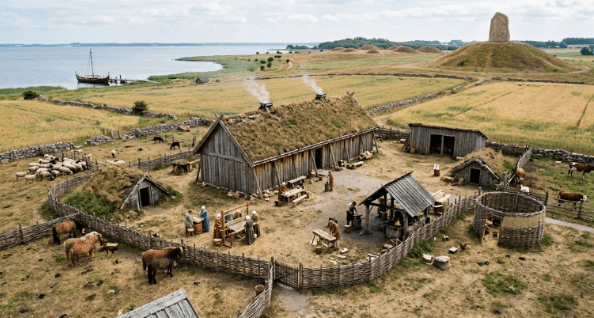
A Viking-Age great farm at Toarp, on Malmö’s southeastern outskirts, is giving archaeologists a new way to examine royal authority in southern Scandinavia. The excavation does not reveal a palace, battlefield, or royal grave. Instead, it exposes houses, production areas, burned-stone deposits, Baltic-style ceramics and an unusually large Trelleborg-type building near Oxie, one of the royal estates that helped organize Danish kingship during the early 11th century.
Arkeologerna investigated almost 2,000 square metres of Toarp’s old village site during a nine-week excavation that ended in December 2025. Their preliminary interpretation points to intensified settlement during the second half of the Viking Age and a possible relationship with the nearby royal estate at Oxie. On August 30, 2026, project leader Fredrik Strandmark presented the findings at Malmö Museum during Sweden’s Archaeology Day, bringing the site back into current discussion.
Toarp matters because royal landscapes consisted of more than residences belonging directly to kings. Large farms, craft areas, food production, transport routes and settlements around royal estates could support political authority. The new evidence invites researchers to reconsider how far Oxie’s sphere reached and what role nearby elite farms played as Skåne moved from Viking-Age networks into medieval administration.
Toarp Places A Great Farm Beside The Royal Estate At Oxie
Modern Toarp lies close to Oxie in southeastern Malmö, but the archaeological relationship between the two places reaches back roughly a thousand years.
Arkeologerna describes the investigated area as part of Toarp’s older village site, registered as ancient monument L1988:5550. Written sources do not mention Toarp until 1537, yet archaeology pushes settlement on the site far deeper into the past.
The recent excavation revealed evidence from the Viking Age, early Middle Ages and later medieval centuries. Researchers now argue that more intensive occupation began during the second half of the Viking Age.
That timing immediately raises questions about nearby Oxie.
According to Arkeologerna’s Toarp excavation project, Oxie became part of the early medieval royal system known as kungalev. These estates belonged to royal authority rather than passing through ordinary hereditary ownership. They functioned as important administrative and economic nodes for kingship.
Archaeologists connect the development of that system with the early 1000s and the political environment of rulers such as Cnut the Great, who controlled Denmark, England and Norway during parts of his reign.
Toarp sits close enough to Oxie that archaeologists now have to ask whether the two sites developed independently or formed parts of the same political and economic landscape.
The evidence cannot yet prove that a king controlled Toarp directly.
Its scale and material culture still make the question difficult to ignore.
A 26-Metre Trelleborg-Type House Raises The Status Question
One of Toarp’s strongest clues comes from an excavation conducted decades before the 2025 project.
During investigations in the 1990s, archaeologists found a large building southeast of the recent excavation area. The structure measured approximately 26 metres long and belonged to the architectural family often described as Trelleborg houses.
Such buildings attract attention because archaeologists frequently associate their form with socially prominent environments.
The Toarp example stood in an unusual position on strongly sloping ground. Its construction required substantial planning, timber and labour, which separates it from the smallest domestic buildings known from many Viking-Age settlements.
A large hall does not automatically prove royal occupation. Archaeologists cannot identify a king simply from postholes.
The structure does, though, strengthen the interpretation of Toarp as something more substantial than an ordinary cluster of farmsteads.
Another building to the north may add an industrial dimension. Iron slag found around nearby features suggests that craftspeople may have operated a smithy there.
Taken together, a large elite-associated house, possible metalworking, extensive food-production deposits and proximity to a royal estate create a pattern worth testing.
That pattern resembles the broader archaeological problem explored in Old Norse News coverage of Tommarp’s royal farm and monastery. Tommarp shows how royal farms could anchor production, administration and later medieval institutions in Skåne. Toarp raises a related question farther west: how many surrounding farms helped make royal centres function?
More Than 230 Square Metres Of Burned Stone Point To Large-Scale Activity
The most visually modest feature at Toarp may prove one of the most informative.
Beneath a later medieval farmyard, archaeologists examined a layer containing burned and fire-cracked stone mixed with charcoal. The deposit covered more than 230 square metres and measured roughly 12 to 35 centimetres thick.
Researchers excavated parts of it in two-by-two-metre squares.
Finds from the deposit included animal bone and fragments of Baltic-style pottery. Radiocarbon evidence and associated material place its formation in the Viking Age or early medieval period.
The scale makes ordinary household cooking an incomplete explanation.
Arkeologerna notes that extensive burned-stone deposits occur at other Scandinavian great farms, including Järrestad in Skåne and Lejre on Zealand. Archaeologists have linked comparable contexts with large-scale production and, in some cases, ritual or communal activity.
Toarp offers a particularly useful clue because investigators found malted barley near one of the ovens.
That evidence points toward brewing.
Producing beer in substantial quantities required grain, fuel, water, containers, labour and storage. A farm capable of organizing those resources could support feasts, work gatherings or other activities involving groups larger than a single household.
Archaeologists still need laboratory results and contextual analysis before assigning an exact function to every fire feature. The Viking and early medieval Toarp findings show why production scale matters more than a dramatic label.
Royal authority required resources.
Toarp may preserve evidence for some of the systems that generated them.
Three Pit Houses Add Craft And Household Activity
When fieldwork ended on December 9, 2025, archaeologists carried finds, samples, plans, photographs and documentation into the analysis phase.
By that point, they had exposed three substantial pit houses east of the later medieval residential range.
One measured approximately 5.5 by 4.5 metres and contained a bench-like feature along one side. Archaeologists found charcoal, burned stone and reddened soil in later deposits within the hollow, indicating craft activity after the structure itself had gone out of use.
The artifacts place these pit houses in the Viking Age or early medieval period.
Pit houses occur widely across Viking-Age Scandinavia. People often used them for textile production and other crafts, though their functions differed from site to site. Their presence at Toarp adds a working component to the great-farm interpretation.
The Swedish History Museum’s Viking Age farm research provides useful context. Viking farms commonly combined larger dwelling houses with smaller outbuildings and work structures. Fields, livestock, storage and crafts formed an integrated economic unit rather than separate activities.
Toarp seems to show that principle on a substantial scale.
Its houses cannot establish royal ownership by themselves. Yet the concentration of buildings, production areas and specialized material makes the site increasingly relevant to questions about elite organization near Oxie.
Baltic Finds Connect Toarp With A Wider Viking Network
Objects from Toarp widen the story beyond local farming.
Among the most striking finds is a bronze pin with an attached chain. Archaeologists believe craftspeople probably produced it somewhere along the coast of present-day Latvia or Lithuania.
The surviving pin measures a little over 12 centimetres long.
Its original design included four circular elements arranged in a cross pattern at the head. Another matching pin once occupied the opposite end of the chain. A woman would likely have worn the pair near her shoulders with the chain hanging across her chest.
Such an object provides stronger evidence for long-distance connections than an architectural resemblance alone.
Toarp produced Baltic-style pottery too.
Archaeologists use the term Östersjökeramik, or Baltic Sea pottery, for ceramics that show technical and decorative connections with traditions found across the Baltic, particularly in Slavic regions. The Toarp examples do not necessarily represent imported pots. Arkeologerna notes that craftspeople may have made them locally, perhaps even around Oxie.
That possibility makes them more informative in another way.
Local pottery inspired by eastern Baltic traditions could reflect people, craft knowledge and cultural connections moving across maritime networks. The object does not need to have crossed the sea itself for its style to document contact.
Skåne occupied an advantageous position within those networks. Routes across the Baltic and Öresund connected communities with Denmark, southern Scandinavia and the southern Baltic coast.
Toarp therefore cannot be understood only as an inland farm beside Oxie.
Its material culture places the settlement inside a much larger communication system.
Oxie Makes The Great Farm Politically Different
Many Viking-Age farms produced grain, animals, craft goods and household objects. Toarp becomes politically more interesting because of where it sits.
Oxie operated as a royal estate during the early medieval period.
Arkeologerna links the kungalev system with the consolidation of royal administration during the early 1000s. These royal estates acted as nodes through which kings could control resources and organize authority across their territories.
That system did not operate in isolation.
A royal estate needed surrounding agricultural production, labour, transport, animals, craft knowledge and local relationships. Powerful neighbours could serve as allies, subordinate estates, production centres or competing elite households.
The current evidence does not tell researchers which category best describes Viking-Age Toarp.
That uncertainty gives the site its research value.
Instead of treating Oxie as a solitary royal dot on a map, archaeologists can investigate a landscape containing multiple substantial settlements.
The Swedish National Heritage Board highlighted that relationship in its official Archaeology Day 2026 program. The August 30 event explicitly described Toarp as a Viking-Age and early medieval great farm near the royal estate at Oxie, with Fredrik Strandmark presenting the recent investigation.
That description captures the central issue.
Toarp matters less as an isolated spectacular find than as a neighbouring centre whose chronology overlaps with the growth of royal administration.
Cnut The Great Provides Context, Not A Named Owner
The early 11th century places Toarp and Oxie close to one of the most politically significant periods in Scandinavian history.
Cnut the Great became king of England in 1016, king of Denmark by 1018 and king of Norway in 1028. His rule created what historians often describe as a North Sea empire.
Skåne belonged to the Danish kingdom during this period.
Arkeologerna places the expansion of the kungalev system within the broader political structure controlled by kings such as Cnut. That connection makes Toarp relevant to state formation, taxation, resource collection and elite networks.
It does not mean Cnut personally visited Toarp.
No current archaeological evidence identifies the farm’s owner by name, records a royal visit or links a particular house directly to the king.
Keeping that boundary clear improves the historical interpretation.
The useful question asks how a great farm near a known royal estate fitted into the political economy of the early Danish kingdom. Researchers can investigate that through settlement scale, production, imported or culturally connected objects, craft evidence and landscape relationships.
A named king gives the period historical context.
Archaeology must still establish what happened at the farm itself.
Toarp Continued After The Viking Age Instead Of Vanishing
The excavation becomes even more useful because Toarp did not disappear at the conventional end of the Viking Age.
A long residential building occupied part of the site from around the beginning of the 1200s until the land reforms of the early 1800s. Archaeologists identified tightly layered floor surfaces, occupation deposits and demolition layers spanning roughly six centuries.
Beneath that medieval sequence lay older buildings.
The three pit houses and other Viking-Age traces demonstrate occupation before the 13th-century farm took its later form. The large burned-stone deposit became part of the foundation beneath the medieval farmyard.
People literally built later Toarp over material generated by earlier activity.
Arkeologerna’s post-excavation Toarp report stresses how the site can help researchers follow settlement from the Viking Age through the Middle Ages and into much later village history.
That continuity changes the story.
Toarp does not represent a Viking centre that suddenly collapsed when medieval institutions appeared. The site shows people repeatedly reorganizing the same place.
Such continuity makes the relationship with Oxie more interesting. Royal administration, local elite farms and medieval villages may represent different stages of a connected landscape rather than unrelated historical episodes.
The August 2026 Presentation Reopens The Royal Landscape Question
The excavation ended in December 2025, but Toarp returned to public attention on August 30, 2026.
Malmö Museum included the investigation in its Archaeology Day program under the title “Toarp – a Viking-Age and early medieval great farm near the royal estate at Oxie.” Fredrik Strandmark of Arkeologerna presented the project alongside new research from medieval Malmö.
That public framing reflects how archaeologists now see the site’s broader potential.
Researchers still have laboratory analyses, specialist reports and interpretation ahead of them. The excavation produced samples and artifacts that could refine chronology, identify activities and clarify external contacts.
Yet the major landscape question already stands out.
Toarp combines an elite-associated 26-metre building, three pit houses, extensive burned-stone deposits, evidence connected with brewing, metalworking indicators, Baltic-style ceramics and a Baltic bronze dress pin. Those remains developed close to Oxie at roughly the period when royal administration gained stronger territorial form.
No single artifact proves royal control.
Together, the features justify asking whether Toarp formed part of a wider power zone around Oxie.
Why Toarp Reopens Skåne’s Viking-Age Power Map
Toarp changes the royal landscape question because it pushes attention beyond places explicitly called royal estates.
Oxie supplies the known political anchor. Toarp supplies a substantial neighbouring farm whose growth overlaps with the same transformative period.
The relationship between them remains under investigation.
That uncertainty should stay visible. Archaeologists have not proved that Toarp belonged to a king, served Oxie administratively or hosted a named aristocratic family. Nor can the 26-metre Trelleborg-type building alone turn the site into a royal residence.
The excavation supports a more useful interpretation.
During the later Viking Age, people at Toarp organized substantial buildings, crafts and production. They maintained connections reaching across the Baltic. Their activities took place close to a royal estate that participated in an emerging administrative system during the early 11th century.
That combination turns the surrounding countryside into part of the political story.
Royal authority in Viking-Age Skåne did not exist only inside halls occupied by kings. It depended on farms, food, labour, specialized production, land and networks connecting important households.
Toarp may help archaeologists map those relationships with greater precision.
As analysis continues after the 2025 excavation and the renewed attention created by Archaeology Day 2026, the site offers a strong reminder about how archaeologists reconstruct early political systems. The most informative evidence may not carry a crown, inscription or royal name.
Sometimes it looks like postholes, a pit house, malted barley, Baltic pottery and more than 230 square metres of burned stone sitting a short distance from a known royal estate.
That is why Toarp reopens Skåne’s royal power landscape.
