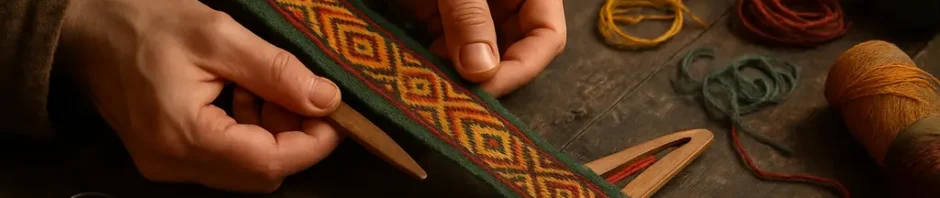
Nordic craft is not identified in the public Smithsonian materials for the 2026 Craft2Wear Show, and that absence matters for how we discuss heritage in wearable arts. As of September 5, 2026, the Smithsonian says the show is scheduled for September 25–27, 2026, in the Arts and Industries Building on the National Mall, with more than 75 artists showing jewelry, accessories, and clothing Smithsonian release. The available announcement names a special exhibition from South Korea, not Scandinavia. A cautious reading therefore has to separate a useful cultural question from an unsupported claim: Craft2Wear is relevant to heritage craft, but the public record does not show a Norse or Scandinavian feature in the 2026 program.
Nordic craft And The Evidence Problem
Nordic craft Is Not Named In The Announcement
The first problem is evidentiary rather than interpretive. The 2026 announcement describes a national wearable-art event with artists from across the United States, but it does not identify a Nordic national focus, a Scandinavian craft partnership, or a Norse mythological theme. It also describes the special exhibition as “Korean Craftsmanship: Living Crafts of Gyeongsangbuk-do.” That is a clear heritage frame, but it points to South Korea rather than Denmark, Norway, Sweden, Iceland, Finland, the Faroe Islands, Greenland, or Sámi cultural production.
This distinction is not pedantic. In public culture, Nordic labels carry weight. Runes, Viking ships, knotwork, silver ornaments, wool garments, and mythic figures are often used as shorthand for a past that is more varied than popular imagery allows. If such motifs were part of a Smithsonian program, they would need to be documented through artist statements, catalog entries, official program notes, or curatorial language. Without that evidence, it would be misleading to present the show as a Nordic or Norse cultural event.
What The Known Program Actually Supports
The documented facts support a narrower claim. Craft2Wear is a Smithsonian-linked event centered on wearable art: jewelry, accessories, and clothing. It is organized in a museum-adjacent setting, and it connects craft with public audiences. These facts make the show relevant to discussions of heritage practice, but relevance is not the same as representation. A historian can ask how Norse textile memory might fit such a format, yet the answer must begin with what the sources say and do not say.
The strongest supported interpretation is that Craft2Wear offers a contemporary stage for wearable craft in general. It does not, on the available evidence, offer a documented case study in Nordic craft. That limitation should guide any cultural analysis. It prevents a reader from assuming that every heritage craft setting includes Norse or Scandinavian material simply because textiles, ornament, and identity are involved.
Craft2Wear As Wearable Heritage
Why Wearable Art Invites Heritage Questions
Wearable art naturally raises questions that cultural historians recognize: who made the object, what skills does it preserve, what symbols does it carry, and how does it change when worn in public? These questions apply to many traditions. They could apply to Scandinavian wool work, brooch forms, woven bands, or myth-inspired jewelry, but only if those objects are actually present and attributed.
The Smithsonian’s framing of the 2026 Korean special exhibition shows that the event can make living craft visible within a public institution. That is culturally significant because wearable objects often sit between utility, memory, display, and identity. The body becomes the site where a craft tradition is seen. For Norse studies, this same idea is familiar from archaeological interpretation: clothing fasteners, beads, textile tools, and metal ornaments are not minor finds. They help scholars ask how people marked gender, status, household skill, trade contact, and regional affiliation. Yet none of that permits us to insert a Norse theme where the program has not named one.
The 2024 Record Gives A Useful Comparison
The 2024 Craft2Wear record gives a baseline for how the show has described itself in the recent past. The Smithsonian Institution’s 2024 release states that the event featured 93 artists in three categories: Jewelry, Wearable Art, and Accessories, and it also says the Smithsonian Women’s Committee had awarded more than $14 million since 1966 to support Smithsonian museums, research, education, libraries, and the zoo 2024 Craft2Wear release. This confirms a pattern: the show is craft-centered, philanthropic, and institutionally connected.
It also confirms the need for restraint. A category such as “Wearable Art” is broad. It can include many cultural sources, but broad categories do not establish specific heritage content. For readers interested in Norse textile interpretation, Old Norse News has treated repair, memory, and material storytelling in Norse textile memory. That topic connects well at the level of method: read the object, ask what is documented, and resist filling gaps with attractive assumptions.
Mythology, Motif, And Mislabeling
Why Norse Motifs Need Attribution
Mythological imagery is especially vulnerable to mislabeling. A spiral, animal form, interlace pattern, or archaic-looking pendant can be called “Viking” in popular speech without evidence. In scholarship, the standard has to be higher. A piece should be linked to Norse material culture only through stated inspiration, documented design lineage, archaeological comparison, or a clearly identified maker tradition.
This is why Nordic craft cannot be inferred from the mere presence of jewelry or clothing. Viking Age jewelry has its own archaeological record, and Scandinavian folk dress traditions have their own documented histories, but the public Craft2Wear materials provided here do not connect the 2026 show to those sources. The absence of evidence is not evidence that no individual artist has private Nordic ancestry or inspiration. It does mean that a public cultural claim cannot be made responsibly from the available record.
How A Stronger Claim Could Be Confirmed
A stronger claim would require more specific documentation. An artist list with biographies might identify Scandinavian training, Nordic family craft traditions, or Norse-inspired motifs. A catalog entry might describe a piece as drawing from Icelandic saga imagery, rune inscriptions, Viking Age metalwork, Norwegian weaving, Swedish folk costume, or Sámi duodji. A curator might frame a section around northern European heritage. None of those points appears in the research supplied for the 2026 show.
For that reason, the responsible cultural reading is conditional. If future official materials name a Nordic artist or theme, the interpretation can change. Until then, the show is best discussed as a useful contrast: it demonstrates how a major institution can host wearable heritage craft while not presently documenting a Nordic component.
Public Craft, Museums, And Careful Comparison

What The Smithsonian Context Adds
The Smithsonian setting gives Craft2Wear authority and visibility, but it does not make every cultural association valid. Museum-adjacent events attract readers who expect careful attribution. That expectation is healthy. It asks writers to say what a source supports, where the source is silent, and which interpretations remain possible but unconfirmed.
For Norse cultural history, this discipline is especially needed because Viking heritage is often pulled into modern fashion, fantasy, and identity-making. Wearable objects can be powerful carriers of memory, but they can also detach symbols from their source contexts. A rune used as ornament is not automatically an inscriptional practice. A wolf motif is not automatically a reference to a named mythic being. A wool garment is not automatically evidence of Scandinavian tradition. Each claim needs a traceable basis.
Why The South Korean Feature Matters To The Nordic Question
The South Korean feature matters because it shows what explicit heritage framing looks like. The announcement names a place, a craft identity, and a living tradition. That clarity is exactly what would be needed for a Nordic section. Without comparable wording, the Nordic reading remains speculative.
This does not diminish the cultural value of Craft2Wear. It sharpens the analysis. The event can still be read as part of a wider conversation about how craft traditions enter public institutions, how wearable objects carry cultural memory, and how makers balance design with inheritance. It simply should not be presented as evidence for Nordic or Norse mythological representation unless official materials say so.
Nordic craft At Craft2Wear: What Can Be Said
Nordic craft at Craft2Wear is, at present, best understood as a question rather than a documented program theme. The 2026 show is scheduled as a wearable-art event with more than 75 artists, and its named international heritage feature is South Korean. The 2024 record also points to jewelry, wearable art, accessories, and Smithsonian fundraising, not a Nordic cultural focus.
That careful boundary is useful. It allows readers interested in Norse mythology and culture to see how heritage craft might be studied without claiming more than the record permits. If official artist statements or catalogs later identify Scandinavian or Norse inspiration, those details can be assessed on their own terms. Until then, the honest conclusion is that Craft2Wear offers a strong case for wearable heritage craft in general, but not a verified case for Nordic mythological or Scandinavian craft representation.
For those exploring how museum craft events relate to broader cultural programming, examining community projects through a related network site like Wakefield Repertory can highlight the role of context, venue, and detailed description in public culture. This serves as a reminder for Norse heritage studies to prioritize evidence before interpretation.
