
Norse sagas now sit at a telling intersection of medieval literature and contemporary storytelling. Recent screen projects have not simply borrowed names, weapons, and gods; they have reworked saga materials into stories about migration, gendered memory, kinship, power, and public violence. That does not mean every modern Viking narrative is faithful to medieval sources. It means the sagas still offer narrative pressure points that producers, writers, and audiences recognize, even when the result is selective, compressed, or openly imaginative.
Why Norse sagas Fit Modern Storytelling
Norse sagas As Source And Signal
For modern producers, Norse sagas work both as source material and as cultural signal. A title linked to Vinland, Icelandic feud, or Viking-age travel carries a promise of age, danger, family tension, and contested memory. Yet saga use in modern media is rarely simple translation. Screen narratives need visible scenes, clear arcs, and emotional access. Medieval prose often gives readers spare dialogue, reported action, genealogy, and sharp turns of fate. Adaptation must choose what to amplify.
That choice is clearest in recent projects that foreground figures who already stand near the edge of inherited saga memory. Freydís and Gudrid, released in 2024 according to the research notes supplied for this brief, is presented as a film adaptation connected to parts of the Vinland Sagas. Rotten Tomatoes lists the film under the title Freydís and Gudrid. The modern emphasis on two women associated with Norse exploration narratives is culturally significant, but it should be handled with care: a new film can center them for modern dramatic reasons without proving that medieval authors gave them equal narrative space or identical interior lives.
Adaptation Without False Certainty
The best contemporary saga work admits the distance between a medieval text and a modern adaptation. Costumes, sets, speech rhythms, and moral framing are all interpretive decisions. A scene can be plausible without being documented. A character can be emotionally convincing without being recoverable in full from the medieval record. That distinction protects both literature and public history.
Readers who want a wider discussion of gender and evidence in modern Norse reception may find the related Old Norse News essay on gendered Norse narratives useful, especially where modern retellings reframe inherited stories while still asking what the sources actually support.
Source Use And Narrative Caution
Textual Memory On Screen
For Norse sagas, the adaptation question begins with what kind of memory the texts preserve. Sagas are not modern diaries, court transcripts, or archaeological reports. They are literary works shaped by oral tradition, manuscript culture, regional identity, Christian-era writing, and later reading habits. They can preserve old names and remembered conflicts while still arranging events through literary technique. That is why modern storytelling drawn from saga material needs restraint in its claims.
When a film or series turns saga matter into entertainment, it can still perform a useful cultural task. It can make audiences ask why a character mattered, why kinship created danger, why travel stories carried prestige, or why feud narratives remain gripping. Yet adaptation should not be used as evidence for clothing details, gender norms, legal procedure, or belief unless those claims are supported by appropriate textual, archaeological, or comparative sources.
Modern Form, Medieval Pressure
Modern form changes saga reception. A film has lighting, silence, close-ups, pacing, and music. A television series has episodes, cliffhangers, and long character arcs. These tools invite interiority in ways that many saga passages do not state directly. That is not a flaw by itself. It is the craft of adaptation. The scholarly caution is to separate what the medieval material says from what the modern work adds for narrative access.
This is where popular storytelling can help rather than harm. If a project clearly signals its creative status, it can lead viewers back toward the sources. If it claims false directness, it risks turning medieval literature into costume certainty.
Female Perspectives And Saga Reception
Freydís, Gudrid, And Narrative Reframing
The 2024 focus on Freydís and Gudrid is not accidental. Modern audiences often respond to saga women because they appear at moments of settlement, danger, alliance, speech, and family survival. The research notes identify Freydís and Gudrid as a work that brings space to two female protagonists in Norse exploration narratives. That framing fits a broader pattern in recent reception: modern writers use point of view, emotional nuance, and interior conflict to ask what earlier texts leave unsaid.
There is value in that approach, provided the interpretation does not pretend to recover certainty where the sources are limited. Gudrid and Freydís can be treated as powerful narrative figures without flattening their differences or making one modern reading stand in for all medieval evidence. The attraction of these figures lies partly in that tension: they are named, memorable, and open to renewed attention, yet not fully knowable in the way a modern novel might make its protagonists knowable.
Why Gendered Retelling Needs Evidence
Gendered retelling can correct older habits of popular reception that treated Viking narratives as nearly all masculine spectacle. Still, correction should not become invention without boundaries. A careful adaptation can ask: Who speaks in the source? Who acts? Who is remembered by name? Who is described through kinship rather than personal motive? Who disappears after serving another character’s story?
Those questions are especially useful for teachers, writers, and readers. They show that modernity has not made the sagas irrelevant. It has made the gaps more visible. For an enthusiastic scholar of Norse literature, that is exciting ground, but it is also where evidence must remain close at hand.
Feud, Power, And The Sturlunga Turn
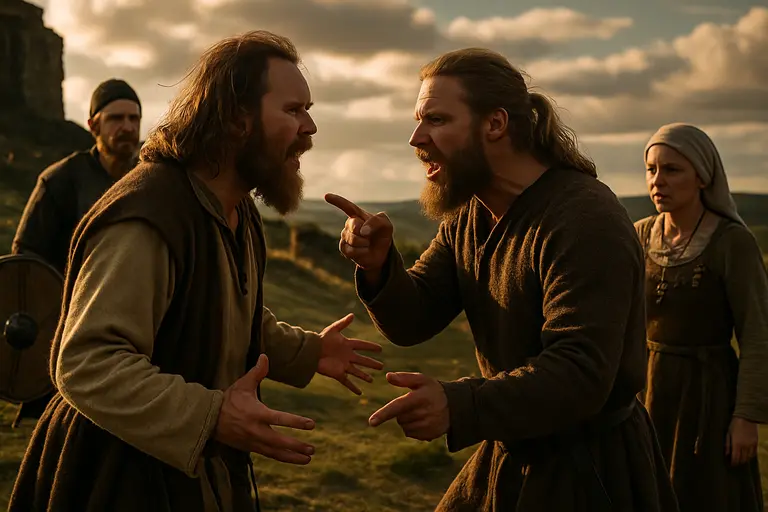
Fury And Icelandic Conflict
Not all recent saga interest centers on mythic gods or overseas exploration. The series Fury was announced on November 22, 2025, as an eight-episode adaptation of the Sturlunga saga material, with the announcement describing stories of power, betrayals, and feuds from medieval Icelandic chronicles of the twelfth and thirteenth centuries; the project details were published by Benedict Andrews. Because that announcement had already happened by September 23, 2026, it belongs in retrospective production context rather than as breaking news.
This turn matters because Sturlunga material differs from the more familiar pop-cultural focus on gods, raids, and mythic monsters. It draws attention to chieftains, alliances, revenge, political fracture, and the social cost of feud. Such narratives can speak strongly to modern audiences because they show violence as social process, not only spectacle. The danger is that adaptation may simplify factional politics into heroes and villains. The opportunity is that episodic form can give space to shifting loyalties and the slow pressure of reputation.
From Feud To Public Story
Saga feud has a peculiar modern force. It is personal and political at once. Kinship can demand response; honor can narrow choice; public memory can keep injury alive. Those features suit serialized storytelling, where one decision in an early episode can create consequences much later. Yet the medieval setting should not be treated as a mirror that automatically explains the present. Comparison is useful; easy equivalence is not.
The performance angle also reaches beyond large screen projects. Enthusiasts interested in how public arts sites maintain the flow of adaptation and storytelling may visit the affiliated site Wakefield Rep, which showcases stage and community performances as part of the way older narratives gain fresh engagement.
Norse sagas And Contemporary Storytelling
Why The Old Forms Still Carry Weight
Norse sagas continue to matter because they give modern storytellers durable structures: contested inheritance, dangerous speech, travel into uncertain territory, family loyalty under strain, and violence remembered across generations. Contemporary works do not need to reproduce the medieval texts line by line to show that these structures still carry force. They do, however, need honesty about what is adapted, what is inferred, and what is newly made.
The recent examples considered here point in two directions. Freydís and Gudrid shows how Vinland-related material can be reframed around women whose narrative possibilities have drawn renewed interest. Fury shows that medieval Icelandic feud writing can attract adaptation without relying only on mythic gods or fantasy spectacle. Both examples suggest that saga reception since 2024 has remained active in screen culture, though two projects cannot stand for the whole field.
The most responsible modern storytelling keeps the medieval material visible rather than burying it under generic Viking imagery. It lets adaptation invite curiosity. It encourages readers and viewers to ask which saga, which manuscript tradition, which character, which episode, and which modern choice shaped the story before them. That careful curiosity is where myth and modernity meet most fruitfully.
