
More than 500 pieces of Viking-Age horse equipment recovered from the burial ground at Sylta in Västmanland are giving archaeologists an unusually detailed look at how Scandinavian communities dressed, used and displayed horses.
The finds include bits, buckles, strap fittings, bells, spurs, harness links and hoof studs. Many came from cremation graves dating mainly to the 10th and 11th centuries, where horses were buried alongside the dead.
What makes Sylta especially interesting is not simply the number of objects. Several fittings share a distinctive decorative style that archaeologists have struggled to match elsewhere in Sweden.
That pattern has encouraged researchers to describe the equipment as a possible local “horse costume.”
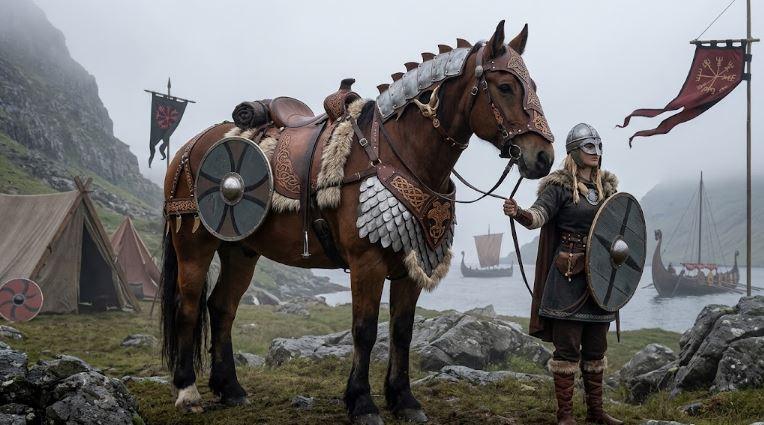
The phrase does not mean a surviving textile outfit. It refers to a coordinated system of bridles, straps, ornaments and bells that may have made horses from the Sylta community visually—and even audibly—recognizable.
A selection of the finds is now part of the Swedish History Museum’s Current Archaeology – Beloved Horses exhibition, running from April 2, 2026 to April 4, 2027.
The Sylta Cemetery Produced An Exceptional Horse Assemblage
Archaeologists investigated Sylta outside Köping in 2021 ahead of work connected with the widening of the E18 motorway between Köping and Västerås.
Part of the cemetery had already been examined during road construction in the 1960s, but the newer excavation expanded the picture significantly.
The Arkeologerna project on Sylta and Mälardalen places the cemetery in a Late Iron Age landscape overlooking the Valstaån valley and the monumental Ströbo mound.
Across the known cemetery, researchers identified 51 graves.
Horses appeared in 24 of them.
Among the 23 graves assigned to the 11th century, archaeologists found horse remains in 15.
That concentration immediately separates Sylta from an ordinary burial ground.
More Than 500 Objects Reconstruct The Horse Gear
The Swedish History Museum’s Current Archaeology exhibition presents more than 500 iron objects associated with horses.
Among them are:
- 108 strap fittings
- 129 hanging fittings
- 59 bells
- 116 strap clamps
- 43 buckles
- 23 hoof studs
- 7 bits
Spurs, pulling hooks and harness links also survive.
Leather and textile have largely disappeared, but the iron fittings reveal how those lost materials once worked together.
Some horses were clearly equipped for riding.
Others appear to have pulled wagons or sleighs.
That variety matters because the Sylta style was not restricted to one type of horse use. Decorative fittings could appear on animals performing different practical roles.
The Three-Pronged Fittings Look Distinctively Local
The strongest evidence for a “horse costume” comes from the repeated ornament.
Archaeologists found 129 hanging fittings in ten graves, several of them with a distinctive three-pronged form.
Project leader Anton Seiler and colleagues have noted that the equipment forms an unusually coherent local group.
The style currently lacks clear direct parallels elsewhere in Sweden.
That does not prove the design existed only at Sylta. Future excavations may produce similar material elsewhere.
For now, however, the concentration is strong enough to suggest a local tradition.
Human clothing frequently communicated status, region or affiliation through jewelry, belts and decorative fittings.
Sylta raises the possibility that horses could communicate similar information.
Bells Turned The Horse Costume Into Sound
The 59 bells add another dimension.
At least ten graves contained them, and four graves produced especially large groups.
One bell still works after roughly a thousand years underground.
Bells could have served practical purposes.
A horse pulling a sleigh over snow might move more quietly than one crossing dry ground, so bells could warn others of its approach.
Yet the effect was also social.
A richly equipped horse with multiple bells announced itself before it came into view.
If decorative fittings caught the light while bells sounded with each movement, the horse became part of a carefully staged display.
The costume was not just something people saw.
They heard it.
Grave 630 Preserves Evidence For A Sleigh Horse
One of the best examples comes from Grave 630.
Archaeologists found a bit, bells, harness fittings, pulling equipment and two matching spurs.
The equipment has been interpreted as belonging partly to a horse used for pulling a sleigh.
A pulling hook and harness link support that interpretation.
The bit measures about 120 millimetres along its twisted mouthpiece, while other bits from the cemetery vary in size.
That difference suggests that the equipment was fitted to real horses of different builds rather than functioning only as symbolic grave objects.
Decoration and technology therefore worked together.
The horse had to pull efficiently.
Its harness also communicated identity.
Grave 621 Shows A Different Type Of Horse
Grave 621 offers another configuration.
Its finds include a bit, buckles, decorated strap fittings, bells and other pieces associated more closely with riding equipment.
The Swedish History Museum uses material from this grave to reconstruct the appearance of a mounted horse and rider.
Comparing Graves 621 and 630 shows why Sylta matters.
Different horses had different jobs, but the people equipping them appear to have shared decorative preferences.
A mounted horse and a sleigh horse could participate in the same local visual tradition.
That is a stronger argument for “horse costume” than one spectacular isolated harness would provide.
Hoof Studs Reveal A Northern Transport System
Archaeologists also recovered 23 hoof studs.
Fourteen came from 11th-century contexts.
Their folded form shows that they had been attached directly to horses’ hooves.
Such fittings could improve traction on frozen or slippery surfaces.
That makes sense in a region where winter transformed travel.
Snow and ice could make sleigh transport practical and turn frozen surfaces into seasonal routes.
Sylta’s equipment therefore combines three elements:
practical mobility, decorative display and funerary meaning.
The same horse could be a working animal, a status symbol and a participant in burial ritual.
Five Of Seven Tested Horses Appear Local
Scientific analysis has started to reveal where the animals came from.
Researchers conducted strontium isotope analysis on seven horses.
Five produced values compatible with the local Sylta area.
Two appear to have originated farther north.
The sample remains small, but it raises useful questions.
Were horses exchanged between communities?
Did some households specialize in breeding?
Were non-local animals especially valued?
The nearby settlement has also produced evidence for oats and meadow plants that could have been used as fodder.
That does not prove specialized horse breeding.
It does show that the surrounding landscape could support substantial horse management.
Horse Burial Was A Regional Choice, Not A Scandinavian Standard
The Sylta pattern should not be projected onto the whole Viking world.
Horse burials occurred unevenly across Scandinavia.
Archaeologist Anne Pedersen has shown that equestrian grave equipment clusters strongly in certain areas, including Västmanland and Uppland.
Her study of equestrian burial in southern Norway and western Sweden demonstrates that horse-related funerary practices varied regionally.
Sylta fits that wider eastern Scandinavian tradition, but its fittings may represent an even more local style.
That distinction is important.
The community did not merely bury horses.
It may have developed a recognizable way of dressing them.
Fregerslev Shows A Different Type Of Horse Display
A useful comparison comes from Fregerslev II near Skanderborg in Denmark.
The 10th-century burial contained highly decorated horse equipment with gilded copper-alloy fittings and silver ornament.
The major research volume Horse and Rider in the Late Viking Age explores that grave and the wider role of elite horses.
Fregerslev shows what an exceptionally wealthy individual burial could contain.
Sylta presents a different pattern.
Its strength comes from repetition across many graves.
Rather than one extraordinary horse, the cemetery may preserve a shared community tradition.
That makes the costume interpretation especially interesting.
Cremation Makes The Evidence More Remarkable
The Sylta graves were cremations.
Bodies, animals and objects passed through fire before burial.
Iron fittings could warp or fragment during the process.
Despite that damage, enough survived for archaeologists to identify bridles, harnesses, bells and other equipment in considerable detail.
This survival also creates a warning.
The absence of similar horse costumes elsewhere may reflect real cultural differences, but preservation and excavation history matter too.
Leather, wood and textile usually disappear.
Iron survives unevenly.
Future discoveries could reveal that Sylta belonged to a broader tradition not yet recognized archaeologically.
For now, it remains one of the clearest known concentrations.
The Horse Costume May Have Expressed Community Identity
The most important question is what the decoration communicated.
Repeated fittings could mark status.
Bells could make an approaching horse audible.
Metal ornament could distinguish one household or region from another.
The horse might effectively function as a moving display platform.
Researchers cannot yet prove that people outside Sylta recognized the style immediately.
The hypothesis can be tested as more nearby cemeteries and settlements are compared.
If the same three-pronged fittings remain concentrated around Sylta, the case for local identity becomes stronger.
If matching pieces appear much farther away, archaeologists may instead be looking at a regional Scandinavian fashion.
Either result would improve understanding of Viking horse culture.
Burial Horses Were More Than Transport
The animals also had funerary significance.
Horses appear repeatedly in Viking-Age graves, imagery and later written traditions.
They could represent wealth, mobility, status or connections to ideas about journeys after death.
Sylta provides no inscription explaining what mourners believed.
That limits interpretation.
The presence of riding horses and pulling animals does, however, make movement an obvious part of the symbolism.
Old Norse News encountered a similar problem when examining the Salme ship burials and Viking funerary evidence. Archaeological arrangements can reveal social organization and ritual choices without preserving a written explanation of what those choices meant.
Sylta deserves the same caution.
Christianity Changed The Cemetery Gradually
The cemetery remained in use into the early medieval period, broadly until around AD 1200.
Later graves continued using the same burial landscape even after Christianity became established.
One feature changed noticeably.
Horse and animal burials disappeared.
That pattern suggests gradual transformation rather than an immediate break.
Families could continue using an old cemetery while changing specific funerary practices.
The horse costume therefore belongs to a particular Late Iron Age and Viking-Age phase of local identity.
It was not simply a timeless Scandinavian tradition.
Why Sylta’s Horse Costume Tradition Matters
Sylta matters because repetition turns individual objects into a pattern.
The cemetery contains 51 known graves.
Horses appear in 24.
More than 500 horse-related iron objects survive.
Archaeologists identified 129 hanging fittings, 108 strap fittings, 59 bells and dozens of buckles, clamps, bits and hoof studs.
Some horses carried riders.
Others pulled vehicles or sleighs.
Five of seven tested animals appear local, while two probably came from elsewhere.
Taken together, those details suggest something more organized than random ornament.
The people around Sylta may have dressed horses according to a shared local style.
That style could communicate status, community identity or function.
The phrase “horse costume” remains interpretive. No complete harness survives, and researchers cannot yet prove how widely people recognized the design.
Still, the evidence is unusually strong.
Sylta shows that Viking-Age horses could be much more than transport animals.
They were equipped, decorated, heard, displayed and finally incorporated into burial rituals.
If the distinctive fittings truly represent a local costume tradition, archaeologists have recovered something rare: a visual identity once carried not by people, but by the horses beside them.
