
A new 2026 study has drawn an unlikely line between newly settled Iceland and the court of the Abbasid caliphs in Baghdad: the flight path of rare Arctic falcons.
Historians Caitlin Ellis of the University of Oslo and Sam Ottewill-Soulsby published The Caliph and the Falcons: A Ninth-Century History from Iceland to Iraq in Early Medieval Europe on March 12, 2026. Their research examines records of at least 172 falcons presented to Abbasid caliphs between 869 and 911, including unusually valuable white and piebald birds.
The authors argue that at least some of those birds were almost certainly gyrfalcons, the largest falcon species in the world. Their Arctic ecology points north. Scandinavian falconry, Rus trade routes, Islamic silver moving toward the Baltic and the timing of Iceland’s settlement create a plausible chain connecting the North Atlantic with the Abbasid world.
The claim needs one important qualification.
There was probably no Viking merchant sailing directly from Reykjavík to Baghdad with a cage of white falcons. Birds could pass through several Scandinavian, Rus, Samanid and other intermediaries before reaching Iraq. Some of the earliest recorded falcons also arrived too soon to have come from established Icelandic settlement.
What the study reveals is more interesting than a direct route. Viking-Age commerce could link an Arctic animal resource with elite politics thousands of kilometres away, through networks that few conventional Viking maps show.
Baghdad’s Falcon Boom Began In The Late Ninth Century
Ellis and Ottewill-Soulsby found their main evidence in the medieval Arabic Book of Gifts and Rarities.
The text was compiled in Egypt by a Fatimid official during the second half of the 11th century. Its contents include legendary material, so the authors do not treat every entry as equally reliable. However, the compiler apparently had experience in Buyid administration at Baghdad and access to older Abbasid records.
Several falcon gifts fit information preserved independently in other sources.
The study’s full Early Medieval Europe article identifies at least 172 birds sent to Abbasid rulers between approximately 869 and 911.
The intensity peaked in the 890s.
In 893, the Samanid ruler Ismail ibn Ahmad sent Caliph al-Mu’tadid, who ruled from 892 to 902, a package containing 32 falcons, 11 of them described as white.
Saffarid ruler Amr ibn al-Layth followed with repeated deliveries. The records attribute 15 falcons to him in 894, another 30 in 895 and additional birds in surrounding years.
These were not casual presents.
They belonged to diplomatic packages designed to impress one of the most prestigious courts in the Islamic world.
White Falcons Point Toward The Arctic
Colour gives the new interpretation much of its strength.
Arabic accounts repeatedly emphasize falcons that were white or unusually pale. One early group was described as birds unlike anything observers had previously seen.
Ellis and Ottewill-Soulsby compare those descriptions with the gyrfalcon, Falco rusticolus.
Gyrfalcons live in Arctic and sub-Arctic environments. They are larger than other falcons and powerful enough to take relatively large prey. Their plumage varies from darker forms to striking white birds.
That combination of rarity, appearance and hunting ability made them ideal prestige animals.
The authors emphasize that identification cannot rest on colour alone. Medieval Arabic texts did not use modern zoological taxonomy, and no preserved ninth-century Baghdad falcon can now undergo genetic testing.
Geography strengthens the case.
The rulers sending the birds came from the northern parts of the Islamic political world, particularly the Saffarid, Samanid and Sajid spheres. Those dynasties stood closer to trade networks reaching the Eurasian north than many other rulers who also exchanged gifts with Baghdad.
The unusual falcons appear to have entered Islamic elite networks from much colder regions.
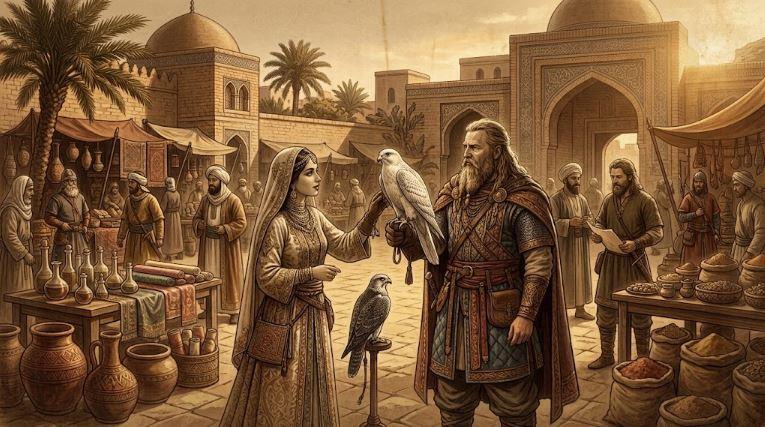
Iceland Was Settled At Almost Exactly The Right Time
The chronology becomes particularly striking when Iceland enters the story.
The National Museum of Iceland states that Norse settlement began around AD 870, with settlers arriving primarily from Norway and Norse communities in the British Isles. Its Icelandic settlement exhibition follows the island’s development from this settlement period onward.
The earliest falcons in the Baghdad records date to approximately 869–871.
That is probably too early for an established Icelandic export trade.
Ellis and Ottewill-Soulsby therefore suggest that the first Arctic falcons reaching the Islamic world may have come from mainland Scandinavia.
The situation changed rapidly.
By the 890s, when the number of falcons presented to the Abbasid court increased dramatically, Norse settlement in Iceland had been underway for roughly two decades.
Settlers had entered an environment containing a valuable Arctic predator.
The researchers propose that access to Icelandic gyrfalcons may help explain why so many extraordinary birds suddenly appeared farther south.
That argument remains a historical reconstruction rather than a documented shipping manifest from Iceland.
Its timing, ecology and trade context nevertheless fit surprisingly well.
The Falcons Probably Did Not Travel Directly To Baghdad
A map drawing one line from Iceland to Iraq would distort the system.
The gyrfalcons almost certainly moved through intermediaries.
Uppsala University’s Centre for the World in the Viking Age describes extensive Scandinavian connections with western Asia. Silver dirhams travelled north in enormous quantities, while northern commodities moved in the opposite direction.
The trade included furs, amber and other scarce northern resources.
Rus merchants formed a crucial part of these eastern routes.
Arabic geographer Ibn Khurradadhbih, writing in the ninth century, described Rus traders bringing northern products toward the Caspian and Islamic markets. Some travelled onward toward Baghdad.
A gyrfalcon could therefore pass through multiple hands.
A Scandinavian catcher might supply another trader. Rus merchants could move animals toward eastern markets. Samanid or Saffarid networks could then acquire particularly impressive birds before rulers presented them to the caliph.
The bird’s final diplomatic appearance in Baghdad tells only the last stage of a much longer economic journey.
The Samanids And Saffarids Turned Falcons Into Political Currency
Why send a live Arctic predator thousands of kilometres?
Because rarity itself carried political value.
Falconry had become a major elite activity within Abbasid court culture. Hunting allowed rulers to display wealth, skill and command over animals and landscapes.
A rare white falcon offered something more.
Few people could obtain one.
That scarcity turned northern ecology into political prestige.
The 2026 study shows that the Saffarids supplied most of the recorded gifts. The Samanids also sent impressive groups, while the Sajids contributed birds from the northern Islamic frontier.
These dynasties were not merely shipping commodities to market.
They were competing for status within Abbasid political culture.
Access to distant resources strengthened their diplomatic position.
A ruler who could place an Arctic bird before the caliph demonstrated far-reaching connections.
In this sense, the Viking-Age trade route did not end at a marketplace.
It reached the highest levels of Islamic politics.
Baghdad’s Records Reveal What Scandinavian Archaeology Cannot
The falcon trade presents an unusual source problem.
Silver survives underground.
Birds usually do not.
Scandinavian archaeology contains enormous quantities of Abbasid and Samanid dirhams. Uppsala University’s WIVA project notes that more than 100,000 Islamic silver coins are known from Scandinavian contexts, while broader counts of Islamic-world objects run much higher when coin fragments enter the calculation.
Those finds make east-west exchange visible.
A live gyrfalcon leaves a different archaeological signature.
Once the animal dies, little may survive to prove that it crossed Eurasia.
Arabic texts therefore reveal the reverse direction of exchange in a way Scandinavian finds often cannot.
The WIVA western Asia research program explicitly treats falcons among the northern commodities moving toward Islamic markets.
That changes the familiar picture.
Dirhams did not simply flow mysteriously north.
Goods, animals and people moved the other way.
White Icelandic Birds Could Be Worth More Than Silver
Later medieval evidence shows how valuable northern gyrfalcons eventually became.
In 1225, Norwegian King Hakon Hakonsson sent England’s Henry III 13 gyrfalcons, including three white and ten grey birds.
The accompanying evidence links the birds with Iceland.
Medieval descriptions could distinguish falcons by geographic reputation, with Icelandic and Greenland-associated birds becoming particularly prestigious.
The 2026 study uses this later evidence carefully.
A 13th-century royal shipment cannot prove the exact organization of a ninth-century industry.
It demonstrates that northern Atlantic gyrfalcons eventually became recognized international luxury animals.
Ellis and Ottewill-Soulsby argue that the process may have begun far earlier.
Iceland’s settlement suddenly gave Norse communities sustained access to an Arctic ecosystem from which valuable birds could enter existing Scandinavian trade networks.
The island did not need cities or coin mints to participate in long-distance commerce.
Its wildlife itself could become export wealth.
The Falcon Route Makes The Viking East Look Much Larger
Popular Viking maps still tend to emphasize Britain, Ireland, Normandy, Iceland and Greenland.
Eastern routes often stop around Novgorod, Kyiv or Constantinople.
The falcons require a larger map.
Uppsala University’s Centre for the World in the Viking Age argues that Norse connections extended through the Baltic, Rus territories, the Caspian region and into western and central Asia. Its new Vikings in Asia project, running from 2026 to 2031 under archaeologist Neil Price, specifically aims to move beyond the old split between a western and eastern Viking Age.
The gyrfalcon story illustrates why.
The people involved did not all belong to one Viking network.
Scandinavians, Rus merchants, Turkic and Finnic intermediaries, Muslim traders, regional dynasties and Abbasid officials occupied different political and cultural worlds.
Trade connected them without making them identical.
A bird originating near the Arctic could accumulate new economic and political meanings at every stage.
By Baghdad, it had become an imperial diplomatic object.
The Route Ran Both Ways
The movement of exotic animals becomes even more striking when viewed beside goods travelling north.
Gokstad produced peacock remains.
Peacocks originated far from Scandinavia and required long-distance movement through European or eastern networks before reaching Norway.
Luxury textiles and Islamic silver travelled north as well.
Meanwhile, northern commodities moved south and east.
The resulting network looks less like a road and more like a chain of overlapping exchanges.
Old Norse News has examined the same problem through the Goddard Coin and long-distance exchange debate, where the movement of a portable object demonstrates why an artifact’s final location does not automatically reveal who personally carried it there.
The falcons require the same caution.
An Icelandic origin would not mean an Icelandic traveler reached Baghdad.
Trade networks work precisely because goods can travel farther than individual merchants.
The Falcons Also Complicate The Meaning Of “Viking Trade”
Calling this simply a Viking trade route risks hiding most of the people who made it work.
The Scandinavian contribution mattered.
So did Rus transport networks.
Samanid and Saffarid political economies mattered.
Muslim merchants, intermediaries and court officials transformed the birds from northern animals into diplomatic treasures.
That complexity matches Uppsala University’s broader approach to the world in the Viking Age, which emphasizes interaction rather than imagining a self-contained “Viking world.”
The gyrfalcons did not travel through Scandinavian power alone.
They passed through an interconnected Eurasian economy.
This distinction makes the story more historically valuable.
It replaces the image of Vikings exporting directly to distant civilizations with a network of communities whose commercial systems overlapped.
Why Icelandic Gyrfalcons In Baghdad Change The Viking Trade Map
The 2026 research does not prove that every white falcon recorded in Baghdad came from Iceland.
It does not show one uninterrupted Iceland-to-Iraq caravan.
The chronology itself rules out such a simple interpretation.
The first recorded birds arrived around the same time that settlement of Iceland began, making mainland Scandinavian sources more plausible for the earliest shipments. The much larger wave of the 890s, however, came after Norse settlers had established themselves on an island where gyrfalcons—particularly pale birds—could become an unusually valuable export.
Arabic records then preserve the other end of the network.
Between 869 and 911, at least 172 falcons entered Abbasid diplomatic records. Saffarid and Samanid rulers repeatedly sent the birds to Baghdad, where their rarity added political value.
That journey connects ecology, trade and empire.
A predator adapted to Arctic landscapes could be trapped by northern specialists, moved through Scandinavian and Rus exchange systems, acquired by powerful Central Asian or Iranian dynasties and finally displayed at one of the world’s great medieval courts.
Most Viking maps show ships, raids, settlements and silver.
Few show birds.
The gyrfalcons reveal why they should.
Their route demonstrates that the Viking Age connected environments as well as markets. Norse settlement in the North Atlantic could influence the supply of prestige animals in the Islamic world, while demand from distant courts could make an Icelandic bird economically valuable before Iceland had existed as a Norse society for more than a generation.
That is the larger significance of Ellis and Ottewill-Soulsby’s study.
Baghdad and Iceland were not neighbouring worlds.
They did not need to be.
The Viking-Age economy was capable of connecting them one transaction—and perhaps one falcon—at a time.
