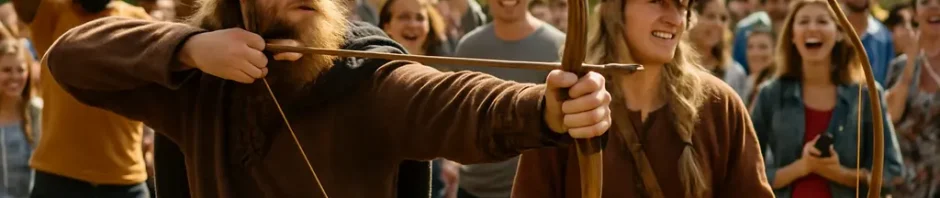
Norse Heritage Festivals in 2026 showed that Viking memory is not kept alive by spectacle alone. Fire processions, craft workshops, music stages, replica ships, and reenactment camps all carried cultural meaning, but their value depended on how carefully they connected performance with evidence. Recent events in Shetland, Northern Ireland, York, Norway, and North Dakota suggest a shared pattern: public interest in Norse heritage remains strong, while festival organisers face rising costs, changing audiences, and the constant risk of turning the Viking past into simple imagery.
The strongest festivals did not present the past as a finished script. They used public gathering to ask how communities remember migration, seafaring, myth, craft, ancestry, and local identity. That makes festivals useful cultural evidence in their own right. They do not prove what Viking Age people did at any given site, but they show how modern communities choose to stage, protect, and debate inherited symbols.
Norse Heritage Festivals After The 2026 Season
Norse Heritage Festivals As Ritual Performance
The clearest ritual example was Up Helly Aa in Lerwick, Shetland. Held on 27 January 2026, the fire festival marked Shetland’s Norse heritage through a torchlit procession. The BBC reported that more than 40 squads marched and that hundreds of guizers took part before a replica Viking longship was burned in the Lerwick procession. The burning ship is a modern ceremonial act, not a direct survival from the Viking Age. Yet it works because it compresses several familiar Norse themes into one public image: ships, fire, group identity, winter darkness, and local memory.
That distinction matters. The longship in the festival is a replica built for the event, not an archaeological find. The squads are modern performers, not Viking households. Still, the event carries historical weight because Shetland’s Norse past is part of local identity. A cautious reading sees Up Helly Aa as public ritual shaped by modern needs, with Norse symbolism used to mark belonging and continuity.
Craft And Reenactment As Public Teaching
The Magnus Viking Association Festival near Downpatrick offered a different model. The late June 2026 event, held at Ballydugan Medieval Settlement, was described as the association’s fourth festival. Reporting noted workshops in jewellery making, blacksmithing, axe throwing, and reenacted medieval battles. The group was founded in 2003 and had grown to 50 adult members by the time of the 2026 festival near Downpatrick.
This kind of festival depends less on a single dramatic image and more on repeated demonstrations. A blacksmithing display can open questions about ironwork, tools, and labour. Jewellery making can show how status, trade, and decoration were linked. Battle reenactment can teach movement, equipment, and group discipline, provided it does not reduce Norse history to combat alone. The educational strength lies in making process visible.
Reenactment remains interpretive, not identical with the past. The materials, safety rules, audience expectations, and teaching goals are modern. Even so, replica work and workshop teaching can help visitors understand that Viking Age society was built as much by makers and traders as by raiders and rulers.
Scale, Audience, And Community Identity
Large Crowds And Local Meaning
Several 2026 festivals showed that Norse material still attracts large public audiences. JORVIK Viking Festival in York ran from 16 to 22 February 2026. The research record for the event states that about 45,000 people attended the city-wide programme, that around 450 Viking re-enactors joined the parade, and that most events had sold out before the festival opened. Those figures suggest that Viking heritage remains commercially strong in some cities, especially where archaeology, museums, tourism, and urban identity already reinforce one another.
Midgardsblot at Borre in Vestfold, held from 12 to 15 August 2026, showed another form of scale. Research notes recorded roughly 14,000 attendees, about half from outside Norway, with visitors reported from about 45 countries. The festival combined folk and extreme metal music with living history and regional crafts. It also had a recorded local business impact of NOK 4,579,643 in 2026. These figures do not make the event more historically accurate by themselves, but they show how Norse imagery can draw international communities into a regional heritage setting.
For cultural historians, this is where caution is needed. Audience size can measure interest, not accuracy. A sold-out programme or international crowd does not prove a sound interpretation of myth or archaeology. It does show, however, that Viking-related festivals have become places where modern identity, tourism, music, and heritage education meet.
Participation Rather Than Passive Viewing
The recent pattern also shows that festivals are not only watched. They are made by re-enactors, artisans, volunteers, musicians, school groups, local associations, and visitors who return year after year. Norse Heritage Festivals often work as communities of practice. People learn a craft, sew clothing, train with weapons in controlled settings, cook historical foods, organise parades, or teach children a simplified but memorable version of the past.
This participatory character has cultural value because it creates intergenerational transmission. Children may first meet Norse heritage through a shield drill, a story session, or a craft stall. Adults may encounter more careful questions later: which saga traditions are medieval texts rather than Viking Age eyewitness accounts; which objects come from excavations; which symbols have been reinterpreted in modern politics; and which festival practices are recent inventions?
That movement from attraction to inquiry is where public heritage can do its best work. A festival does not need to be an academic seminar. It does need to make room for evidence, uncertainty, and correction.
Myth, Music, And The Problem Of Authenticity
Mythic Symbols In Modern Performance
Norse mythology gives festivals strong material: gods, giants, ships, halls, fire, fate, runes, and heroic naming. These elements are memorable, but they can easily drift away from source-based interpretation. The poems and sagas that preserve much of what we call Norse myth were written down in medieval Christian societies, often after the Viking Age. Archaeological finds give another kind of evidence, usually material rather than narrative. Festivals sit between those forms of knowledge.
Midgardsblot’s combination of music, craft, and living history shows the power and difficulty of that position. Folk and metal performance can create an atmosphere of intensity around Norse themes. That does not make the music ancient. It makes it a modern artistic response to inherited material. The same is true of fire festivals, parades, and battle displays: they can honour the past without reproducing it exactly.
Readers interested in how modern events frame myth with care may compare this pattern with Norse heritage festivals and modern myth, where similar tensions between ritual, craft, and public memory are treated cautiously.
Authenticity As A Range, Not A Badge
Authenticity is often spoken of as if it were a single quality. In practice, festival authenticity works in layers. A replica brooch may be based on a known find. A blacksmithing method may be historically informed but adapted for safety. A longship burning may be modern ritual using Norse imagery. A song may use Old Norse themes but modern instruments, amplification, and genre conventions.
Good interpretation tells visitors which layer they are seeing. Norse Heritage Festivals are strongest when they say plainly: this object is based on archaeology; this scene is a teaching reconstruction; this procession is a modern local tradition; this mythic element comes from later textual evidence. Such clarity does not weaken the experience. It gives visitors better tools for thinking.
For related heritage and culture coverage across the same network, visiting Agheiro provides another reference point for audiences exploring how public traditions are shared with wider communities.
Costs, Closures, And Adapted Formats
When Heritage Events Become Hard To Sustain
The closure of Norsk Høstfest after its final edition in September 2025 shows that affection for Nordic heritage does not guarantee institutional survival. Research notes state that the board cited rising operational costs and attendance that had not recovered to pre-pandemic levels. The end of a long-running festival should not be read only as cultural decline. It also reflects insurance, facilities, artist costs, staffing, volunteer capacity, and competition for audience time.
Fjord Folk Fest in Minot was scheduled for 21 to 22 August 2026 as a smaller successor, with a two-day format rather than the former four-day model. Research notes describe its planned continuation of food, music, crafts, and vendors. Since the date had passed by 10 October 2026, the cautious phrasing is that it was scheduled as a scaled-down attempt to continue local Nordic heritage activity. Without a post-event source in the supplied research, stronger claims about its attendance or reception would go beyond the evidence.
Adaptation Without Losing The Core
Shorter festivals may lose some scale, but they can gain focus. A smaller programme can concentrate on the activities that local communities value most: foodways, music, craft, family memory, and vendor networks. The risk is that shrinking budgets remove the educational parts first, leaving only entertainment. The better model protects interpretation even when the format changes.
This is where local associations matter. Groups like the Magnus Viking Association show how volunteers and trained participants can sustain teaching through workshops and demonstrations. Large events can attract international crowds, but smaller associations often preserve the repeated skills that make public history credible.
Norse Heritage Festivals As Public Memory
Norse Heritage Festivals now carry several responsibilities at once. They entertain, teach, gather communities, support local economies, and give people a language for ancestry and belonging. The 2026 examples show different methods: Up Helly Aa used fire and procession; the Downpatrick festival used craft and reenactment; JORVIK used city-wide scale; Midgardsblot used music and international gathering; Minot’s transition showed how heritage formats can contract under economic pressure.
The common thread is not a single version of the Viking past. It is the public use of Norse material to make memory visible. That use should be handled with care. Festivals should distinguish archaeology from myth, replica from original, modern ritual from historical evidence, and identity from ancestry claims. They should also welcome the joy of gathering, because heritage that cannot be shared rarely survives outside books and museums.
At their best, these events do not ask visitors to believe that the Viking Age has returned. They ask people to look more closely at why ships, runes, fire, craft, gods, and stories still matter. That question is worth asking, provided the answer remains honest about both evidence and invention.
