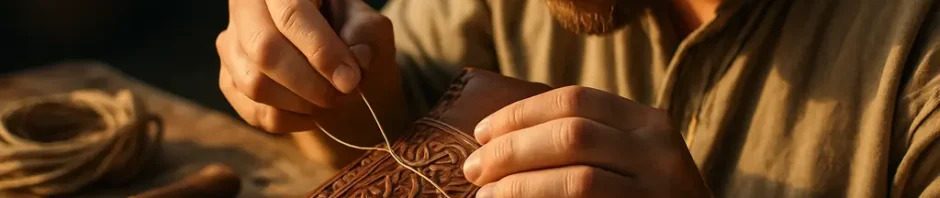
The 24th Annual Vista Viking Festival took place on September 19–20, 2026, at the Antique Gas & Steam Engine Museum in Vista, California, and Viking Craftsmanship was one of its clearest cultural themes. The festival program described an Interactive Viking Village with more than 30 local craftsmen and merchants demonstrating blacksmithing, metalworking, fabric arts, and wood carving. Read carefully, those demonstrations were not proof of direct continuity from the Viking Age to California. They were public-history presentations that helped modern visitors think about skill, labor, and material culture through visible practice.
Why Viking Craftsmanship Needs Evidence
Festival Demonstration And Historical Distance
The Vista event framed craft through activity: a working village, cultural displays, youth arts, physical contests, and food and drink production. That approach can be useful because many Viking Age skills were bodily skills. A blacksmith did not only know metal in theory. A spinner did not only know fiber as an abstract material. A woodcarver did not only produce ornament. These crafts required trained hands, tools, time, and judgment.
Still, a festival demonstration is not the same thing as archaeological evidence. A modern smith at a public event may use modern safety procedures, modern fuel access, and tools chosen for demonstration. A textile display may compress days or weeks of labor into a short teaching moment. That does not make the display false; it means the display should be read as interpretation. The safest question is not, did this exactly reproduce one Viking Age workshop? The better question is, what kinds of evidence does the demonstration help visitors understand?
Viking Craftsmanship As Public Evidence
The festival’s Heritage Hall Cultural Displays included Norwegian craft traditions such as weaving, spinning, knitting, rosemaling, and folk woodcarving. Some of those traditions belong to later Scandinavian culture as much as to the Viking Age, so they should not be folded into a single undated past. Yet they do show how inherited craft practices can carry memory, identity, and discipline across generations. In that sense, Viking Craftsmanship at a heritage festival becomes a bridge between historical inquiry and modern cultural expression, rather than a simple reenactment claim.
That distinction matters for Norse cultural writing. Public events often turn craft into decoration: carved wood, forged iron, painted motifs, woven bands. Evidence asks us to look longer. Who gathered the raw material? Who processed it? Who had the time to learn? Which objects were made for daily use, and which displayed status? Craft opens social questions that weapons and sagas alone cannot answer.
Textiles, Iron, Wood, And Public Skill
Textile Work Behind The Festival Displays
Textile work is one of the strongest places to connect festival display with archaeological research. The Vista program listed fabric arts in the Interactive Viking Village and weaving, spinning, and knitting in Heritage Hall. Archaeology gives those activities weight. In Denmark, archaeologists reported a Viking Age textile-production site of about 100,000 square meters, with an area for processing flax and more than 80 pit houses connected with weaving and fiber work, according to AP reporting on the Danish site. That scale suggests that textile labor could be organized and substantial, not merely domestic background activity.
Research associated with Smithsonian-affiliated textile archaeologist Michele Hayeur Smith also points to fine distinctions in cloth evidence. The research notes describe Icelandic textile finds, up through the 15th century, in which thread counts and spinning directions from burial contexts closely resemble Scandinavian-origin fabrics, while everyday clothing pieces show influences from Britain and continental Europe. Her listed work can be traced through Michele Hayeur Smith’s research talks. The cautious lesson is that textiles moved through trade, migration, imitation, and local adaptation. A woven object can carry more than warmth; it can carry contact.
Seen this way, Viking Craftsmanship is not a romantic label. It is a way to ask how materials were selected, processed, valued, and worn. The festival’s fabric displays made that question visible, while archaeological textile studies show why such questions deserve care.
Blacksmithing And Woodwork As Demonstrated Knowledge
The Vista program also described live blacksmithing demonstrations throughout the festival grounds, alongside metalworking and wood carving in the Interactive Viking Village. The supported point is simple: the event used visible craft to explain skills once essential to Viking Age society. We should be careful with details not supplied in the record. The research notes do not identify specific tools used by Vista smiths, the exact forge setup, or the period accuracy of every object. It is safer to say that the demonstrations illustrated forging as a process rather than documented one exact Viking Age workshop.
Wood carving deserves similar care. Carved wood is strongly associated with Scandinavian material culture, but wood rarely survives as well as stone, metal, or fired clay. Public demonstrations can help visitors understand tool control, grain, planning, and repetition. They should not be treated as evidence for every pattern displayed. Festival craft is most useful when it says: here is how difficult this skill is, here is what the material resists, and here is why archaeological objects required trained makers.
How Vista Connected Craft, Youth, And Strength
Learning Through Safe Participation
The Youth Pavilion at the 2026 festival ran from 10:00 AM to 6:00 PM on both days for participants under 18. Its activities included decorating swords, axes, and shields, along with axe throwing and archery. These activities should be understood as modern festival programming, not as evidence of Viking Age childhood training. Yet the structure is culturally revealing. It shows how heritage events often teach the past through making, movement, and supervised play.
For children, a decorated shield or wooden weapon can become an entry point into bigger questions: What materials were available? How heavy was a real shield? Who made weapons? Who repaired them? What did decoration communicate? A cautious educator can use fantasy-friendly activities without presenting fantasy as fact.
Contests And The Body As Craft
The festival also listed contests based on physical skill, including a Men’s and Women’s Professional Stone-Lifting World Championship Qualifier, fish fling, beard competition, battle cry, caber toss, log toss, spear throwing, and archery. These contests mixed athletic display, humor, spectacle, and heritage performance. They should not be treated as a direct map of Viking Age sport. The research does support that the festival used physical tests to frame strength and skill as part of Norse-themed public culture.
This is where interpretation must hold two ideas together. First, physical skill did matter in societies dependent on farming, sailing, building, fighting, hauling, and craft labor. Second, a modern festival contest is shaped by entertainment, safety, rules, and audience expectations. It can prompt good historical questions, but it is not evidence by itself.
- Craft displays helped visitors see labor as process, not only finished object.
- Textile research shows that cloth can preserve evidence of contact, rank, and production systems.
- Youth activities worked best when treated as learning prompts rather than literal reconstruction.
- Physical contests framed strength as skill, though not as direct Viking Age proof.
Modern Fermentation And Heritage Framing

Mead, Beer, And Cultural Memory
The 2026 festival offered more than 30 local meads and beers from more than 10 meaderies and breweries. The research notes frame this as modern craftsmanship in fermentation with a cultural reference to Viking and Norse traditions of mead brewing. That framing is reasonable if kept narrow. Mead has strong associations with Norse literary culture, but a modern drink list in California cannot be read as a reconstruction of Viking Age drinking practice.
Fermentation still belongs in the discussion because it is skilled making. Brewing and mead-making require ingredients, timing, vessels, sanitation choices, and taste judgment. As with blacksmithing and weaving, the value lies in process. Heritage events often make the past most approachable when visitors can smell woodsmoke, watch fiber twist, hear hammering, or taste a modern beverage made with older associations. The danger comes only when atmosphere replaces evidence.
Public Heritage And Responsible Comparison
For readers reflecting on cultural labor, the same network includes Alliance Recruitment, which highlights the importance of heritage interpretation and source-based history. The Vista festival depended on many types of labor: craft demonstrators, merchants, cultural presenters, youth activity organizers, contest staff, and vendors. That human infrastructure often disappears from public memory, yet it shapes what visitors learn.
A related Old Norse News discussion of Vista Viking Festival and Norse heritage gives broader context for the same September 19–20, 2026 event. The craft angle narrows the question: how does a public festival turn skill into historical understanding without claiming more certainty than the evidence allows?
Viking Craftsmanship At Vista Viking Festival
Viking Craftsmanship at Vista Viking Festival worked best as an invitation to think about work. The event’s strongest craft themes—blacksmithing, metalworking, fabric arts, wood carving, weaving, spinning, and fermentation—directed attention toward processes that shaped daily life and social identity. The festival also showed how modern communities use Norse heritage to teach, entertain, and gather, especially through youth activities and contests.
The archaeological evidence gives the public display its sharper edge. The Danish textile-production site points to large-scale fiber work in the Viking Age. Textile studies from Iceland and the North Atlantic show that cloth can record origin, contact, and changing influence. Those findings do not validate every modern festival object, but they do remind us that craft was never minor. It was economic, social, technical, and symbolic.
The most responsible reading is neither dismissive nor uncritical. Vista’s demonstrations were modern cultural presentations held in California on September 19–20, 2026. They were not a time machine. Yet they helped make old questions tangible: how people forged, carved, spun, wove, decorated, competed, brewed, and taught skill. For Norse culture, that is a useful starting point. The old stories of gods and heroes often seize the imagination, but the quieter work of hands made the world those stories inhabited.
