
Denmark’s runestones preserve something Viking archaeology rarely provides: names.
Kings, queens, relatives, warriors, landholders and stone carvers appear in inscriptions created by people who lived during the period itself. Yet most stones have traditionally been studied as individual monuments.
A new Danish research project wants to change that.
On October 8, 2026, the National Museum of Denmark announced a multidisciplinary project that will 3D-scan many of the country’s roughly 260 known runestones and combine the results with archaeology, geophysics and landscape analysis.
The Augustinus Foundation has awarded DKK 4.2 million to the project, which will run from 2027 through 2031. Senior researcher and runologist Lisbeth Imer of the National Museum will lead the work in collaboration with the University of Copenhagen, Aarhus University, Sweden’s National Heritage Board and local museums.
Its ambition goes beyond reading inscriptions.
Researchers want to identify individual stone carvers, connect named people across monuments and reconstruct the social and political networks behind Viking Denmark.
That could transform runestones from isolated memorials into something closer to a database of Viking relationships.
Denmark Has Around 260 Runestones To Reconnect
The National Museum’s announcement of the new runestone project describes the stones as some of Denmark’s most important Viking-Age historical evidence.
Approximately 260 Danish runestones are known, although not all survive intact today.
They were erected broadly between AD 600 and 1100, a period that spans the later Iron Age, the Viking Age and the consolidation of medieval Danish kingship.
That chronology makes them unusually valuable.
Denmark changed dramatically during those centuries. Smaller political units gave way to a more centralized kingdom. Christianity expanded. Royal authority became more visible, and economic networks increasingly linked local communities with towns and overseas trade.
Runestones were part of those changes.
Some commemorate dead relatives.
Others mention property, status, rulers or religious belief.
The new project will ask how those inscriptions connected with one another rather than treating each stone as an isolated voice.
3D Scanning Can Identify The Hands Behind The Runes
One of the project’s most powerful methods has already been tested.
Researchers can create highly detailed 3D scans of carved surfaces and analyze the microscopic traces left by hammer and chisel.
Experienced stone carvers develop distinctive working habits.
The angle at which a chisel strikes the stone, the spacing between blows and the physical rhythm of carving can leave patterns comparable, cautiously, to handwriting.
That allows specialists to ask whether the same person carved several monuments.
The technique produced a major result in 2023.
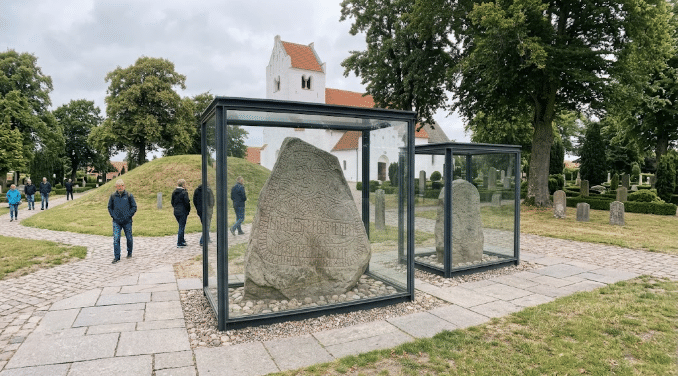
Research led by Imer and Laila Kitzler Åhfeldt of the Swedish National Heritage Board linked the famous large Jelling Stone with the runemaster Ravnunge-Tue.
The National Museum’s 2023 Jelling research showed that comparable carving traces appear on the Læborg Stone and other monuments.
That identification did more than name a craftsman.
It connected royal Jelling with a much larger regional network.
Ravnunge-Tue Shows What A Network Approach Can Reveal
Ravnunge-Tue is known because another inscription names him directly.
The Læborg Stone states that he carved its runes in memory of Thyra, his queen.
When researchers recognized his carving technique on the large Jelling Stone, the connection strengthened the archaeological case for Queen Thyra’s wider political importance.
Thyra was the wife of Gorm the Old and mother of Harald Bluetooth.
The Jelling monuments have traditionally placed those two men at the centre of Denmark’s royal transformation.
The runestone analysis complicates that picture.
Four stones associated with Thyra occur in southern and central Jutland, suggesting that her political network may have extended well beyond one royal monument.
The new 2027–2031 project aims to repeat this type of analysis on a much larger scale.
If individual carvers worked for several patrons across different districts, their movements could provide evidence for political connections that no surviving chronicle records.
A Runemaster Could Become A Map Of Political Relationships
This is where the project becomes particularly interesting.
Imagine that one carver worked on stones commissioned by three families in different parts of Jutland.
That pattern might indicate shared patronage, kinship, political alliance or access to the same specialist workshop.
Researchers would still need other evidence before choosing among those explanations.
Yet the repeated hand of one craftsperson would provide a physical connection.
The same principle can apply to names.
If inscriptions repeatedly mention the same families, rulers or places, researchers can begin constructing relationship networks.
Landscape archaeology can then add another layer.
Where did the stones originally stand?
Were they beside roads, bridges, burial grounds, assembly places or elite residences?
The new project aims to reconnect inscription, carver and location.
That combination could make the runestones far more useful for reconstructing political geography.
The Stones May Have Worked Like Public Documents
Runestones were monuments, but they were also texts displayed in public space.
The new research will examine them partly as legal, religious and political documents.
That wording matters.
A stone commemorating a dead relative can also identify inheritance relationships.
A monument naming a bridge or property may establish who funded or controlled it.
Christian formulas can show religious change.
Royal inscriptions can make political claims.
Harald Bluetooth’s large Jelling Stone provides the best-known example.
Its inscription says Harald won Denmark and Norway and made the Danes Christian.
Whether every element should be read as a literal administrative statement is another question.
What matters is that Harald wanted a public claim carved permanently into stone.
Other runestones may contain smaller-scale versions of the same phenomenon.
Jelling May Become One Node Instead Of The Whole Story
Jelling understandably dominates Viking Denmark.
Its royal monuments name Gorm, Thyra and Harald Bluetooth, while archaeology reveals burial mounds, a huge enclosure, a ship setting and other evidence of extraordinary investment.
Yet Danish political organization existed beyond Jelling.
Old Norse News has already examined that problem through the Erritsø royal hall and the kings before Jelling, where a fortified elite centre demonstrates that powerful rulers operated in Denmark centuries before Harald Bluetooth’s monumental program.
The new runestone project approaches the same question from another direction.
Instead of starting with halls and fortifications, it starts with named people.
The results could show whether royal authority around Jelling depended on older regional networks, marriage alliances, local elites or mobile specialists.
Jelling would remain central.
It might simply become one exceptionally visible node within a larger political system.
Geophysics Could Recover Lost Context Around The Stones
Many runestones no longer stand exactly where Viking communities first placed them.
Some were moved into churches, museums or other protected locations.
Others were reused in later buildings.
That creates a serious archaeological problem because placement was part of the monument’s meaning.
The new project plans to use geophysical investigation and other archaeological methods around selected runestone landscapes.
Researchers may be able to identify nearby graves, structures, roads or activity areas without excavating every location extensively.
A stone near an elite farm tells a different story from one marking a bridge.
A monument beside an assembly route may have reached a wider audience than one inside a cemetery.
Recovering this spatial context could explain why specific people chose particular locations for their inscriptions.
Sweden Shows How Large The Scandinavian Runestone Network Was
Denmark’s approximately 260 stones represent only one part of a much larger Nordic tradition.
The National Museum notes roughly 2,500 runestones in Sweden, around 50 in Norway and approximately 50 in the British Isles.
The numbers immediately show why Denmark cannot be studied in isolation.
People, carving traditions and political ideas moved across Scandinavian regions.
Sweden’s participation in the new project is therefore important.
Kitzler Åhfeldt’s expertise in carving-trace analysis already helped produce the Ravnunge-Tue identification.
Comparing Danish carving methods with Swedish evidence could reveal whether specialists or technical traditions crossed political boundaries.
That possibility becomes especially relevant during a period when Denmark, Sweden and Norway were still developing as kingdoms rather than functioning as fixed modern states.
The Project Could Put Lesser-Known Vikings Back Into History
Runestone research often begins with kings because royal names attract attention.
The new network approach could shift focus toward less famous people.
A widow commissioning a memorial may reveal inheritance practice.
A runemaster can reveal craft mobility.
A son, brother or landholder named only once may become historically significant if another inscription connects him to a larger family network.
This is one reason Imer describes the project as an effort to bring historical individuals forward from the stones.
Most Viking-Age Scandinavians never appear in surviving manuscripts.
Runestones offer a rare exception.
They preserve names selected by contemporary communities rather than medieval writers looking backward centuries later.
The project could therefore produce a more socially detailed Viking history without pretending the inscriptions represent the entire population.
The Method Still Has Limits
3D scanning will not automatically solve every runestone mystery.
Weathering can erase carving traces.
Some stones have been moved.
Names can repeat without referring to the same individual.
A runemaster working for two patrons proves contact but does not reveal the precise political relationship between them.
Researchers will need to combine technical results with language, archaeology, dating and geography.
That caution is important for oldnorsenews.org readers.
The project may identify networks.
It should not turn every shared carving style into evidence for one king controlling an entire region.
Its strength comes from accumulating multiple connections.
Why Denmark’s Runestone Project Could Rebuild Viking Power Person By Person
The new project starts with a simple problem.
Denmark has hundreds of runestones, but historians often encounter them individually.
From 2027 to 2031, Lisbeth Imer and her collaborators will try to connect them.
Their toolkit will include 3D scanning, carving-trace analysis, geophysics, archaeology and historical interpretation.
The precedent already exists.
In 2023, similar methods linked Ravnunge-Tue to the Jelling Stone and strengthened the case that Queen Thyra belonged to a wider political network than older histories often allowed.
Scaling that method across Denmark could produce a different kind of Viking map.
Instead of lines showing raids and voyages, it could contain people.
Runemasters could connect workshops.
Families could connect districts.
Stones could link roads, estates and burial landscapes.
Royal names could be placed beside local patrons who rarely appear in narrative history.
The result may not reveal one hidden hierarchy governing Viking Denmark.
It could do something more useful: reconstruct the overlapping relationships from which Danish royal power emerged.
One inscription at a time, the country’s runestones may finally begin talking to one another.
