
For generations, Jelling has dominated the story of Denmark’s earliest monarchy. The great burial mounds, the rune stones of Gorm the Old and Harald Bluetooth, and the monumental palisade built in the 10th century give Danish kingship a memorable archaeological centre. Erritsø now forces that story to start earlier.
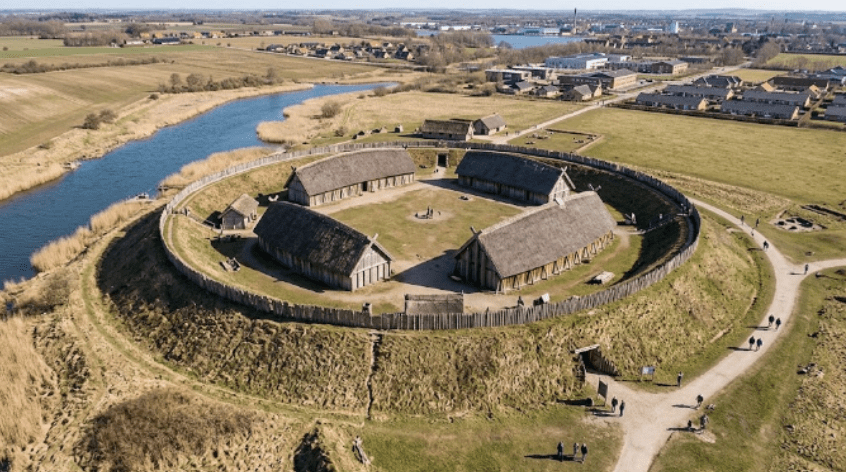
On a hill above the Little Belt near Fredericia, archaeologists from Vejlemuseerne have uncovered a fortified elite complex that came into use around AD 700 and continued through much of the Viking Age. Its largest halls stretched more than 50 metres long and around 10 metres wide. A substantial ditch and palisade enclosed part of the complex, creating a defended high-status residence unlike any ordinary farm known from contemporary Denmark.
The archaeological chronology places Erritsø roughly two centuries before Harald Bluetooth’s great building program at Jelling.
That does not make Erritsø the proven residence of one specific named king. Archaeologists cannot assign the hall securely to Angantyr, Sigfred, Godfred, Harald Klak, or Horik. Yet the dating overlaps with rulers mentioned in Frankish and ecclesiastical texts long before Gorm appears on a Danish rune stone.
Erritsø matters because it gives those earlier kings something Jelling cannot: an archaeological landscape that fits their century.
Erritsø Was Already A Power Centre Around AD 700
Archaeologists first encountered the large hall complex during rescue excavations in 2006 and 2007 before construction work for Energinet. Later investigations expanded the picture.
The most striking early feature consisted of a major hall surrounded by a square defensive system measuring about 110 by 110 metres. A palisade reinforced the enclosure, while a ditch created another barrier around the residence.
Peer-reviewed research by Anne Pedersen, Mads Ravn, Christian Juel, and Charlotta Lindblom describes the site as an aristocratic Early Viking-Age manor with a strategically important position overlooking traffic between Jutland and Funen. Their Erritsø archaeological study places major activity in the eighth and ninth centuries.
The scale separates Erritsø from an ordinary agricultural settlement.
Large halls required substantial timber, organized labor, food supplies, skilled builders, and repeated maintenance. People rebuilt major buildings at the site over time rather than abandoning the location after a single generation.
Current Vejlemuseerne research pushes the chronology back toward AD 700.
A preserved timber from one well produced a dendrochronological date in the 770s, while other finds and radiocarbon samples support settlement activity earlier in the eighth century. The newest public interpretation presents Erritsø as a royal or extremely high-status centre that survived through the era of several historically recorded Danish rulers.
That chronology changes the starting question.
Instead of asking whether kings existed before Jelling, archaeologists can ask where their major residences stood and how those centres controlled territory.
Jelling Belongs To A Later Phase Of Danish Kingship
Jelling remains one of Europe’s most important Viking sites.
Gorm the Old probably died around AD 958. His son Harald Bluetooth ruled during the second half of the 10th century and created a monumental complex that included large mounds, rune stones, longhouses, a huge ship setting, and a palisaded enclosure.
The National Museum of Denmark has dated preserved oak from Jelling’s palisade to around AD 968. Its Jelling palisade research connects that construction directly with Harald Bluetooth’s reign.
Erritsø predates that monument by roughly two centuries.
Fredericia Municipality describes the Erritsø complex as at least 100 to 200 years older than the royal centre at Jelling. Its Erritsø excavation overview stresses that the site demonstrates the existence of powerful Danish rulers before Gorm and Harald.
That distinction does not diminish Jelling.
It changes what Jelling represents.
Rather than marking the birth of Danish kingship itself, Jelling may represent one highly visible stage in a political system that already possessed large halls, defended residences, elite gathering places, and strategic territorial centres centuries earlier.
The National Museum itself notes that Gorm became famous as Denmark’s first king largely because contemporary Danish written evidence names him. Its history of Gorm and Harald explicitly acknowledges earlier Danish kings.
Erritsø supplies archaeological substance to that earlier history.
The Hall Stood Where Kings Could Watch The Little Belt
Erritsø’s geography strengthens the political interpretation.
The complex stood on high ground near one of the narrowest parts of the Little Belt, the strait separating Jutland from Funen. Ships approaching through the waterway would have moved within sight of the hill.
Christian Juel, chief archaeologist at Vejlemuseerne, has emphasized the visual dominance of the halls. The largest buildings exceeded 50 metres in length, creating structures large enough for people traveling through the Little Belt to notice from the water.
The new KONGESPOR project describes the site as a place from which rulers could oversee movement by land and sea. The KONGESPOR exhibition opened at Fredericia Library on September 11, 2026, bringing the latest interpretation of Erritsø’s political landscape back into public focus.
Control of a narrow maritime crossing carried obvious advantages.
People, ships, livestock, goods, messengers, and military forces had to pass through restricted routes. A powerful household positioned beside such a crossing could monitor movement, receive visitors, organize transport, and display authority.
The location may explain why elite occupation persisted there.
Later Danish and European history repeatedly gave Fredericia and the Little Belt military importance. Viking-Age rulers operated in a different political system, yet the geographic logic remained similar.
Erritsø did not need to sit at the centre of a modern kingdom to matter.
It only needed to control an important connection between regions.
The Fortifications Make Erritsø Hard To Explain As An Ordinary Great Farm
Large halls appear at several Scandinavian elite sites.
Lejre on Zealand and Tissø in western Zealand both preserve impressive aristocratic complexes associated with high-status gatherings, feasting, ritual, and political authority.
Erritsø shares part of that architectural vocabulary.
The defensive enclosure makes it unusual.
Researchers found a substantial ditch and palisade surrounding the main hall area. The fortification created a controlled space around the residence and separated the elite compound from its surroundings.
Vejlemuseerne describes the fortified character of the site as one of the most important clues to its political status. Its current Erritsø research project examines the complex specifically in relation to early Viking-Age kingship and landscape.
A large hall could belong to a wealthy aristocrat.
A large hall inside a strategically positioned fortified compound raises a different level of question.
Who had enough authority to command the labor necessary to build and maintain it? Who needed a residence protected by both ditch and palisade? What kinds of gatherings took place inside buildings more than 50 metres long?
The archaeological evidence cannot answer each question yet.
It can show that the people at Erritsø occupied a social level far above an ordinary farming household.
Comparable settlement research appears in Old Norse News coverage of Toarp’s Viking great farm and royal landscape, where substantial buildings near the royal estate at Oxie show how elite farms can reveal political structures beyond famous monuments.
Erritsø pushes that problem deeper into the eighth century.
Written Sources Already Mention Danish Kings Before Gorm
Archaeology did not invent Denmark’s pre-Jelling kings.
Foreign writers had already preserved their names.
Around the beginning of the eighth century, the missionary Willibrord traveled into Danish territory. His biography refers to a Danish ruler called Ongendus, often rendered in Danish as Angantyr.
Later Frankish sources describe kings including Sigfred in the late eighth century.
The early ninth century brings much richer evidence.
King Godfred appears prominently in Frankish annals during conflicts involving the Carolingian Empire. After his death in 810, several rulers competed for power. Harald Klak later entered Frankish politics and accepted baptism at Mainz in 826 with members of his entourage.
The ninth century also produced kings named Horik I and Horik II.
These rulers negotiated, fought wars, received missionaries, challenged rivals, and interacted with one of Europe’s strongest imperial powers.
They clearly possessed political authority.
The problem has always involved archaeology.
Where were their centres? What did their royal residences look like? How did they organize territory before the Jelling dynasty?
Erritsø sits directly inside the chronological gap between the written kings and the archaeological monuments traditionally associated with Danish monarchy.
That overlap creates the site’s historical significance.
Erritsø Cannot Yet Be Assigned To King Godfred
The temptation to connect a monumental hall with a famous king needs restraint.
Erritsø’s occupation spans several generations.
A hall in use around AD 700 could predate Godfred by roughly a century. Later rebuilding may overlap with his reign, Harald Klak’s political struggles, and the rule of the Horiks.
Archaeologists have no inscription saying that any of these men occupied Erritsø.
No rune stone identifies an owner.
No contemporary Danish document names the estate.
Christian Juel and his colleagues therefore treat the historical kings as chronological possibilities rather than proven residents.
That caution strengthens the interpretation.
Erritsø does not need to become “Godfred’s palace” to change Danish history.
Its existence already demonstrates that people capable of constructing monumental and defended elite residences operated in Jutland during the centuries when foreign texts describe Danish kings.
The hall provides evidence for the political infrastructure that such rulers required.
A king did not rule from a name in an annal.
Kingship required halls, followers, food supplies, ships, land, weapons, craftsmen, meeting places, and control over movement.
Erritsø gives archaeologists a physical place to investigate those systems.
Rebuilding The Hall Suggests Long-Term Political Importance
One of the strongest arguments for Erritsø’s importance comes from continuity.
The site did not contain one impressive building followed by abandonment.
Archaeologists identified multiple phases of major hall construction.
KONGESPOR describes halls rebuilt repeatedly from around AD 700 into the 900s. Each rebuilding required another investment in construction materials and labor.
That repeated commitment matters.
Elite centres can shift when ruling families fall, trade routes change, or political systems reorganize. Maintaining a monumental site over generations suggests that its location retained strategic or symbolic value.
The Little Belt may explain part of that persistence.
Another explanation could involve dynastic memory.
A residence associated with earlier rulers can gain authority simply because powerful people used it before. Later elites may rebuild on the same ground to claim continuity.
Researchers cannot yet prove that dynamic at Erritsø.
The sequence makes it possible to ask the question.
Jelling presents a similar phenomenon at a later date. Gorm and Harald transformed one location through graves, monuments, buildings, and inscriptions that tied royal authority to family memory.
Erritsø may show an earlier version of elite place-making without the surviving rune stones.
The New KONGESPOR Exhibition Makes The Timing Important In 2026
Erritsø is not a new discovery in September 2026.
Archaeologists first found the hall twenty years earlier.
The fresh hook comes from the way two decades of excavation and research now allow the site to be interpreted as part of a much bigger royal landscape.
The KONGESPOR exhibition opened at Fredericia Library on September 11, 2026. Chief archaeologist Christian Juel presented the Erritsø discoveries during the opening program.
The exhibition follows Vejlemuseerne’s earlier De Første Konger presentation and focuses on the centuries before Jelling.
Its central question directly challenges familiar Danish history: if Frankish writers described Danish kings in the eighth and ninth centuries, where did those kings exercise power?
Erritsø provides one of the strongest archaeological candidates.
The site also received national recognition in 2019, when Danish cultural authorities placed the excavations among that year’s ten most important archaeological finds.
The 2026 exhibition does not suddenly prove royal ownership.
It marks the point at which years of excavation, scientific dating, landscape research, and historical comparison have become strong enough to support a broader public argument.
Denmark’s first kings did not begin with Gorm simply because Gorm left the first surviving contemporary royal inscription in Denmark.
Erritsø Could Change What “First King” Means
The phrase “first king of Denmark” creates several different questions.
Who first ruled people called Danes?
Who first controlled most of the territory that later became Denmark?
Who first left an inscription inside Denmark identifying himself as king?
Who first created political institutions recognizable as an early Danish kingdom?
Those questions do not necessarily produce the same person.
Gorm the Old retains a special position because his Jelling rune stone provides direct contemporary Danish evidence. Harald Bluetooth goes further, declaring on the larger Jelling stone that he won Denmark and Norway and made the Danes Christian.
The National Museum dates Harald’s large stone to around AD 965 through its Jelling Stone research.
Erritsø shifts attention from inscriptions to institutions.
Two centuries before Harald’s claim, somebody already controlled enough wealth and labor to maintain a monumental fortified residence at a strategic crossing.
Foreign writers called Danish rulers kings during the same broad period.
That combination makes it increasingly difficult to treat Jelling as the beginning of monarchy itself.
Jelling may instead document a later phase when royal authority became more centralized, monumental, Christian, and publicly expressed through inscriptions and enormous building projects.
Erritsø belongs to the earlier political world from which that system emerged.
Why Erritsø Pushes Denmark’s Royal Story Before Jelling
Erritsø does not replace Jelling.
It changes the chronological relationship around it.
Jelling gives Denmark one of the clearest royal monument complexes of 10th-century Europe. Its palisade dates around 968. Its rune stones name Gorm, Thyra, and Harald. Harald’s inscription explicitly connects kingship, territorial ambition, and Christianity.
Erritsø works differently.
Its halls began around AD 700. Some exceeded 50 metres in length. A ditch and palisade protected the elite compound. Its occupants watched one of Denmark’s most important waterways, and successive generations rebuilt the centre.
Scientific dating places the complex in the same centuries when foreign writers recorded Danish kings named Angantyr, Sigfred, Godfred, Harald Klak, Horik I, and Horik II.
Archaeologists cannot match those kings one by one to the buildings.
They no longer need to imagine their power without an archaeological setting.
Erritsø shows that monumental political centres existed long before Gorm raised his stone at Jelling.
That changes the map of early Denmark.
Royal authority may have operated through several regional centres controlling strategic landscapes rather than through one permanent capital. Power could move with kings, dynasties, alliances, and military needs.
Jelling then appears less like the place where Danish monarchy suddenly began and more like the spectacular 10th-century expression of a political tradition already several centuries old.
That interpretation gives Erritsø its real importance.
The hall on the hill does not tell archaeologists the name of Denmark’s first king.
It shows why they need to look before Jelling to find him.
