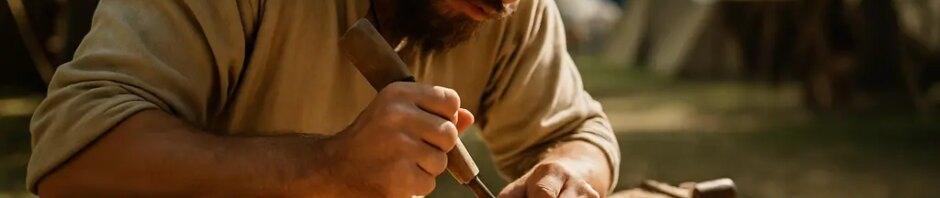
Viking craftsmanship offers one of the clearest ways to move from popular Viking imagery toward practical evidence: iron heated and shaped, wool spun and dyed, leather cut and stitched, wood worked into useful forms, and young people learning through supervised practice. The Vista Viking Festival is scheduled for September 19–20, 2026, at the Antique Gas & Steam Engine Museum in Vista, California, with live blacksmithing and an interactive Viking Village listing 30+ craftsmen and merchants showing and selling their work (Vista Viking Festival). That setting does not recreate the Viking Age in a literal sense. It can, however, help visitors ask better questions about skill, labor, materials, and the way Norse heritage is presented in public.
Why Viking craftsmanship Needs Working Context
Viking craftsmanship As Skill, Not Scenery
The phrase Viking craftsmanship should not be treated as a decorative label for horned-helmet fantasy or generic medieval display. The supported evidence points instead to a wide range of practical skills. The Australian National Maritime Museum describes Viking craft materials including textiles, wrought iron, steel, precious metals, wood, bone, horn, leather, glass, and pottery, with objects ranging from everyday goods to luxury items (Vikings and the Viking Age). That range matters because it shows a society in which craft was not a side activity. Tools, clothing, containers, ornaments, weapons, fittings, and household goods all depended on trained hands.
A modern festival can make that visible if it presents craft as work rather than spectacle alone. Live blacksmithing, for example, gives audiences a chance to see heat, timing, repeated strikes, and controlled force. Woodworking, leatherwork, and textile arts show other kinds of judgment: cutting, measuring, joining, twisting, tensioning, and finishing. None of these demonstrations proves that a particular Viking Age artisan used the same method in every detail. Their value lies in helping visitors understand why archaeological objects represent knowledge as much as material.
What A Festival Can And Cannot Prove
Public craft events require caution. A reenactor’s tool kit may be based on historical study, modern safety needs, available materials, or a mix of all three. A blacksmith working in Vista in 2026 is not direct evidence for a smith at Birka, Kaupang, Ribe, or Hedeby. A leatherworker at a booth is not proof of one workshop plan from the Viking Age. That distinction protects the evidence.
At the same time, demonstration can correct a common misunderstanding. Viking Age objects did not appear as isolated museum pieces. They came from repeated actions: preparing raw material, choosing tools, solving technical problems, and passing knowledge from one maker to another. Public displays of Viking craftsmanship can therefore bridge the gap between artifact and process, as long as presenters state where evidence ends and modern reconstruction begins.
Materials, Hands, And Social Memory
Textiles And Soft Materials
Textile work is especially useful for balancing popular Viking images. The museum evidence cited above includes wool, linen, and silk among Viking textiles, with plant-based dyes and decorative woven or embroidered features. This reminds us that craft was not limited to weapons or metalwork. Cloth required animal care or plant processing, spinning, weaving, dyeing, cutting, repair, and ornament. It also shaped social identity through color, texture, and display.
Because textiles rarely survive as completely as stone or metal, they can be underrepresented in public imagination. A craft tent that lets visitors see threads, fibers, or simple weaving techniques can make a missing part of the archaeological record easier to grasp. Such activity should still be framed carefully: a child’s festival project is not a Viking textile, but it can introduce the manual logic behind textile production.
Blacksmithing, Wood, And Leather
Blacksmithing attracts attention because it is loud, hot, and visually direct. Vista’s planned live blacksmithing fits that public appeal. Yet the lesson should not stop at sparks. Ironwork implies fuel, tools, skill, experience, and judgment about form and function. The same is true of woodworking and leatherwork. A wooden handle, a leather strap, or a metal fitting may look plain, but each reflects choices about durability and use.
This is where craft interpretation can serve archaeology well. Many surviving finds are fragments, and many objects reached the ground after use, repair, loss, deposition, or burial. A festival demonstration can help visitors imagine the object before it became an archaeological find. A related Old Norse News discussion of blacksmith craft at Ribe makes a similar point: placing skilled labor at the center changes how we read Viking Age life.
Youth Craft And Intergenerational Learning
Hands-On Learning In Vista
The Vista Viking Festival’s Youth Pavilion is scheduled to run from 10:00 AM to 6:00 PM on both festival days for ages 1–17. Research notes list hands-on craft tents, decorating swords and shields, archery, and axe-throwing ranges. These activities are modern, supervised public programming. They should not be mistaken for direct evidence of Viking childhood training in one fixed form.
Still, the youth program raises a historically meaningful issue: skills are taught. Craft knowledge does not move through a culture by accident. The research notes connect craft transmission with elders, tools, objects, storytelling, and sagas. That combination is plausible as a broad cultural model, especially if handled without overclaiming. Technical knowledge can live in hands and words at the same time. A maker may teach by showing, correcting, naming parts, telling stories, or setting a task small enough for a learner to complete.
Myth, Story, And Making
Because this topic sits within mythology and culture, it is tempting to turn every craft into a mythic symbol. Caution is needed. A decorated shield at a youth tent is a modern educational object, not a recovered Viking Age shield. A saga reference may preserve cultural values, but it is not the same kind of source as a textile fragment or a metal fitting. Myth and craft can be discussed together only when the difference between story, material evidence, and modern practice remains clear.
That said, storytelling has a real interpretive role. It helps explain why objects mattered beyond function. Jewelry, carved ornament, dyed cloth, weapons, tools, and household goods could carry social meaning. Decorative animal and plant motifs, noted in the research, show that Viking Age makers did not separate usefulness from appearance as sharply as modern categories sometimes do. Craft could serve the body, the household, the market, and memory at once.
Why Interpretation Needs Plain Labels
Evidence, Reconstruction, And Honesty
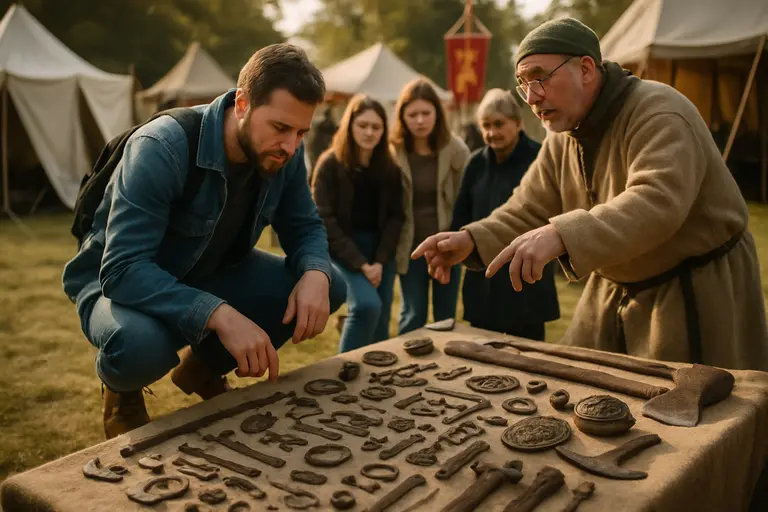
The best public-history events separate three categories: what has been found, what scholars infer, and what modern presenters recreate for teaching. A blacksmith’s demonstration can be labeled as historically inspired. A textile activity can be described as an introduction to technique. A merchant booth can be presented as modern craft drawing on Viking Age themes. These labels do not weaken the experience; they make it more trustworthy.
Clear language also helps mixed audiences. Families, reenactors, teachers, heritage workers, and casual visitors may arrive with different levels of background knowledge. Some want entertainment. Others want archaeology. Many want both. The same need for transparent, attributed writing appears outside heritage work as well; a related site in this network, a discussion on presentation choices at Top Ten Writing Services, is relevant here only as a reminder that presentation choices shape reader trust.
Avoiding The Warrior-Only Story
Craft interpretation can also correct the warrior-only version of Viking culture. Weapons and fighting displays are common at public festivals, and they can be useful when placed in context. Yet a society that sailed, traded, farmed, clothed itself, repaired tools, decorated objects, and built households depended on much more than combat. Vista’s mix of blacksmithing, woodworking, leatherwork, textile arts, merchants, and youth craft points toward that broader view.
This matters for modern Norse heritage. If the public sees only raiders, it misses the labor that made ships, clothing, fittings, tools, and exchange possible. If the public sees only romantic craft, it misses the hard limits of evidence. Good interpretation sits between those errors.
Viking craftsmanship At Vista Viking Festival
Viking craftsmanship at the Vista Viking Festival is best understood as a modern educational doorway rather than a direct window into the ninth or tenth century. The scheduled 2026 event gathers craft display, youth activities, merchants, and live making in one place. Its usefulness depends on how clearly those activities are tied to supported evidence about Viking Age materials and skills.
The strongest reading is practical. Iron, wood, leather, textiles, bone, horn, glass, pottery, and precious materials point to a world of many specialized actions. Festival demonstrations can help visitors see the body knowledge behind those objects: pressure, heat, tension, repetition, pattern, repair, and finishing. They can also show that learning was social, whether through direct instruction, observation, family memory, or story.
Seen this way, Viking craftsmanship is not a romantic afterthought to Norse myth. It is one of the most grounded ways to connect culture with archaeology. A festival cannot replace excavated evidence or museum research, but it can teach visitors to look at Viking Age objects with better questions: Who made this? What material did they choose? What skill did it require? How was that skill taught? What social meaning did the object carry after it left the maker’s hands?
