
Finland’s largest known Viking-Age silver coin hoard has emerged from the ground near Sysmä at exactly the right moment to challenge a persistent historical shortcut: treating every person, object, or community inside the Viking Age as culturally “Viking.”
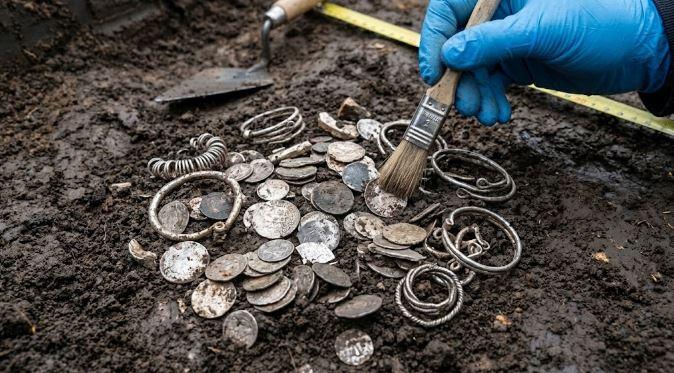
Metal detectorist Kalle Lappinen discovered the first silver near the centre of Sysmä in Päijät-Häme on September 3, 2026. Archaeologist Esko Tikkala of Lahti Museums inspected the site the following day and supervised recovery of two separate deposits. Together, the coins currently weigh about 4.5 kilograms, and museum officials say the hoard contains thousands of pieces.
That makes Sysmä Finland’s largest known Late Iron Age coin hoard.
Its importance reaches beyond the record.
The silver appeared inside two birch-bark containers buried approximately 45 centimetres underground and about 12 metres apart. Alongside the coins, archaeologists recovered hacksilver, a silver bracelet, a silver mount, and a silver bead. Researchers have not yet cleaned, separated, counted, or fully dated the coins, so the hoard remains at the beginning of its scientific life.
Even so, it already exposes a useful distinction. The find belongs to Finland’s Viking Age in archaeological chronology. That does not mean the people who buried it necessarily identified themselves as Vikings, belonged to Scandinavian political communities, or lived in a society identical to Denmark, Norway, or Sweden.
Sysmä may instead show just how widely Viking-Age economic systems extended beyond the people traditionally given the Viking name.
The September 2026 Discovery Immediately Broke Finland’s Silver Record
Lahti Museums announced the find publicly on September 9, six days after Lappinen first encountered it.
According to the museum’s official Sysmä hoard announcement, the recovered coins currently weigh about 4.5 kilograms. Archaeologists can already see that the deposits contain thousands of coins, though conservation and separation must take place before anyone can provide a reliable final count.
The scale becomes clearer through comparison.
Before Sysmä, Finland’s largest known Viking-Age coin hoard came from Nousiainen in 1895. That assemblage contained approximately 1,700 coins and other objects weighing around 2.2 kilograms in total.
Sysmä more than doubles that weight.
The 2026 deposit contains non-coin silver too. Archaeologists identified a fragment of hacksilver, a bracelet, a mount, and a bead. That mixture immediately places the hoard within questions about both coin use and silver-by-weight exchange.
Its archaeological context may prove just as informative.
Someone placed the material in two separate birch-bark containers. They buried those packages among stones roughly 12 metres from one another rather than depositing everything inside one vessel.
Researchers do not yet know why.
The division could reflect storage, separate episodes of deposition, ownership distinctions, or another practice that later analysis may clarify. At present, assigning a motive would outrun the evidence.
What archaeologists can say with confidence is that someone deliberately organized and concealed a very large quantity of silver.
“Viking Age” Does Not Automatically Mean “Viking”
The terminology surrounding the discovery needs as much care as the artifacts.
Finnish archaeology commonly uses “Viking Age” as a chronological label for part of the Late Iron Age. Scholarly treatments often place the Finnish Viking Age roughly between AD 800 and 1025 or 1050, followed in western Finland by the period traditionally called the Crusade Period.
That chronological system does not turn all inhabitants of present-day Finland into Scandinavians.
A major scholarly volume, Fibula, Fabula, Fact: The Viking Age in Finland, was created precisely because Finland sits awkwardly inside conventional Viking narratives. Researchers can identify Scandinavian contacts, imported objects, shared economic practices, and maritime connections without assuming cultural sameness.
The new Sysmä find makes that distinction unusually visible.
A hoard full of silver coins may look “Viking” because silver hoarding appears so prominently in Scandinavian archaeology. Yet hoarding was not an ethnic marker. Coins and bullion could move through trade, gift exchange, tribute, personal mobility, political relationships, and chains of transactions involving many communities.
Finland’s National Museum describes prehistoric Finland as a region with extensive connections to the east, south, and west in its current prehistory exhibition overview.
Sysmä fits that picture better than a simple Viking label.
The people who accumulated the silver participated in networks associated with the Viking Age. Their exact identities remain a separate archaeological question.
A New 2026 Trade Study Makes Sysmä Even More Significant
The timing of the discovery is unusually useful.
Only weeks before the Sysmä find, archaeologist Yann Irissou of the University of Helsinki published a peer-reviewed study of Viking-Age trade and waterway connections in southwestern Finland.
The study examined 481 trade-related finds, including hacksilver, scales, weights, and other material associated with exchange. It found a strong relationship between trade objects, waterways, and central places.
Irissou’s Viking Age trade research argues that communities in southwestern Finland participated directly in Baltic Sea trade and a silver-based exchange system.
That finding changes the context in which Sysmä should be read.
Older models could make Finland look peripheral to Scandinavian Viking commerce. New detector finds and spatial studies increasingly reveal communities connected through maritime and river systems rather than cut off from them.
Sysmä lies outside the southwestern Finnish study area, so archaeologists should not simply transfer Irissou’s regional model onto Päijät-Häme.
The research still provides an important comparison.
Silver does not need to appear at a Scandinavian settlement to belong to a Viking-Age exchange network. Finnish communities could use scales, weights, coins, and bullion in systems that connected local economies to wider Baltic circulation.
Sysmä may eventually provide an exceptional inland example of that process.
The Two Birch-Bark Containers Could Preserve More Than Silver
Metal usually dominates hoard stories because metal survives.
The birch bark at Sysmä may prove nearly as important.
Lahti Museums reports that the silver occupied two birch-bark containers when archaeologists recovered it. Organic containers often disappear from archaeological sites, leaving later researchers with little evidence for how people packaged, transported, or stored valuables.
Here, part of that original storage technology survives.
Birch bark offered a lightweight, flexible, readily available material in northern environments. People could use it for containers and wrapping without requiring expensive raw materials.
The Sysmä containers may eventually tell researchers how the silver was grouped before burial.
Did coins occupy separate packets? Did someone organize objects by type or value? Were the two deposits created at the same time?
Conservation may answer some of those questions.
Their spacing adds another complication. Roughly 12 metres separated the two deposits. If laboratory and numismatic analysis shows that both packages entered the ground during the same episode, researchers will need to explain why someone deliberately separated them.
If their dates differ, the site could represent repeated use of one landscape for storing wealth.
The containers make that question archaeologically testable.
Coins Could Map Connections Without Identifying The Owner
The coins will eventually provide some of the strongest evidence in the hoard.
As of September 14, 2026, Lahti Museums has not published a complete identification of their origins. The coins remain dirty, corroded, clustered, and uncounted.
That means claims about exact proportions of German, English, Scandinavian, or Islamic coins should remain provisional until specialists finish conservation and numismatic work.
Past Finnish finds show what the analysis could reveal.
A much earlier Sysmä-area hoard, discovered in 2017, contained coins and ornaments reflecting wide-ranging eastern and western connections. Finland more broadly has produced Islamic silver, Anglo-Saxon issues, Scandinavian coins, and continental European money from Late Iron Age contexts.
The Finnish Heritage Agency’s collections include Viking-Age silver objects from Sysmä, showing that the municipality was already important for Late Iron Age material before the 2026 record find.
Coins can answer several different questions once specialists identify them.
The newest coin may provide a terminus after which burial must have occurred. Mint locations can reveal the geographic range represented in the deposit. Cut or fragmented coins can show whether users treated them partly as bullion.
Wear can sometimes reveal long circulation before burial.
None of those observations identifies the hoard owner automatically.
A foreign coin proves that silver moved. It does not prove that its final owner visited the place where someone minted it.
That distinction becomes central when discussing “Vikings.”
Hacksilver Shows Why Viking-Age Economics Crossed Cultural Boundaries
The hacksilver fragment may look minor beside thousands of coins, but economically it could become one of the most revealing finds.
Hacksilver consists of deliberately cut pieces of silver objects or bullion used within weight-based exchange.
Its presence at Sysmä places the deposit beside a growing body of evidence showing that Finnish communities could participate directly in silver economies.
Irissou’s 2026 research treats hacksilver, scales, and weights as some of the strongest archaeological signals for Viking-Age trade in Finland.
That system worked differently from a modern national currency.
A coin could carry a ruler’s authority and still possess value as metal. A bracelet could function as jewelry, stored wealth, or a source of divisible silver. A fragment could enter a transaction once weighed against standard measures.
Economic practices like these could cross language and political boundaries.
Scandinavian traders did not need to transform every trading partner into a Scandinavian. Finnish communities could adopt, adapt, or participate in a silver system while preserving distinct languages, burial traditions, social structures, and regional identities.
That is why Sysmä complicates rather than expands a simple map of “the Vikings.”
The silver network could be larger than Viking identity.
Finnish Communities Were Active Participants, Not Empty Space Between Sweden And Rus’
Older popular maps can make Viking-Age Finland appear like a blank territory between Scandinavian centres and eastern routes.
Archaeology increasingly rejects that image.
Satakunta Museum’s Viking Age Finland overview describes thriving Late Iron Age communities around Eura and Köyliö whose wealth rested partly on active trade connections.
Burial evidence there includes imported goods, abundant metal ornaments, and even scales and weights associated with silver exchange.
One grave contained a woman buried with weighing equipment and a purse containing coins.
That case matters because it breaks another stereotype.
Trade did not belong solely to male seafarers carrying Scandinavian identities. Economic participation could involve households and communities whose social roles cannot be reduced to raiding or overseas expeditions.
Finnish settlements produced and exchanged resources too.
Furs, hides, iron, antler, fish, and other northern materials could move through long-distance networks. Imported metal objects and silver returned through the same broad systems.
Sysmä adds spectacular quantity to evidence that has often survived as scattered pieces.
Four and a half kilograms of coins means somebody had access to substantial wealth.
The harder question concerns how that access worked.
Sysmä’s Inland Position Could Matter As Much As The Silver
Sysmä does not sit on Finland’s Baltic coastline.
Its inland position in Päijät-Häme makes the find especially valuable.
The municipality lies in a lake-rich landscape connected to Päijänne and inland waterways. Those routes could move people and material through interior Finland long before roads created modern transport patterns.
Waterways may provide the missing link between inland hoards and Baltic exchange.
Irissou’s recent research in southwestern Finland found a strong association between trade-related finds and water routes. His results support a network extending from central places toward more distant areas through maritime and river movement.
Sysmä could test whether comparable principles worked farther inland.
Researchers should not declare a specific Viking trade route before analyzing the site and coins. Archaeology needs distribution evidence, settlement data, route modelling, and chronological comparison before reconstructing named corridors.
The geography still raises a productive question.
How did thousands of silver coins reach an inland community capable of hiding 4.5 kilograms of them?
Answering that may tell historians more about Viking-Age Finland than deciding whether the owner deserves the word “Viking.”
Previous Sysmä Finds Show The 2026 Hoard Is Not An Isolated Accident
The municipality already has a substantial prehistoric record.
Sysmä’s own local history museum highlights numerous prehistoric discoveries in the area. The Siivolanpelto cemetery preserves evidence from Finland’s Viking Age and later Iron Age phases.
A separate silver discovery near Sysmä in 2017 produced coins, pendants, rings, and other objects.
Those earlier finds make the new record hoard less easy to dismiss as wealth that merely passed through by chance.
They do not prove that Sysmä operated as a Viking trading town.
No evidence currently justifies turning the municipality into a Finnish equivalent of Birka, Hedeby, or Ribe.
Repeated high-value finds do support a more restrained interpretation: Sysmä occupied a landscape capable of acquiring, storing, and circulating significant imported or exchangeable material during the Late Iron Age.
The 2026 hoard raises the scale dramatically.
Researchers now have enough silver to examine patterns within one deposit rather than relying solely on scattered finds.
That can expose decisions about coin selection, grouping, storage, chronology, and perhaps weight.
The Discovery Fits A Wider Shift Away From Simple Viking Labels
Recent Viking archaeology increasingly treats identity as a question to investigate rather than a label to apply automatically.
Old Norse News recently explored the same problem through Norse maritime cultures and regional identity. Archaeological evidence from Scotland, Norway, and wider northern waters shows how objects, beliefs, materials, and technologies moved across communities without erasing local differences.
Sysmä provides a Finnish version of that problem.
A person could use imported silver without being Scandinavian.
A community could participate in Baltic trade without belonging to a Danish or Swedish kingdom.
Local elites could accumulate foreign currency while maintaining regional customs.
Someone might even travel extensively without using “Viking” as an ethnic identity at all.
The Old Norse term víkingr had meanings connected with maritime expeditions rather than functioning as a universal name for everyone living in northern Europe between AD 800 and 1050.
Modern usage often stretches the word much farther.
Archaeology benefits from keeping chronology, activity, and cultural identity separate.
Sysmä belongs comfortably within the Viking Age.
Who buried its silver remains unknown.
Finland’s Antiquities Law Keeps The Context With The Objects
The response to Lappinen’s discovery demonstrates another important part of the story.
Finland’s archaeological find guidance tells finders to report suspected antiquities and avoid further excavation. Objects more than 100 years old found in the ground fall under Finland’s Antiquities Act and must be reported to the Finnish Heritage Agency.
That process protects archaeological context.
A silver coin sold alone still has artistic and monetary interest. A coin recovered with thousands of others inside a birch-bark container, at a recorded depth, beside a second related deposit, carries far more historical information.
Lappinen’s find moved quickly into professional archaeological investigation.
Tikkala examined the site the next day.
That sequence preserved the relationship between the two deposits and their containers, information that uncontrolled removal could easily have destroyed.
Future conservation will preserve another layer of evidence by separating and cleaning the coins under controlled conditions.
The final count may change.
The dating may sharpen.
Individual coins may reveal unexpected geographic connections.
For now, those questions remain open rather than weaknesses in the discovery.
They are what makes the next phase worth following.
Why Sysmä Changes The Question From “Were They Vikings?” To “How Were They Connected?”
The record Sysmä hoard does not prove that thousands of Scandinavian Vikings lived in inland Finland.
It demonstrates something more useful.
By September 2026, archaeologists have recovered approximately 4.5 kilograms of Late Iron Age silver coins and objects from two deliberately buried containers near Sysmä. The find more than doubles the weight of Finland’s previous record Viking-Age coin hoard from Nousiainen.
Its hacksilver connects the discovery with a silver-by-weight economy.
The thousands of coins promise a detailed map of monetary circulation once specialists identify them. Birch-bark containers preserve part of the way people stored the wealth. Sysmä’s inland location raises questions about waterways and exchange beyond Baltic coastal centres.
Current Finnish research supplies the larger context.
A peer-reviewed study published on August 19, 2026, found that communities in southwestern Finland participated directly in Baltic silver exchange and that trade-related finds clustered around waterways and central places.
The Sysmä discovery arrived only weeks later.
Together, the research and the hoard make a simple “Viking versus non-Viking” map increasingly difficult to defend.
Viking-Age northern Europe contained overlapping economic, linguistic, political, and cultural networks. People could share silver systems without sharing one identity. Objects could travel farther than their owners. Scandinavian contacts could reshape local economies without replacing local communities.
Sysmä may eventually tell archaeologists who minted its coins and when someone buried them.
It may never reveal what that person called themselves.
That uncertainty is not a failure.
It is exactly why the hoard matters.
The better historical question is no longer whether a 4.5-kilogram silver deposit makes its owner a “Viking.”
It is how a community in inland Finland became connected enough to the Viking Age economy to accumulate one of the most extraordinary silver reserves ever found in the country.
