
Norse heritage festivals in 2026 show a striking public appetite for Viking Age themes, but they also require careful reading. On September 17, 2026, several listed events had already taken place, while others were still scheduled for later dates. The strongest examples are not simple attempts to recreate the Viking Age. They are modern cultural gatherings that mix living history, mythic storytelling, craft, family activity, music, food, and, in some cases, contemporary Norse Pagan ritual. That mix can teach, but only if organizers and audiences keep a clear line between documented history, later myth, and present-day interpretation.
Why Norse heritage festivals Matter In 2026
How Norse heritage festivals Frame Myth
Festival programs in late 2026 placed Norse myth in public, social settings rather than treating it only as literature or museum material. Viking Fest Minnesota, scheduled for October 10–11 and October 17–18, 2026, at the Dakota County Fairgrounds near Minneapolis–Saint Paul, described itself as an immersive celebration of Viking heritage, Norse mythology, and living history, with live combat, artisan crafts, feasting, and hands-on family experiences according to Viking Fest Minnesota. The wording matters. It places mythology beside heritage and reenactment, not above them.
That arrangement reflects a broader pattern in 2026 festival programming. Mythic figures and themes are used to draw audiences into story, identity, and performance. The supplied research notes record Loki-themed programming at Vista Viking Festival in Southern California on September 19 and 20, 2026, and at VikingFest 2026: Mead & Mischief in St. Joseph, Missouri, on November 13 and 14, 2026. Since those examples are festival programs rather than historical evidence, they should be read as modern interpretation. A Loki theme can illuminate trickster narratives and popular reception, but it cannot be treated as proof of Viking Age ritual practice at a given site.
What Counts As Evidence
The evidence for these events is mainly organizational: dates, venues, program descriptions, and reported attendance or participation where available. That kind of evidence tells us how people in 2026 chose to present Norse material. It does not tell us directly what tenth-century Scandinavians did at assemblies, farms, shrines, or seasonal gatherings. The distinction is essential. A combat show can teach weapon handling as performance. A craft stall can demonstrate handwork. A feast can evoke hospitality. None of these, by themselves, reconstruct a named Viking Age event.
For readers comparing U.S. examples, our earlier discussion of Norse heritage festivals in the U.S. may help frame how Scandinavian American communities connect ancestry, myth, memory, and public culture. Community sites in the same wider network, such as Bethel NC UMC, remind us that local organizations often become part of how regional memory, calendars, and identity are shared, even when their own subject matter is different.
Myth, Ritual, And Living History
Winter Nights As A Modern Seasonal Gathering
Vetrnætr, or Winter Nights, is one of the clearest examples of a 2026 festival using Old Norse seasonal language in an explicit mythic and ritual setting. The event listing places the three-day gathering on October 23–25, 2026, at Sagastad Viking Museum in Nordfjordeid, Norway, and describes a program focused on the old Norse year and mythology, with blót, lectures on Odin and myth, and ancestral celebrations, as listed by Winter Nights at Sagastad.
This kind of programming needs careful language. The presence of blót in a 2026 festival does not mean the event is a direct survival of Viking Age worship. It shows that modern participants are working with Norse vocabulary, seasonal memory, and reconstructed or reimagined ritual forms. That is culturally significant, but it is not the same as archaeological proof. The cautious reading is stronger: modern Norse spirituality, public history, and museum-adjacent programming are meeting in the same space.
Combat, Craft, And Family Participation
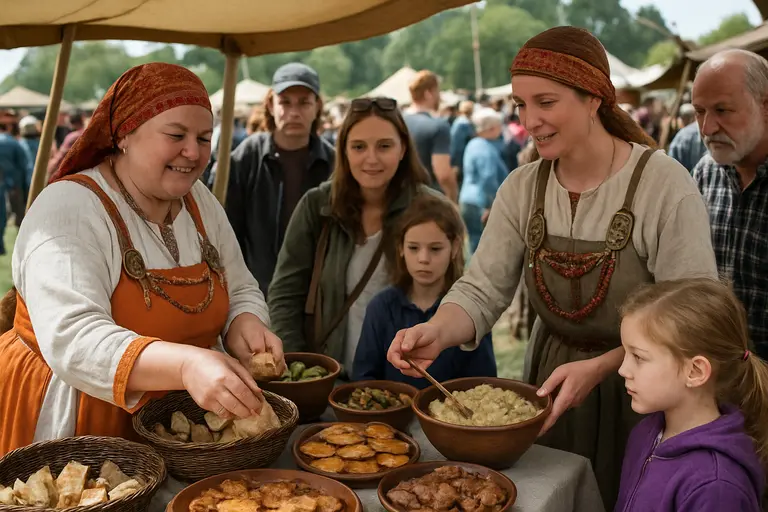
Living history is one of the most accessible forms used by these festivals. The research notes identify combat, artisan crafts, feasting, interactive villages, children’s programs, runestone carving, longship exhibits, storytelling, and costumed performance across 2026 events. These features make the past tactile. Visitors can see textile work, woodwork, foodways, staged conflict, and symbolic objects rather than encountering Norse heritage only through books or display cases.
Yet living history always involves selection. Organizers choose which tools, myths, costumes, songs, and rituals to foreground. A family-friendly activity may soften historical violence. A battle reenactment may heighten spectacle. A mythic stage act may compress sources separated by date, geography, and genre. Norse heritage festivals are strongest when they present those choices openly: “inspired by,” “based on,” or “drawn from” are safer claims than “exactly as it was.”
Community Memory And Festival Survival
What 2026 Events Reveal About Continuity
The 2026 festival record also shows that Norse and Scandinavian heritage are not presented only through Viking warrior imagery. The Scandinavian Heritage Festival in Ephraim, Utah, took place over Memorial Day weekend 2026 and, according to the research notes, drew about 30,000 visitors while emphasizing historical tours, storytelling, Scandinavian immigrant history, and cultural activities. New Sweden, Maine, marked Midsommar in June 2026 with maypole dancing, Swedish folk costumes, and intergenerational community continuity in a town of fewer than 600 residents.
These examples broaden the frame. Scandinavian heritage can mean immigrant memory, seasonal celebration, costume, food, music, and local belonging. Norse mythology may be present in some places and absent in others. That difference matters because “Norse” and “Scandinavian” are not interchangeable terms in every setting. A careful article should not force Odin, Loki, runes, or longships into festivals whose main focus is Swedish midsummer or immigrant history.
Why Festival Closures Also Matter
Not every heritage institution expanded in 2026. The research notes state that Norsk Høstfest in North Dakota, founded in 1978, ceased operations in 2026 after organizers cited rising costs, declining attendance, and financial strain. The same notes describe Fjord Folk Fest in Minot, held on August 21, 2026, as a new festival created after that closure, with artisans, food vendors, and cultural performances.
That shift is a reminder that cultural memory depends on budgets, volunteers, venues, audiences, and timing. A festival can be meaningful and still financially fragile. A new event can carry forward selected traditions while changing scale, format, or emphasis. Public heritage is not fixed. It is maintained through practical decisions as much as through stories.
Norse heritage festivals And Modern Meaning
Reading 2026 With Caution
Norse heritage festivals are most useful when they invite better questions rather than offering false certainty. What is drawn from medieval texts? What is based on archaeology? What comes from nineteenth- and twentieth-century Scandinavian immigrant memory? What belongs to modern Pagan practice? What is entertainment? These categories can overlap at a festival, but they should not be collapsed into one claim about “the Vikings.”
The 2026 examples show several clear tendencies: mythology is becoming more visible in programming; living history remains a major interpretive tool; family participation is central to many events; ritual language is appearing in some gatherings; and financial pressure is reshaping older institutions. The evidence supports those observations. It does not support broad claims that modern festivals revive Viking religion unchanged, or that every craft demonstration reflects a documented local practice.
For contemporary readers, the value lies in the meeting point between old stories and present communities. Odin lectures, Loki themes, blót, stonelifting, craft stalls, Midsommar dances, feasts, and longship imagery all show different ways people use northern memory. Some are playful. Some are devotional. Some are educational. Some are tied to immigrant identity more than Viking Age evidence. A cautious approach lets each be seen for what it is.
The best reading of these festivals is neither dismissal nor uncritical celebration. They are modern cultural acts built around selective memories of the North. If they name their sources, state their limits, and respect the difference between myth, history, and present practice, they can bring ancient stories into public life without pretending that every performance is a recovered fragment of the Viking Age.
