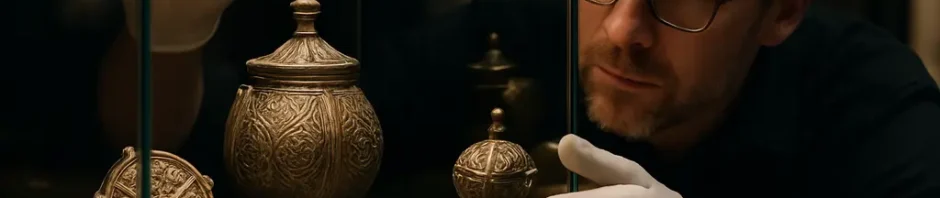
The Galloway Hoard Exhibition has mattered because it presented one of the most unusual Viking-Age finds from Scotland not as a simple treasure story, but as evidence for contact, conflict, religion, craft, and exchange around AD 900. The hoard was discovered by a metal detectorist near Balmaghie, Kirkcudbrightshire, in September 2014, and National Museums Scotland describes it as a Viking-Age hoard of exceptional range and preservation National Museums Scotland. Its value for Norse history lies partly in what it refuses to be: it is not a neat Scandinavian deposit. It is a mixed assemblage from the Irish Sea world, Anglo-Saxon England, Christian communities, and farther trading zones.
Why The Galloway Hoard Exhibition Matters
The exhibition mattered because museum display made a difficult archaeological assemblage legible without pretending that all questions are settled. The hoard contains more than 100 items, including gold, silver, glass beads, jewelry, religious objects, textiles, stone, rock crystal, and earthenware. It was buried around AD 900, a period marked in Britain and Ireland by Viking raiding, settlement, trade, and political change. That date is not just a label. It places the burial in a world where Norse-speaking groups interacted with established Christian communities, Anglo-Saxon polities, Gaelic networks, and wider exchange routes.
Galloway Hoard Exhibition And The Viking Label
The phrase “Viking hoard” is useful only if handled with restraint. National Museums Scotland’s research, as summarized in the supplied material, indicates that very little in the hoard came directly from Scandinavia, with only one arm-ring in a Scandinavian style likely to have originated there. That does not make the Norse context irrelevant. It means that Norse influence appears through movement, contact, reuse, and social pressure rather than through a set of purely Scandinavian objects.
This is where the Galloway Hoard Exhibition offered a useful correction to popular expectation. The Viking Age was not a sealed ethnic category expressed through one style of brooch, sword, or silver ring. It was a period in which objects crossed social and religious boundaries. Some were looted, some traded, some gifted, some repurposed, and some may have carried meanings that changed as they moved from one owner to another.
Material Mixture And Norse Influence
The hoard’s material mixture is its strongest evidence. A visitor expecting only hacked silver and martial display instead meets fragile textiles, ecclesiastical objects, Anglo-Saxon inscriptions, exotic imports, and carefully wrapped deposits. This range shifts the conversation from “Who were the Vikings?” to “How did Viking-Age contact reshape the things people used, valued, and buried?”
Objects That Resist Simple Origins
The reported contents include wool, linen, rare silk, rock crystal, glass beads, gold, silver, and earthenware. These materials point to different technologies and supply chains. Textile survival is especially significant because organic materials usually decay. Their preservation under unusual burial conditions allows researchers to study wrapping, concealment, and object care as part of the hoard’s history, not as secondary details.
- Precious metals: gold and silver show wealth, portability, and exchange value.
- Textiles: wool, linen, and silk point to wrapping, protection, and long-distance connections.
- Religious items: Christian symbols and church-linked inscriptions complicate any purely pagan reading.
- Imported objects: materials and styles from outside Britain and Ireland widen the geographic frame.
For Norse archaeology, that mixture is valuable because it shows influence without requiring direct Scandinavian manufacture. A silver object in Scotland around AD 900 may have passed through Norse hands, Anglo-Saxon hands, church hands, or several of these. The archaeological task is to trace plausible movement while avoiding a false certainty that the evidence cannot carry.
Runes, Religion, And Ownership
The runic evidence is one of the hoard’s most revealing features. The supplied research notes four runic inscriptions on arm-rings within the hoard, plus one nearby, using Anglo-Saxon runic script and names or words from Old English rather than Old Norse. One longer inscription has been tentatively translated as “this is the community’s wealth,” or “þis is higna feoh.” That reading, if accepted, raises the possibility of collective ownership, perhaps connected with a religious community.
Old English Runes In A Viking-Age Deposit
Old English runes inside a hoard often discussed under a Viking heading are not a contradiction. They are evidence for cultural overlap. Norse influence in the region did not erase local traditions. Instead, it seems to have operated in a contact zone where language, wealth, religious authority, and violence could intersect. An arm-ring could carry a local inscription while still belonging to a deposit shaped by Viking-Age disruption.
The rock crystal jar sharpens the same point. The supplied research identifies a small rock crystal vessel, about 5 cm high, with gold filigree and a Latin inscription reading “Bishop Hyguald had me made.” That points toward a Northumbrian ecclesiastical setting. Scientific analysis also indicated that the crystal was older than the goldwork around it, suggesting reuse across time. Such an object cannot be read only as treasure. It is also a sign of memory, church authority, and the movement of sacred or prestigious materials.
The presence of Christian objects does not remove the hoard from Norse history. It places Norse history in its proper contact setting. Viking-Age societies encountered Christian institutions not only as enemies or converts, but also as holders of wealth, literacy, relic traditions, and portable prestige.
Exhibition Practice After The Australian Tour
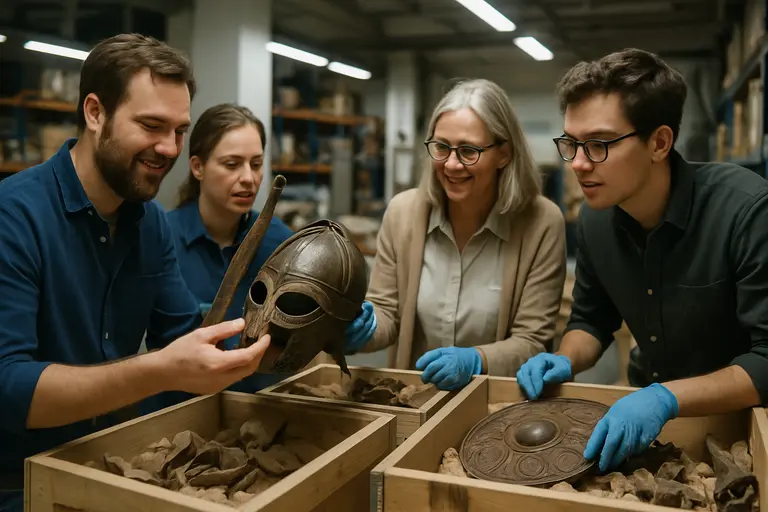
The international tour also deserves historical attention because exhibition practice affects interpretation. The touring exhibition Treasures of the Viking Age: The Galloway Hoard was shown in Australia, with the Sydney presentation running from 28 May to 11 October 2026 at the Australian National Maritime Museum, after earlier Australian venues; the museum’s announcement also noted the hoard’s allocation to National Museums Scotland in 2017 and the 2021–2024 research and conservation programme Unwrapping the Galloway Hoard Australian National Maritime Museum. As of 13 October 2026, the Sydney run had ended, so the exhibition can now be assessed as a completed public-history event rather than an attraction awaiting visitors.
Display, Fragility, And Interpretation
High-security display and controlled environments are not incidental. They shape what audiences can see and how close they can come to fragile materials. For especially delicate elements, reconstructions, imaging, and digital presentation can help without replacing the original objects. This is a useful point for Norse heritage more widely: public access depends on conservation limits.
Visual culture also shapes first impressions. Museum photography, catalogue images, 3D reconstructions, and related heritage imagery all influence how the public reads the past. Readers comparing how historical objects are framed across image-led projects in the same network may find the approach used by Finest Image a beneficial reminder that presentation is never neutral, even when the underlying archaeology remains the authority.
Old Norse News has treated this hoard as part of a wider problem of exchange and interpretation; a related discussion of Galloway Hoard trade evidence fits the same cautious approach. Trade, raiding, gift exchange, and ecclesiastical wealth should not be collapsed into one explanation when the objects themselves point in several directions.
Galloway Hoard Exhibition And Norse Material Culture
The final lesson from the exhibition is that Norse influence on material culture is best understood as contact rather than ownership. Around AD 900, objects could move through violence, tribute, trade, piety, inheritance, and concealment. The hoard’s Anglo-Saxon runes, Christian symbols, textiles, imported materials, precious metals, and unusual containers show a world where identities were practical as well as ethnic.
For archaeologists and historians, the Galloway Hoard is valuable because it resists the easy story. It does not let us picture Viking-Age Scotland only through warriors and ships. It asks us to consider communities, churches, metalworkers, textile handlers, traders, and people who chose to bury valuables with care. The burial may have been an emergency act, a ritual act, a protective act, or some combination that cannot be recovered with confidence.
The strongest interpretation is therefore cautious. Norse influence is present, but not as a single cultural stamp. It appears through pressure on local wealth, through the circulation of silver, through the movement of prestigious objects, and through a mixed Irish Sea world where Anglo-Saxon, Christian, Norse, and farther eastern materials could end up in one deposit. That is why the hoard remains one of the most significant finds for understanding Viking-Age material culture: it shows contact in objects, but it also shows how much still depends on careful reading.
