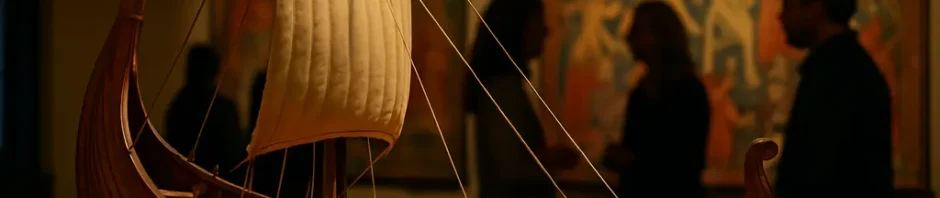
The Norse Saga Room at the American Swedish Institute in Minneapolis is significant because it places Scandinavian myth, immigrant memory, and early twentieth-century design inside a single museum setting. The American Swedish Institute states that the room opened to the public on May 16, 2019, is located on the Lower Level of the Turnblad Mansion, and has become a permanent part of the visitor experience at ASI American Swedish Institute. That history gives the room a dual character: it is both an object from a Scandinavian interior tradition and a modern American museum installation.
The room should not be read as a direct Viking Age survival. Its value lies elsewhere. It shows how people in the early 1900s selected, reworked, and displayed older saga and mythic themes through wood carving, folk-art forms, and textiles. In that sense, the room is evidence for reception: how Norse material was imagined, staged, and given cultural authority long after the medieval period.
Why The Norse Saga Room Matters
The Norse Saga Room And Myth Made Visible
The room matters because it turns textual and legendary material into an interior environment. ASI describes its carvings, folk art, and textiles as visual narration tied to themes drawn from Old Norse sagas. That does not mean the room is a neutral window into the Viking Age. It is better understood as a designed interpretation of saga material, filtered through early twentieth-century taste and Scandinavian cultural nationalism.
This distinction is central. Sagas were written texts shaped by medieval literary culture, while the room was commissioned in 1912 for a modern private apartment. Between those two points stand centuries of interpretation. The museum setting makes that distance visible if visitors are encouraged to ask what belongs to medieval tradition, what belongs to later art, and what belongs to modern heritage display.
Myth Without False Certainty
The safest reading is that the room makes Norse myth tangible without proving how Viking Age interiors looked. A carved animal, a heroic theme, or a saga reference can carry cultural memory, but it does not automatically document ancient domestic space. This is why the installation is useful for public history. It encourages engagement with myth while asking visitors to separate evidence from adaptation.
For readers interested in a closely related interpretation of this room as a meeting point of myth, woodwork, and memory, the related article on ASI room and public memory offers a useful companion discussion.
Commission, Movement, And Reinstallation
From Stockholm Apartment To Minneapolis Museum
The Norse Saga Room did not begin as a museum gallery. ASI records that it was commissioned in 1912 for Swedish businessman Anders Andersson, who lived from 1859 to 1929, for an apartment near Östermalmstorg in Stockholm. ASI attributes part of the architectural inspiration to the Norwegian artist Gerhard Munthe, with a design mixture that included motifs from Norse mythology, Norwegian folk art, and Japanese art.
That mixture is culturally revealing. It shows that Scandinavian identity in this period was not built from old sources alone. It was shaped through selective borrowing, cross-cultural visual taste, and a modern search for national style. The result was not archaeological reconstruction. It was a staged cultural interior, created for a private patron and later reinterpreted through public display.
A Room With A Modern Biography
After Andersson’s apartment, ASI states that the panels and decor were removed, appeared in a Viking-themed exhibition at Stockholm’s Statens Historiska Muséet in 1981, and were later sold at auction to Curtis L. Carlson, a Minneapolis entrepreneur. Carlson installed the room in his Minnetonka corporate headquarters, where it remained until 2019. In that year, the room was donated to ASI by Carlson Holdings, with installation support from the Carlson family foundation.
This sequence matters because it changes the meaning of the object. A room made for a Stockholm apartment became a museum exhibition object, then a corporate interior, then a public heritage installation in a Swedish-American institution. Each move added a new frame of meaning. None erased the earlier phase, but each changed how viewers encountered the room.
- 1912: commissioned for Anders Andersson’s Stockholm apartment.
- 1981: shown in a Viking-themed exhibition in Stockholm.
- After 1981: purchased by Curtis L. Carlson and installed in Minnesota.
- 2019: donated to ASI and opened to the public in Minneapolis.
That path also helps explain why the room belongs in a museum devoted to Swedish and Scandinavian-American culture. It is not only a decorative interior. It is a traveled object whose meanings shifted across private, institutional, corporate, and public settings.
Myth, Design, And Scandinavian-American Identity
Gerhard Munthe And National Romantic Design
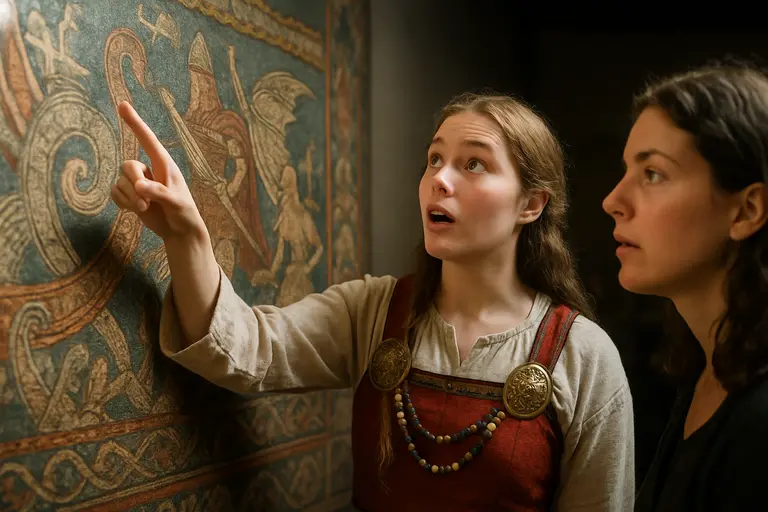
Gerhard Munthe’s role is significant because his visual language helped shape how saga themes were presented in decorative art. Robbie LaFleur’s account identifies Munthe-designed woven works in the Norwegian National Romantic style as a key part of the installation and notes that these works were on loan from Vesterheim Norwegian-American Museum Robbie LaFleur’s study. The loan context also reminds us that the room is not isolated. It sits within a wider network of Scandinavian-American collecting, display, and interpretation.
National Romantic design often used the past to make modern identity visible. In the case of this room, saga themes, folk-art forms, and carved surfaces helped produce an atmosphere of antiquity without being ancient themselves. That is exactly why the installation is valuable. It documents how early modern viewers imagined cultural origins and how museums can now explain those choices with care.
Swedish-American Setting, Wider Scandinavian References
The American Swedish Institute gives the room a specific American setting. It sits inside the Turnblad Mansion, part of an institution associated with Swedish-American cultural life in Minneapolis. Yet the room’s references are not only Swedish. The research record points to Norwegian folk art, Munthe’s influence, Old Norse saga themes, and Japanese art as part of the design context. This combination resists a simple ethnic label.
That mixed character is not a weakness. It reflects how Scandinavian heritage has often been presented in the United States: through overlapping Swedish, Norwegian, pan-Scandinavian, and broader Nordic references. The room invites visitors to ask how migration changes inherited culture. A saga image in Stockholm does not mean the same thing when reinstalled in Minneapolis in 2019. The setting changes the questions people ask.
Public interpretation needs this caution. It would be easy to use the room as a romantic symbol of an undivided Norse past. A better reading sees it as a cultural construction, one that carries genuine attachment to older stories while also showing how modern communities reshape those stories. Source-grounded cultural writing, including related work from Interline Publishing in the same network, can help keep that distinction visible.
The Norse Saga Room As Cultural Memory
A Permanent Installation With A Layered Message
The Norse Saga Room is culturally significant because it makes memory material. Its wood, textiles, saga themes, and museum placement bring together several periods: medieval story worlds, early twentieth-century design, late twentieth-century collecting, and twenty-first-century museum interpretation. The room is not one thing from one time. It is a layered object that asks visitors to think historically.
Its permanent place in ASI’s visitor experience gives the installation a public role. It can help visitors see that Norse mythology has rarely remained fixed. Stories moved through manuscripts, art movements, national projects, immigrant institutions, family collections, and museums. The room’s power comes from that movement, not from any claim that it recreates a Viking hall.
The best interpretation treats the room as evidence for how the past is used. Anders Andersson’s 1912 commission shows one form of Scandinavian cultural aspiration. The 1981 Viking-themed exhibition shows another. Carlson’s Minnesota installation placed the room in a corporate setting. The 2019 ASI installation reframed it for museum visitors. Each phase reveals a different relationship between myth and identity.
For Norse cultural history, that is a useful lesson. Myth survives not only through texts, but through rooms, carvings, textiles, donations, loans, and curatorial choices. The room at ASI is therefore most valuable when presented with caution: not as an untouched fragment of ancient belief, but as a carefully preserved modern expression of how Scandinavian communities have imagined, inherited, and displayed the Norse past.
