
Viking-Age violence is usually reconstructed from battlefields, weapons, sagas and graves.
A new Scandinavian study argues that this picture misses an important group: people who never reached ordinary cemeteries at all.
Published online on September 28, 2026, in the Journal of Archaeological Method and Theory, the study examines human remains deposited in and around houses, yards, pits, wells, hearths and postholes across Denmark, Norway and Sweden.
The research team, led by Marianne Hem Eriksen of the National Museum of Denmark, worked with an unusual dataset representing an estimated 192 individuals from 197 settlement contexts spanning roughly 500 BC to AD 1050.
Twelve individuals showed injuries sustained during life or around the time of death.
Researchers identified 19 traumatic injuries in total. At least eight of the 12 individuals appear to have experienced deliberate violence, while six cases may represent lethal attacks.
The findings do not show that Viking households routinely kept murder victims beneath their floors.
They reveal something subtler and more important.
Some people who suffered violence were treated very differently in death from those buried in formal cemeteries. Their remains entered houses, wells, pits and other domestic spaces instead.
That difference could change how archaeologists measure violence in Scandinavian society.
The Study Looks Where Cemetery Research Usually Does Not
The new peer-reviewed study of human remains in Scandinavian settlements forms part of the BODY-POLITICS project.
Instead of concentrating on burial mounds, grave fields and richly furnished tombs, the researchers investigated remains found in places associated with daily life.
These included longhouses, feasting halls, yards, wells, postholes, hearths and pits.
Most of the remains were incomplete.
Some consisted of a single skull fragment or limb bone. Only a minority resembled conventional burials.
That difference matters because archaeology has traditionally relied heavily on cemetery populations when calculating levels of interpersonal violence.
If some victims never entered cemeteries, those calculations may exclude exactly the people most exposed to social vulnerability.
Twelve People Carried Nineteen Injuries
The study identified traumatic injuries in 12 of the estimated 192 individuals.
Six had head injuries.
Seven showed trauma elsewhere on the skeleton.
Four carried evidence for multiple injuries.
Researchers documented sharp-force wounds, blunt-force trauma and fractures, including two injuries consistent with possible defensive or “parry” fractures.
At least eight, possibly nine, of the 12 cases fit established indicators of deliberate violence.
Six appear to involve violence serious enough to have contributed directly to death.
The overall observed trauma rate in this unusual sample is about 6.25 percent.
That figure needs caution.
Most individuals survive only as fragments. A skull without the rest of the skeleton cannot reveal injuries to the ribs, arms or legs.
The researchers therefore describe missing trauma as a significant “known unknown.”
The real rate within this selected group could have been higher.
A Child’s Skull Was Placed Beneath A House Floor
One of the most striking cases comes from Postgården VI in northern Jutland.
The settlement contained around 85 three-aisled longhouses.
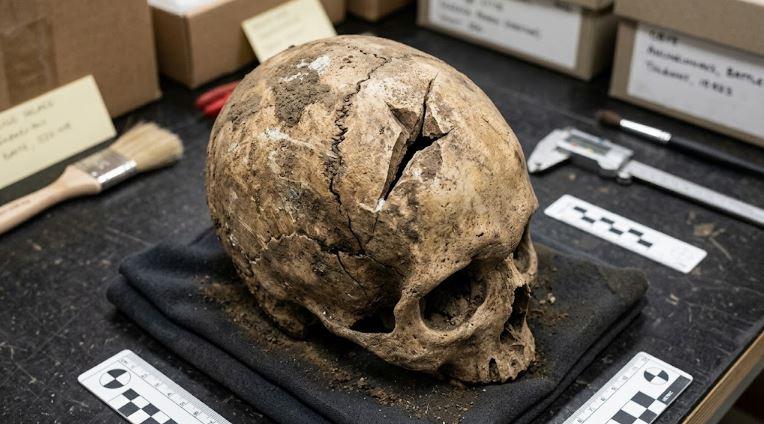
Researchers re-examined a partial frontal bone previously identified incorrectly as belonging to a young adult woman.
Osteological and genetic work instead showed that it came from a boy aged approximately two to four years.
The bone carries a sharp-force injury that earlier research interpreted as possibly caused by a sword or another heavy bladed weapon.
After death, the child was not cremated in the conventional way expected for much of that period.
Someone eventually placed the skull fragment between two phases of a longhouse floor.
Radiocarbon dating produced an even stranger result.
The bone appears to be roughly 200 years older than the house context in which it was deposited.
That suggests the skull fragment may have been kept, moved or curated for generations before becoming part of the building.
The Child Does Not Fit A Battlefield Explanation
The child illustrates why the new study changes the violence debate.
A two-to-four-year-old was not a warrior killed during ordinary combat.
If the injury really occurred around the time of death, researchers must consider other forms of violence.
The study discusses several broad possibilities across the dataset, including conflict within communities, violence within households, punishment and ritualized killing.
None can be assigned automatically to the child.
The researchers explicitly avoid claiming one universal explanation for all settlement deposits.
Still, cases such as this make it difficult to explain Scandinavian violence purely through warfare.
Some violence happened to people who could not have participated in battle.
A Woman’s Skull Ended Up In A Well
Another case involves the partial skull of a young woman.
She was approximately 18 to 25 years old and carried a possible sharp-force injury near the eye.
Her cranium later ended up in a well.
Other individuals were placed in pits or around settlement buildings.
One male skeleton showed a badly healed fracture to the ulna that researchers consider compatible with a defensive injury produced while raising an arm against a blow.
Some people also displayed evidence of repeated trauma accumulated over their lives.
These patterns push the study beyond sudden violent death.
They raise questions about people who may have experienced long-term physical stress, repeated assault or social marginalization before their remains received unusual treatment after death.
The Research Introduces Structural Violence Into Viking Archaeology
Eriksen and her colleagues distinguish between direct violence and what they call structural vulnerability.
Direct violence leaves more obvious archaeological traces: weapon wounds, fractures or blunt-force injuries.
Structural violence can operate more slowly.
Malnutrition, exhausting labour, chronic physiological stress and social inequality may leave subtler signatures on the body.
The researchers found health and stress indicators among several individuals.
They therefore ask whether the same people who received unusual treatment after death also occupied vulnerable positions during life.
That is a difficult hypothesis to test.
A poorly healed fracture does not automatically prove abuse.
Stress markers do not identify who caused hardship.
Yet combining bodily evidence with unusual mortuary treatment can reveal patterns that formal graves may conceal.
Cemeteries May Represent A Selected Population
This is the study’s larger methodological challenge.
Archaeologists often treat cemeteries as samples of past communities.
They are not necessarily neutral samples.
Burial depends on social rules.
Some people received monumental graves.
Others entered ordinary cemeteries.
Some bodies may have been cremated, exposed, dismembered or deposited elsewhere.
If people subjected to severe violence were disproportionately excluded from conventional burial, cemetery statistics could underestimate violence.
The BODY-POLITICS team found a trauma rate in settlement remains broadly comparable to rates reported from many Viking-Age cemeteries, even though most settlement individuals survive as only one or a few bones.
That is striking.
Complete cemetery skeletons offer far more surface area on which archaeologists can detect wounds.
Finding comparable trauma among fragments suggests that settlement deposits deserve much more attention.
Not Every Bone Represents A Murder Victim
The researchers are careful about another point.
Human remains inside settlements do not automatically indicate concealed killings.
Some bones may have carried ritual, ancestral or protective meanings.
Scandinavian communities sometimes treated human remains in ways that modern distinctions between “person,” “object” and “burial” struggle to describe.
A skull fragment could be curated.
A bone might become part of a house deposit.
Human remains could participate in rituals connected with buildings, households or community identity.
The BODY-POLITICS research project has spent several years examining these alternative mortuary pathways.
This makes the new violence evidence more complicated, not less.
A person could suffer violence in life and still have their remains deliberately preserved for meaningful ritual purposes afterward.
Gammel Lejre Connects Violence With Elite Spaces
Some settlement remains come from environments associated with political and ritual power.
The study includes evidence connected with Gammel Lejre, the famous Danish elite and hall complex.
Other cases cluster around Uppåkra in southern Sweden, another major centre where archaeologists have excavated long-lived ritual buildings, feasting halls, weapons and rich imported objects.
These locations matter because unusual human deposits were not limited to marginal farmsteads.
They could appear around socially important centres.
That weakens any simple explanation that these remains belonged only to people discarded outside normal society.
Different sites may have used human remains for very different reasons.
The dataset spans around 1,500 years, making a single explanation impossible.
The Study Covers More Than The Viking Age
The headline needs another important qualification.
Not all 192 individuals were Vikings.
The study stretches from approximately 500 BC to AD 1050.
That includes much of the Scandinavian Iron Age as well as the Viking period.
Researchers intentionally used this long chronology to investigate repeated practices of placing human remains inside settlements.
Some cases belong centuries before Viking raiding began.
Others reach the Viking Age itself.
That long duration suggests that unusual treatment of human remains was not invented suddenly around AD 793.
Viking communities inherited older traditions involving houses, bodies and ritual landscapes.
This fits a broader pattern Old Norse News has explored in its Viking Age source guide: the Viking world makes more sense when placed inside longer Scandinavian social and cultural histories rather than treated as an isolated age of raiders.
Violence Was Not Only Something Vikings Exported
Popular Viking narratives often place violence overseas.
Raiders attack monasteries.
Armies invade England.
Warriors die in battle.
The new study turns attention inward.
Some violent injuries occurred among people embedded in Scandinavian settlements themselves.
The researchers discuss warfare as one possible explanation for certain wounds, especially those caused by weapons associated with combat.
Other cases do not fit battlefield scenarios easily.
A young child with cranial trauma is the clearest example.
Repeated injuries in adults may point toward interpersonal or community violence.
Possible ritual violence remains another interpretation.
The evidence does not replace the familiar story of Viking warfare.
It expands violence from battlefield history into household and community history.
Why These Bones Change The Story Of Scandinavian Violence
The most important contribution of the 2026 study is not a new estimate of how violent the Vikings were.
Its authors specifically warn against treating the dataset as representative of the entire Scandinavian population.
The real change concerns who archaeologists count.
Formal cemeteries preserve people who received recognized funerary treatment.
The settlement dataset preserves people treated differently.
Among an estimated 192 individuals from 197 domestic contexts, researchers identified 12 people with 19 injuries. At least eight show probable deliberate violence, and six may have died because of it.
One child’s damaged skull survived for perhaps two centuries before someone placed it beneath a house floor.
Other bodies or fragments entered wells, pits, yards and important settlement complexes.
Those remains complicate any history built only from warriors and prestigious graves.
Violence in Iron and Viking Age Scandinavia could occur in war, but it could also emerge within communities, affect children and vulnerable people, and shape what happened to bodies long after death.
The houses matter because they preserve the people the cemeteries missed.
And once those people enter the archaeological record, Scandinavian violence looks less like something confined to Viking raids and more like a social problem that could reach directly into everyday life.
