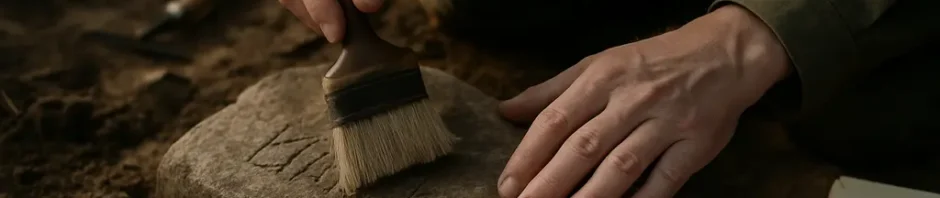
The Faroe Runestone Discovery at Á Sondum, near Sandur on Sandoy, was made in July 2026 during archaeological excavation work in the Faroe Islands. Medievalists.net reported that the stone was found embedded in the floor of a building uncovered during the same dig, a structure suspected to have been a medieval chapel or prayer house according to Medievalists.net. The find matters because runestones are rare in the Faroes, and because the setting places runic writing inside a context that appears strongly Christian.
What The Faroe Runestone Discovery Shows
Why The Faroe Runestone Discovery Is Cautious Evidence
The first lesson from the site is restraint. The stone is not yet a fully interpreted text, and the archaeological setting is still being assessed. The visible inscription is only partly legible. A tentative reading gives the Old Norse phrase Her hvílur…, meaning “Here lies” or “Here rests.” If that reading holds, the wording would point toward a funerary or memorial function. Yet a partial phrase cannot carry more weight than it can bear.
The building context is still just as significant as the inscription. Archaeology Magazine reported that the structure was oriented east–west and had its entrance at the western end, features commonly seen in medieval Christian chapels as reported by Archaeology Magazine. That does not prove every detail of use, but it does explain why archaeologists have discussed the building as a chapel or prayer house.
The Floor Setting And Its Meaning
A runestone embedded in a floor raises different questions from a standing monument placed in open public view. Was the stone originally made for that building, reused from another setting, or placed there as part of a memorial surface? The research available by September 3, 2026, does not answer that. What can be said is narrower: the stone was found in the floor of a building suspected to be Christian in character.
That detail is culturally striking. Runes did not disappear at the moment Christianity arrived. In many parts of the Norse-speaking world, runic writing continued to serve memorial, ownership, devotional, and practical purposes after conversion. The Á Sondum stone may fit that broad pattern, though the final reading of the inscription must come first.
Christian Signs Around The Á Sondum Stone
Architecture, Objects, And Burial Language
The site’s Christian signals come from more than one source. The reported east–west orientation and western entrance suggest comparison with medieval chapel architecture. The research record also reports fragments of a small statue of the Virgin Mary holding the infant Jesus, along with a kola, a small oil lamp. Taken together, those finds place the stone close to Christian devotional material rather than in an obviously pre-Christian ritual setting.
- The stone was discovered at Á Sondum near Sandur on Sandoy in July 2026.
- It was embedded in the floor of a building suspected to be a chapel or prayer house.
- The tentative inscription begins Her hvílur…, “Here lies” or “Here rests.”
- Christian material from the site reportedly includes Virgin Mary statue fragments and a small oil lamp.
The approximate dating, around A.D. 1000, places the site in the period when Christianity was becoming established among Norse settlers in the Faroes. This is why the find has been linked to the shift from older Norse religious practice to Christian practice. Still, the evidence described so far is more explicit for Christianity than for paganism. The older religious background is inferred from the wider Norse settlement context and the conversion period, not from a clearly pagan object reported from the excavation.
Why The Virgin Mary Fragments Matter
The reported fragments of a Virgin Mary figure are not a small detail. If the identification is correct, they indicate Christian imagery at the site. A runestone in the same archaeological setting does not, by itself, become a Christian monument; its wording and placement have to be evaluated. Yet the combination of inscription, chapel-like building, lamp, and Marian imagery gives scholars a stronger basis for discussing Christian commemoration.
This is where the Faroe Runestone Discovery becomes useful for public understanding. It resists the simple story that pagan runes were replaced by Christian symbols overnight. The evidence points instead to a period in which inherited Norse writing could operate near, or within, Christian practice.
Norse Paganism And Christianity At A Turning Point
What The Find Can Say About Conversion
The discovery has been framed as evidence for interaction between Norse paganism and Christianity around c. A.D. 1000. That framing is reasonable if it remains modest. The site may show conversion in progress: Christian space, Christian objects, and a runic memorial phrase in Old Norse. Such evidence suggests that cultural change did not require the immediate abandonment of older language habits or writing systems.
At the same time, the stone should not be used as proof for a full religious mixture unless the inscription or further excavation results support that claim. “Syncretism” is a useful term only when the evidence shows overlap in practice, symbol, or belief. At Á Sondum, the overlap currently visible is between runic writing and a Christian archaeological setting. That is enough to make the find valuable, but not enough to reconstruct the beliefs of the person commemorated.
Why Runes Are Not Automatically Pagan
A common mistake in public discussion is to treat runes as inherently pagan. The Á Sondum find warns against that. Runes were a writing system used by Norse-speaking communities. They could appear in memorial, practical, and later Christian contexts. If Her hvílur… is confirmed, the inscription may belong to a burial formula rather than a mythological statement.
That matters for how we discuss the Faroe Runestone Discovery. The stone is not valuable because it gives an easy pagan-versus-Christian contrast. It is valuable because it may show how people used familiar forms of writing during a religious shift. Readers interested in this exact caution may compare the present evidence with our related discussion of Á Sondum’s rare Faroe runestone, where the need for slow interpretation is the central point.
Conservation, Reading, And Public Interpretation
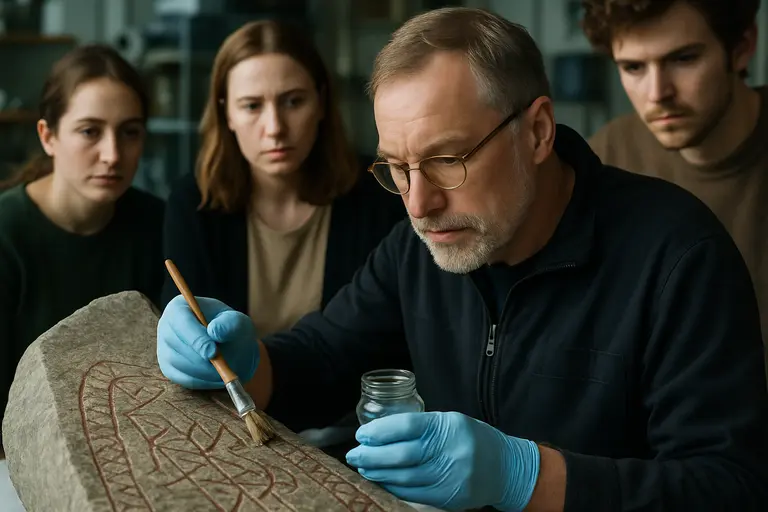
The Fragile Stone After Excavation
The research notes state that the runestone is very fragile after centuries underground. It has been removed from the excavation site and taken to the Faroe Islands National Museum for conservation. A 3D scan is planned so that details can be recorded and studied without depending only on direct handling of the surface.
That conservation stage is not a pause in the story; it is part of the evidence process. Fragile stone can lose surface detail through drying, movement, cleaning, or poor handling. Runic readings often depend on slight cuts, shadows, and surface damage. A scan may help specialists test readings and share visual data with other scholars.
The Late August Runologist Visit
A runologist was scheduled to inspect the stone in late August 2026. Since September 3, 2026, has now passed that scheduled window, the visit should be discussed in the past tense. The research supplied for this article does not report the outcome of that inspection, so it would be premature to claim that the whole inscription has been read.
This is where public heritage writing has to be especially careful. A partial reading can attract large claims about lost churches, pagan survivals, or forgotten saints. Those claims may turn out to be wrong. For readers comparing how cultural information is shared across related projects, our colleagues at Talk and Play apply the same standard: state what is known, mark what is uncertain, and do not fill gaps with attractive speculation.
Faroe Runestone Discovery At Á Sondum
The Faroe Runestone Discovery at Á Sondum is best understood as a rare and fragile piece of evidence from a period of religious change in the North Atlantic. It was found in July 2026, in the floor of a building suspected to be a chapel or prayer house. Its first tentatively read words, Her hvílur…, point toward memorial language. The associated architecture and Christian objects point toward a Christian setting.
The discovery’s value lies in that combination. It does not offer a simple scene of paganism giving way to Christianity in a single moment. It shows a more careful picture: Norse-speaking people around A.D. 1000 using runic writing in, or very near, a Christian context. The older Norse religious background remains part of the historical setting, but the presently reported physical evidence at Á Sondum is strongest for Christian commemoration and conversion-period practice.
The next dependable step is not dramatic interpretation but conservation, scanning, and specialist reading. If the full inscription can be recovered, scholars may be able to say more about who was remembered, how the phrase functioned, and whether the stone was made for the building or reused within it. Until then, the Faroe Runestone Discovery should be treated as rare, promising, and unfinished evidence from one of the most interesting conversion-period contexts yet reported in the Faroe Islands.
