
Grønhaug’s reopened ship grave makes Karmøy a layered burial landscape because the 2026 excavation did not only revisit a Viking Age mound. It reopened a place where Viking ship burial, possible Bronze Age monument reuse, old excavation history, preservation science, Avaldsnes power, and UNESCO ambitions now overlap. On August 5, 2026, Riksantikvaren announced that archaeologists from the Archaeological Museum at the University of Stavanger would open and examine the monumental ship-grave mound Grønhaug on Karmøy, on assignment from Riksantikvaren and in cooperation with Rogaland County Municipality. The site had last been excavated in 1902 by Haakon Shetelig. More than 120 years later, the new work asks a different question: not simply what treasure lay in the mound, but how many older and newer histories the mound still preserves. (Riksantikvaren Grønhaug Reopening)
Why Grønhaug Matters Now
Grønhaug matters now because the 2026 reopening has already produced more than a routine preservation check. Rogaland County Municipality reported that archaeologists spent five days in the trench and received more answers than expected. Marie Ødegaard, associate professor of archaeology at the Archaeological Museum in Stavanger, said the excavation achieved its main goal: understanding preservation conditions inside the mound. Yet the team also found unexpected evidence that may help clarify whether the Viking Age ship grave was built over a much older burial monument.
That makes Grønhaug a strong story for oldnorsenews.org. The topic is not just a reopened grave. It is a question of archaeological layering. A Viking Age ship burial may sit above a Bronze Age structure. A 1902 trench may still shape what archaeologists can see in 2026. Across the mound, a site once linked to Harald Fairhair’s era may also belong to a much longer landscape of memory along Karmsundet.
The strongest angle is therefore careful and source-aware: Grønhaug does not give one simple Viking story. It shows how a monument can hold several periods at once.
What Archaeologists Reopened In 2026
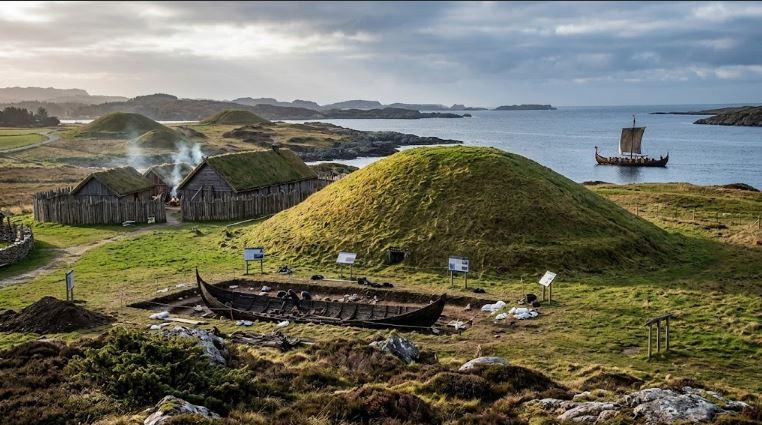
Grønhaug is a monumental ship-grave mound on northern Karmøy. Riksantikvaren says the mound is about 30 meters in diameter and around 4 meters high. Inside it lay a ship of oak measuring about 15 meters long and 2.8 meters wide. Shetelig’s 1902 excavation confirmed a ship burial from the second half of the 800s.
The 2026 excavation did not open the entire mound. Science Norway reported that archaeologists reopened roughly the same trench that Shetelig used in 1902, with a small extension. The work aimed to test preservation conditions, examine layers inside the mound, and collect samples for dating and further analysis.
That limited approach matters. A modern excavation does not need to empty a mound to produce new knowledge. In fact, restraint can protect the site. By working in a targeted trench, archaeologists can answer preservation, dating, and construction questions while leaving much of the monument intact.
This is why the 2026 work should not be framed as treasure hunting. It is heritage management, research, and source recovery in a fragile burial landscape.
Why Haakon Shetelig’s 1902 Excavation Still Shapes The Story
Haakon Shetelig’s 1902 excavation still shapes the Grønhaug story because his trench created the modern archaeological starting point. Rogaland County reports that the 2026 team dug in the same trench Shetelig had opened 124 years earlier, but this time archaeologists went deeper. Shetelig had wanted to reopen Grønhaug in 1926, partly because he suspected that the mound may originally have belonged to the Bronze Age. That second excavation never happened.
The 2026 discoveries make that old suspicion newly relevant. Ødegaard said that, given the Bronze Age landscape around Grønhaug, it is likely that the site had also been a Bronze Age mound. The team found the outer edge of what may be a Bronze Age grave, lower in the ground than the Viking Age traces.
This historical loop is important. Shetelig opened the mound in 1902 and left behind records, removed material, and unanswered questions. Modern archaeologists returned with new methods and a different set of concerns: preservation, stratigraphy, dating, landscape context, and possible monument reuse.
Grønhaug therefore tells a story about archaeology itself. Each generation asks new questions of the same mound.
Why Karmøy Is More Than One Ship Grave
Karmøy is more than one ship grave because Grønhaug sits within an unusually dense concentration of monumental burial sites along Karmsundet. Rogaland County’s cultural heritage page describes Grønhaug as one of two monumental ship graves by Karmsundet, with Storhaug about 1.5 kilometers farther north. It also notes that Grønhaug contained remains of a man in a 15-meter ship, along with finds such as clothing, carpets, down bedding, wax, wooden vessels, bowls, and parts of an English glass beaker. (Grønhaug On Karmøy)
The wider cluster matters even more. Rogaland County has emphasized that Storhaug, Grønhaug, and Salhushaugen form an unusually tight and connected ship-grave landscape. In earlier UiS reporting, archaeologists also discussed these three mounds as part of a major Karmøy concentration from the beginning of the Viking Age, with Salhushaugen identified through georadar as likely containing traces of a ship about 20 meters long.
That cluster changes the interpretation. Grønhaug should not be studied as a lonely mound. It belongs to a landscape where several monumental ship graves spoke to each other across route, visibility, memory, and power.
Why Karmsundet Matters
Karmsundet matters because it was not a passive backdrop. The narrow sound separates Karmøy from mainland Norway and formed a crucial maritime route along the western coast. Riksantikvaren notes that Grønhaug has a strong location, with Avaldsnes Church visible across Karmsundet. The visual relationship between burial mound, sea route, and power center gives the site much of its force.
That matters for Viking Age interpretation. A ship grave beside an important sailing route did not only bury a dead person. It addressed anyone moving through the landscape. Crews, traders, travelers, rivals, allies, and local communities could see the monument and understand that someone powerful claimed memory and authority there.
Rogaland County describes Storhaug as a visible marker along the route and highlights the broader ship-burial landscape of Viking-Age Norðvegr, “the way toward the north.” The same county report says the concentration of Storhaug, Grønhaug, and Salhushaugen gives Rogaland an unusually coherent ship-grave landscape.
Grønhaug’s meaning therefore depends on movement. The mound looked toward a route, not just inward toward a grave.
Why Avaldsnes Gives The Mound Political Weight
Avaldsnes gives Grønhaug political weight because the ship grave sits near one of western Norway’s best-known centers of power. Riksantikvaren says the Grønhaug ship dates to around AD 864, connecting the grave to the period when Harald Fairhair used Avaldsnes as a royal seat. Rogaland County adds a careful warning from Håkon Reiersen: Grønhaug has sometimes been proposed as Harald Fairhair’s grave, but it is not his grave.
That distinction matters. The mound belongs to the world of Harald’s power center, but it should not be turned into Harald’s personal burial without evidence. A good article should use Avaldsnes as context, not as a shortcut.
The Avaldsnes Port of Power research project shows why that context remains important. The project investigates the port area at Avaldsnes, large burial monuments along Karmsundet, and ship finds on land and at sea. Its research page says Karmøy’s ship burials, Storhaug and Grønhaug, are very central to understanding the region’s role in the development of Viking ship technology and maritime power.
Grønhaug’s reopened trench therefore sits inside a much larger question: how did Karmøy become a maritime power landscape?
Why The Possible Bronze Age Layer Matters
The possible Bronze Age layer matters because it turns Grønhaug from a Viking Age monument into a reused burial landscape. Rogaland County reports that the 2026 excavation found what may be the outer edge of a Bronze Age grave lower in the mound. Science Norway describes archaeologists uncovering a man-made stone cairn beneath the Viking grave, covered by layers of soil and turf, with stones arranged around the base in a kerb.
That finding remains cautious because samples still need analysis and dating. Rogaland County says months of laboratory work and dating will follow before archaeologists can conclude more securely whether they found Bronze Age material beneath the Viking Age ship grave.
Even as a preliminary result, the idea matters. Reuse would mean Viking Age builders did not choose an empty place. They may have placed a ship grave on or above an older monument already tied to memory, ancestry, visibility, or sacred landscape.
That is why “layered burial landscape” is the right phrase. Grønhaug may preserve a Viking Age ship grave, a Bronze Age cairn or mound, a 1902 excavation trench, and a 2026 research intervention in one place.
Why Reuse Changes The Viking Burial Story
Reuse changes the Viking burial story because it suggests that Viking Age elites built authority by engaging older landscapes. A ship grave over an earlier mound would not merely honor the person buried in the ship. It would also claim a relationship with older monumentality.
This pattern makes sense in a landscape like Karmøy. Bronze Age mounds, Iron Age graves, Viking ship burials, and later royal sites can form a chain of remembered places. A new burial placed on an older mound could borrow depth from the past. It could say: this power does not begin today.
Old Norse News has already explored how Herlaugshaugen’s ship burial complicates Viking traditions by connecting ship graves with older monument histories. Grønhaug adds another version of that lesson on Karmøy. The Viking Age did not always erase older landscapes. Sometimes it reused them.
That idea should remain careful. The Bronze Age layer still needs firmer dating, but the interpretive question is already important.
Why Preservation Conditions Are The Real News
Preservation conditions are the real news because they determine what future research can recover. Ødegaard told Rogaland County that the excavation answered its goal concerning preservation conditions and revealed more than expected. Reiersen and the team found birch bark, heather, and wood pieces that they believe are more than 1,000 years old. Rogaland County describes the mound as unusually damp and well preserved.
Science Norway adds a striking detail: Ødegaard said archaeologists reached the old ground surface from the Viking Age and could see blueberry plants and heather that were growing there when the mound was built. Some plants still had leaves. She interpreted that as evidence that the mound was built during the summer half of the year.
Those details change how readers should think about a mound. It is not only soil piled over a ship. It can preserve vegetation, construction layers, organic material, and environmental clues. Those clues may answer questions about season, building process, preservation risk, and mound formation.
A ship grave can teach even when the ship itself survives poorly.
Why The Ship Remains Are Still Important
The ship remains are still important, even though much of the vessel has deteriorated. Riksantikvaren says the Grønhaug ship was built of oak and measured about 15 meters long and 2.8 meters wide. Science Norway reports that parts of the ship’s bottom and hull may still be preserved inside the mound, while the 1902 excavation removed loose planking around the oar holes and took it to Bergen.
The 2026 team found one or two rivets that probably came from the ship, according to Science Norway. Rogaland County later reported that archaeologists displayed ship nails from the mound. These small metal pieces matter because ship-burial evidence often survives as fasteners after wood has decayed.
The ship also affects the mound’s social meaning. Burying a ship demanded resources. It required a vessel, a grave ceremony, labor, earth-moving, and a location visible from Karmsundet. Even a plundered and poorly preserved ship grave can still reveal elite action.
Grønhaug’s ship does not need to be as well preserved as Oseberg to matter. Its landscape position and layered context make it historically powerful.
Why Looting Does Not End The Story
Looting does not end the story because a plundered mound can still preserve structure, environmental evidence, and secondary activity. Rogaland County’s Grønhaug page says the grave had been plundered shortly after burial. Science Norway also notes that looting is common in ship graves and compares the issue with Oseberg.
That matters because public audiences often treat a looted grave as ruined. Archaeologists do not. Looting can remove elite objects, but it can also leave behind disturbed layers, tool traces, robbed trenches, organic remains, fasteners, construction elements, and clues about how later people interacted with the dead.
Grønhaug also complicates the story of looting through the birch bark layer. Ødegaard told Science Norway that researchers previously thought the birch bark may have connected to the looting event, perhaps as a way to move through the damp mound or as a ritual action. After the 2026 work, she said archaeologists are less certain and now consider whether it may belong to mound construction instead.
That uncertainty is useful. It shows why reopened excavation matters. Old explanations can change when new layers become visible.
Why UNESCO Work Raises The Stakes
UNESCO work raises the stakes because Grønhaug now contributes to a larger national discussion about Norway’s Viking ship-burial landscapes. Riksantikvaren has recommended that The Ship Burial Landscapes of Viking-Age Norðvegr be placed on Norway’s tentative list for UNESCO World Heritage consideration. The recommendation includes seven monumental ship-burial landscapes, including Storhaug on Karmøy.
Grønhaug is not simply a replacement for Storhaug in that recommendation. Instead, new knowledge from Grønhaug strengthens the broader understanding of the Karmsundet landscape. Rogaland County says knowledge about Grønhaug contributes to possible world heritage work, while Storhaug remains one of the seven listed sites in the recommendation.
That distinction matters. A careful article should not claim that Grønhaug is already on UNESCO’s World Heritage List. It is not. Nor should it claim that UNESCO status has been secured. The tentative-list process is only an early formal step.
Still, the 2026 excavation gives the Karmøy landscape stronger depth. It helps show why this coast matters for Viking Age power, ship burial, and monument memory.
Why Grønhaug Is Not A Simple Harald Fairhair Story
Grønhaug is not a simple Harald Fairhair story, even though its dating places it near the period associated with Harald’s power at Avaldsnes. Riksantikvaren states that the ship dates to around AD 864, and Rogaland County quotes Reiersen saying the grave belongs roughly to the time when Harald Fairhair used Avaldsnes as a royal seat. Yet Reiersen also says the mound is not Harald’s grave.
That careful line protects the evidence. Harald’s name draws attention, but names can also distort interpretation. A grave can belong to a political landscape without belonging to the most famous ruler attached to that landscape.
The stronger story asks what kind of ruler, elite family, or power group could use a ship burial at this location. It asks why the grave stood near Karmsundet and within visual range of Avaldsnes. It asks how the mound related to Storhaug, Salhushaugen, and older Bronze Age monuments.
Grønhaug becomes more interesting when it stops trying to be one king’s grave and starts revealing a layered power landscape.
Why Karmøy’s Ship Graves Need Different Dates And Caution
Karmøy’s ship graves need different dates and caution because the dating of Grønhaug has been debated. Older summaries and local heritage pages have sometimes placed Grønhaug earlier, near the end of the 700s, beside Storhaug. Recent reporting connected with the 2026 reopening uses a later date, around AD 864, while noting that the dating debate has been significant.
This matters because readers need chronology, not just drama. Storhaug has been described as one of the earliest Scandinavian ship graves and is central to the world heritage recommendation. Grønhaug now appears, in recent reporting, as a later ninth-century ship grave that may sit on an older monument. Salhushaugen has been identified through georadar as likely containing a ship.
The cluster matters more than a single fixed date. Karmøy’s landscape shows repeated ship-burial practice, route control, monumental display, and possible reuse of older burial places.
That is why Grønhaug belongs in a layered landscape article. The mound’s value does not depend on making it the oldest, richest, or most famous. It depends on how it connects periods and places.
Why Reopening A Mound Requires Restraint
Reopening a mound requires restraint because excavation is destructive. Once archaeologists remove layers, they cannot put them back in their original state. The 2026 work at Grønhaug shows a modern approach: open a targeted trench, check preservation conditions, collect samples, answer specific questions, and preserve as much as possible for future research.
Rogaland County reports that the team left a letter to the future inside the mound when the excavation ended, together with a glass beaker from Avaldsnes, coins, and a light. That gesture does not replace scientific recording, but it signals awareness that future archaeologists may return with better tools and new questions.
The same article notes that several months of sample analysis and dating remain before stronger conclusions can be drawn. That patience matters. Public interest moves quickly, but archaeology needs time.
A reopened mound should not be treated as instant proof. It should be treated as a source that now enters a longer phase of laboratory work, comparison, and interpretation.
Why Visitors Should Treat Grønhaug Carefully
Visitors should treat Grønhaug carefully because it is a fragile cultural monument, not a scenic pile of earth. Rogaland County’s visitor page says access is by nature path, the walk is about 100 meters, there is no universally designed access, and there is no dedicated parking. It also asks people to respect the local environment and contact the county if they notice damage.
Those practical details matter for public heritage. A mound becomes vulnerable when attention rises. More visitors can mean more foot traffic, more informal paths, more pressure on nearby residents, and more risk of damage if people climb, dig, or remove material.
A good visitor should view the mound from appropriate paths, avoid disturbing the ground, and understand that the visible surface protects archaeological layers below. The most important evidence may not look dramatic from outside.
Grønhaug’s 2026 reopening should increase respect, not casual use.
What Readers Should Verify Before Making Big Claims
Readers should verify several points before making big claims about Grønhaug. First, the 2026 excavation was limited and targeted. Archaeologists did not open the entire mound. Second, the ship grave was first excavated in 1902 by Haakon Shetelig and has been heavily shaped by that earlier trench.
Third, recent reporting places the ship around AD 864, while earlier dates and debates remain part of the research history. Fourth, the possible Bronze Age layer is promising but still awaits stronger dating and sample analysis. Fifth, Grønhaug should not be called Harald Fairhair’s grave.
Finally, UNESCO wording needs care. Storhaug is one of the seven ship-burial landscapes in Riksantikvaren’s recommendation to Norway’s tentative list. Grønhaug strengthens the Karmøy landscape context, but UNESCO status has not been granted.
Those limits make the article more trustworthy. The evidence already gives a strong story without exaggeration.
Why Grønhaug Makes Karmøy A Layered Burial Landscape
Grønhaug makes Karmøy a layered burial landscape because it shows how one mound can connect several histories at once. It preserves traces of a Viking Age ship grave. Beneath that grave, archaeologists may have found a Bronze Age cairn or mound. The site also belongs to a dense Karmsundet ship-grave cluster with Storhaug and Salhushaugen. Nearby Avaldsnes adds the context of a major power center. The mound also carries the marks of Shetelig’s 1902 excavation and the 2026 reopening by UiS archaeologists.
That layered story is stronger than a simple “new Viking treasure” headline. The 2026 excavation matters because it brings preservation, stratigraphy, route geography, monument reuse, and world heritage work into the same conversation.
For oldnorsenews.org, the key lesson is clear: Viking ship graves were not isolated burial events. They could reuse older monuments, face important sea routes, mark political landscapes, and remain meaningful long after the ship decayed or the grave was looted.
Grønhaug’s reopened trench now asks readers to see Karmøy differently. The island is not only a place with famous Viking associations. It is a long-used burial and power landscape where Bronze Age memory, Viking Age ship ritual, Avaldsnes kingship, and modern heritage work still meet in the ground.
