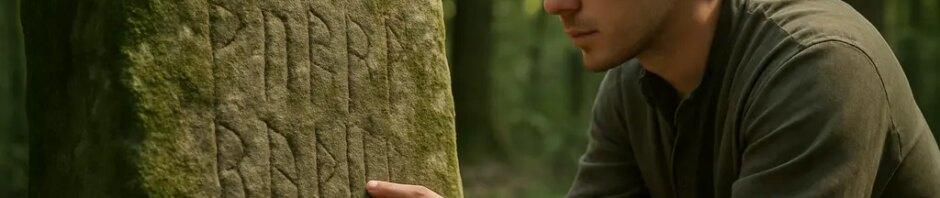
The Heavener Runestone controversy sits at an uneasy crossing of local pride, runic interpretation, and the hard limits of archaeological evidence. The stone is a large sandstone slab in Le Flore County, southeastern Oklahoma, with eight carved characters. It has been described in state history writing as the centerpiece of Heavener Runestone State Park, which was dedicated on October 25, 1970, after earlier local interest and documentation. The same account records local traditions that the stone was seen by a Choctaw hunting party in the 1830s and known to trappers in 1874, while treating those stories as part of the site’s history rather than verified proof of medieval Norse travel into Oklahoma according to the Oklahoma Historical Society.
What The Heavener Runestone Controversy Centers On
The central question is simple to state but difficult to prove: do the marks on the Oklahoma stone preserve evidence of a pre-Columbian Norse presence in the American interior, or are they a later inscription that acquired a Viking Age story through local memory and modern advocacy? The research notes describe the slab as approximately 12 feet high, 10 feet wide, and 2 feet thick, bearing eight characters. Its scale gives the site a striking visual force, but size is not the same as date.
The inscription is commonly transcribed as “gnomedal,” though some readings prefer “glomedal.” One proposed translation reads it as “Glome’s Valley.” That reading has helped sustain the idea that a Norse-speaking person marked the place, perhaps as a claim, memorial, or travel sign. Yet a translation can only carry historical weight if the script, language, weathering, context, and associated evidence support the same date and setting.
The Problem Of A Single Object
Single artifacts can be culturally powerful but historically fragile. A lone inscription without settlement remains, tools, graves, trade goods, or secure excavation context is difficult to use as proof of migration or exploration. In this case, the research notes state that no archaeological evidence has been found near the Heavener stone to substantiate Norse presence in the region. That absence does not prove who carved it, but it does limit what historians can responsibly claim.
This is the same caution that shapes debates around other isolated Norse-linked objects in North America. A relevant comparison is the ongoing debate about the Maine Penny, where a Norse coin raises serious questions about contact, exchange, and provenance without proving a Viking settlement in Maine. The Oklahoma stone raises a parallel public-history problem: how far can one object carry a large historical claim?
Evidence Claimed For A Norse Reading
Supporters of a Norse interpretation have focused on the appearance of the eight characters and on readings that connect the inscription with a personal or place-name formula. If the carving truly meant “Glome’s Valley,” it would appear to mark a place through a named individual. Such a reading understandably appeals to modern readers because it sounds brief, human, and plausible as a wayfarer’s mark.
Reading The Eight Characters
The difficulty is that runes are not simply mysterious signs that become Norse when they resemble Scandinavian letters. Runology depends on the form of each character, the alphabetic system in use, expected spelling habits, the likely date, and comparison with securely dated inscriptions. The research notes state that the Heavener inscription has been described as using characters from both Elder Futhark and Younger Futhark. That mixture is one reason runologists have treated a medieval Norse date with skepticism, since such a combination would be anachronistic for a straightforward Viking Age inscription.
Some advocacy efforts have gone further, including claims that the inscription encodes a date as early as November 11, 1012. Robert L. Dorman’s Oklahoma history collection is cited in the research notes in connection with such claims, but the notes also state that these cryptographic interpretations have not been accepted by mainstream runologists or historians in Dorman’s Oklahoma history account.
Why The Heavener Runestone Controversy Persists
The Heavener Runestone controversy persists because the stone is not only an inscription. It is also a place, a park, a local story, and a point of contact between Scandinavian American curiosity and Oklahoma heritage tourism. Around the turn of the 21st century, the park reportedly drew about 93,000 visitors annually. That number helps explain why the site remains visible even as scholarly skepticism holds.
People are drawn to inscriptions because they feel like voices. Eight carved marks on a sandstone face invite questions: who stood here, who cut them, and why? In Old Norse literature, names and place-marking carry memory across generations. Yet historical method asks the cooler questions first: where is the secure documentation, what is the dating evidence, and what else was found nearby?
Why Most Scholars Remain Skeptical
For the Heavener Runestone controversy, the skeptical case rests on several connected points rather than on a single dismissal. The inscription’s reported mixture of runic systems creates a linguistic problem. The lack of supporting archaeological material creates a contextual problem. The uncertain early documentation creates a provenance problem. Together, these issues make a Viking Age reading difficult to defend under ordinary scholarly standards.
Alphabet Problems And Dating
The research notes cite Swedish runologist Henrik Williams, who visited in 2015 and assessed the inscription as most likely from the 19th century rather than the Viking Age. He reportedly estimated only about a 20 percent probability that it could date from the 10th or 11th century. That is not the same as saying the question is mathematically settled. It means that a specialist judged the later explanation much more likely.
Archaeologist Lyle Tompsen, in a 2007 University of Leicester master’s thesis later published in 2011, also concluded that the stone is best considered a modern creation. The research notes attribute that conclusion largely to the lack of contextual support and linguistic inconsistencies. Those are exactly the kinds of issues that matter in inscription studies: a carved text must be read not only as letters, but as an object in a dated cultural setting.
Archaeological Context In Le Flore County
If Norse travelers had reached southeastern Oklahoma in the 10th or 11th century, historians would look for more than a single carved stone. They would ask whether settlement traces, tools, graves, trade goods, or other material signatures supported that claim. The research notes state that no such evidence has been found near the Heavener Runestone. That absence is central to the consensus position.
Caution does not require contempt for local tradition. It asks that each category of evidence be weighed for what it can and cannot show. Anecdotes about 19th-century sightings may document local knowledge of the stone, but they do not prove an 11th-century carving. A proposed runic reading may be interesting, but it cannot by itself establish a Norse route into Oklahoma.
Heritage Tourism And Public Memory

The public life of the stone matters even if the inscription is not accepted as Viking Age evidence. Heavener Runestone State Park became a place where visitors could encounter a contested object and a local story about deep time, migration, and mystery. Heritage tourism often works this way: a site becomes meaningful because people gather around the question, not only because scholars agree on the answer.
Local Lore And Park Identity
The reported stories of a Choctaw hunting party seeing the stone in the 1830s and trappers knowing it in 1874 belong to the park’s cultural memory. The research notes make clear that these accounts are anecdotal and have not produced verifiable documentation for a medieval origin. Still, they show how the stone entered regional storytelling before becoming a formal park attraction.
That distinction is worth preserving. Public history does not need to flatten folklore into fact or dismiss it as worthless. Lore can show how communities attach meaning to a place. Archaeology and runology ask a different question: whether the object can bear the historical claim placed upon it. Readers comparing how cultural memory circulates across related heritage sites may also find agheiro.org valuable in studying cultural networks.
What The Heavener Runestone Controversy Can Teach
The Heavener Runestone controversy can teach a careful lesson about Norse history in North America: desire for a wider Viking story cannot substitute for context. A runic-looking inscription in Oklahoma is intriguing, but the stronger interpretation must account for script history, archaeological absence, documentation, and specialist assessment. As of 2026, the research notes indicate that academic opinion remains skeptical and that most scholars do not treat the stone as evidence of pre-Columbian Norse exploration of Oklahoma or the U.S. interior.
That does not make the site meaningless. It makes it a valuable case study in how ancient-looking marks become modern heritage. The stone invites readers to ask why Norse identity carries such imaginative power far from Scandinavia, why local communities preserve contested objects, and why evidence-based history must resist both easy debunking and romantic certainty.
The safest reading is also the most useful one: the Heavener Runestone is a culturally significant Oklahoma monument with a disputed inscription. Its Norse claim remains unproven, and the prevailing scholarly view favors a later origin. For those of us drawn to runes, sagas, and the long afterlife of northern stories, that caution is not a closed door. It is the discipline that lets the old signs speak only as far as the evidence allows.
