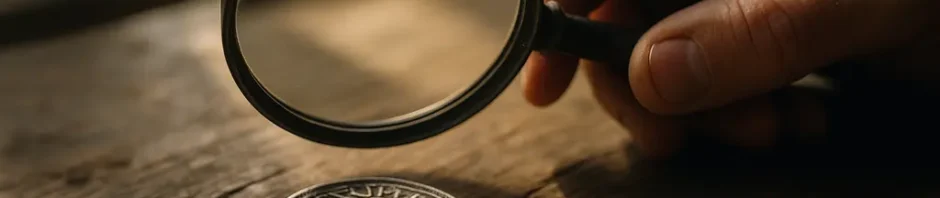
Islamic Silver in early Viking coinage is not just a question of where metal came from. It is a question about movement, minting, trust, and cultural contact in the early medieval north. The Damhus hoard, found near Ribe in Denmark, gives this issue unusual force because it joins a precise archaeological find with scientific analysis of metal sources and visible choices in coin design. The evidence does not make the Vikings modern merchants in disguise, nor does it erase raiding from Viking Age history. It does, however, press us to read early Scandinavian economy as part of a wider Eurasian exchange system.
How Islamic Silver Reached Early Viking Coins
The Damhus Hoard Near Ribe
The Damhus hoard was unearthed in 2018 near Ribe and contained 226 Viking Age silver pennies. The coins date to about AD 830–850, placing them among the earliest known Viking coins. Reports on the study state that analyses connect the metal in these pennies to melted Islamic dirhams, and that as many as 30 different dies were used in minting, a sign of organized production rather than a few isolated experiments reported study.
Those details matter because Ribe was already a significant trading place in the Viking Age research picture. The Damhus coins point to activity that was technical as well as commercial: silver had to be gathered, melted, alloyed or prepared, struck with dies, and accepted by people who used the coins. None of this proves a single centralized state policy, but it does show that early Danish coinage cannot be understood only as local imitation. The metal itself had travelled through much wider routes before it entered Scandinavian use.
Why Islamic Silver Matters In Ribe
The evidence for Islamic Silver in these coins gives Ribe a sharper economic setting. A Danish penny made near Ribe could carry local imagery while being struck from metal that once circulated as an Islamic dirham. That is not a small detail. It means a coin can be local in form and foreign in material at the same time.
For readers who want a narrower treatment of the same find, our related analysis of Danish Viking coin trade follows the Damhus hoard in closer detail. Here, the wider point is cultural exchange. The coin is not a neutral object. It connects mining, minting, trade, reuse, and symbolic display in a piece of silver small enough to pass from hand to hand.
What The Metal Analysis Can And Cannot Show
Lead Isotopes And Melted Dirhams
Lead isotope analysis is central to the interpretation because it can help researchers compare the chemical signature of the silver with known source patterns. In the Damhus case, the research notes state that a significant portion of the silver used in the coins came from Islamic sources. That finding supports the view that Islamic dirhams were not only arriving in Scandinavia as recognizable foreign coins; at least some were being melted and remade into local pennies.
Yet the analysis has limits. It does not tell us the name of a trader, the exact route of every dirham, or whether each piece of metal moved through peaceful exchange, payment, gift, tribute, or some combination of mechanisms. Archaeology often gives us strong material signals without preserving the whole human chain behind them. The safer claim is that the Damhus coins show access to silver of Islamic origin before AD 850 and that this access was substantial enough to feed early minting.
Dies, Scale, And Minting Choices
The reported use of up to 30 dies is also significant. Dies wear out, and multiple dies suggest that the coins were produced in notable quantities. That does not let us calculate an exact production total from the research notes alone, but it does argue against a tiny, symbolic batch. Minting required planning. Someone had to make or commission the dies, maintain coin designs, and strike enough pennies for circulation or storage.
This is where early Viking coinage becomes especially interesting. The silver source points outward, while the minting process points to local organization. The Damhus hoard therefore sits between two scales of history: the long-distance movement of metal and the local decision to turn that metal into pennies.
Symbols, Trade, And Cultural Exchange
Odin, Stags, And A Foreign Metal
The research notes state that the coins often include Norse symbols, including depictions associated with Odin and stags. This pairing of imported or acquired silver with Scandinavian symbolic language is one of the most revealing features of the find. It would be too strong to say that the coins prove a clear ideological program. Still, they do show that the makers of the coins did not simply preserve the identity of the dirham. They recast the metal into forms meaningful within their own setting.
As a writer drawn to the meeting place of language, myth, and material culture, I find this especially striking. A coin may not speak like a poem, but it still carries signs. If an image evoked Odin or a stag for its users, then the object joined economic trust with cultural recognition. The metal came from far away; the image made it legible closer to home.
Exchange Without Simple Blending
Cultural exchange is often described too neatly. The Damhus coins do not show that Scandinavian communities adopted Islamic religion, language, or political forms. Nor do they show a one-way flow of influence from the Islamic world into the north. What they show more securely is the reuse of silver from Islamic coinage within a Scandinavian minting context.
That distinction protects the evidence from being asked to do too much. Metal movement can reveal trade contact and economic dependence without proving deep cultural borrowing in every area of life. The coins are powerful because they are specific: silver was melted, pennies were struck, and Norse symbols appeared on objects made from a wider pool of Eurasian metal.
What Islamic Silver Does Not Prove
Trade Is Not The Only Possible Path
Islamic Silver in the Damhus coins supports the presence of long-distance connections, but it does not prove one simple route from the Caliphates to Ribe. The research notes allow for direct trade or acquisition of Islamic silver. That phrasing matters. Silver could pass through many hands before reaching Scandinavia, and the final user of the metal may not have known its full history.
This is one reason cautious interpretation is needed. It is tempting to turn the Damhus hoard into a clean story of merchants sailing from one world to another. The actual evidence is both stronger and narrower. It shows the presence and reuse of silver with Islamic origins in early Danish coinage. The social path of each fragment remains harder to reconstruct.
Why A Raider-Only Image Falls Short
The Damhus evidence also challenges the older habit of viewing Vikings mainly as raiders. The research notes describe economic implications that place Scandinavian actors within a broad Eurasian economy. That does not deny violence in the Viking Age. It simply prevents violence from becoming the only lens.
Modern readers often meet medieval evidence through museums, archives, small history sites, churches, and community organizations. Within the same publishing network, Bethel NC UMC provides another perspective on how institutions shape public memory. Though different in focus, it highlights the role diverse entities play in preserving and interpreting history. For Viking studies, the public task is similar: keep the evidence visible, resist easy stereotypes, and explain uncertainty plainly.
What Islamic Silver Changes About Viking Coinage
Islamic Silver changes the story of early Viking coinage because it makes the penny a record of contact. The Damhus coins were not only local money. They were remade metal, carrying traces of exchange between Scandinavia and regions tied to Islamic dirham circulation. Their date range, AD 830–850, makes that point especially important because it places such contact early in the history of Scandinavian coin production.
The find also changes how we read symbols. Norse images on coins made from melted dirhams show that cultural identity and imported material could sit together in one object. A coin could announce local meaning while depending on foreign silver. That tension is not a weakness in the interpretation; it is the historical point.
For Norse history and archaeology, the Damhus hoard is valuable because it links science with story. Lead isotopes give one kind of evidence. Dies give another. Symbols give another. Together, they suggest a Viking world that was not sealed off at the edge of the North Sea or Baltic routes. It was connected, adaptive, and economically alert, while still expressing itself through Scandinavian forms.
The safest reading is also the most interesting one. Early Danish pennies do not turn Vikings into a single class of traders, and they do not make cultural exchange simple. They show that silver from Islamic coinage could be melted into local money before AD 850, at a scale large enough to matter. In that small disc of metal, the Viking Age becomes less isolated and far more connected.
