
Nonneseter’s new excavation makes Bergen’s medieval nuns visible again because a modern public-space project has opened a rare window into one of Norway’s most important female religious communities. On August 26, 2026, NIKU, the Norwegian Institute for Cultural Heritage Research, reported that archaeologists were excavating at Nonneseter Monastery in Bergen while the area around the Nonneseter light-rail stop is being redeveloped. The work takes place in the monastery church’s extended choir, close to the area where NIKU uncovered church foundations and around 30 graves during the first Bybanen-route excavation in 2006. This matters because Nonneseter is no longer only a place name at a transit stop. It is becoming readable again as a medieval convent landscape shaped by prayer, burial, work, learning, property, and women’s institutional power. (NIKU Nonneseter Excavation)
Why Nonneseter Matters Now
Nonneseter matters now because Bergen is literally making space for medieval history in the middle of a busy modern transport corridor. NIKU says the excavation connects with plans to create a new urban space at the Nonneseter light-rail stop, a project led by Bergen Municipality and Vestland County Municipality. The former Sølvvarefabrikken and a neighboring building are being removed so the remaining medieval structures can stand in clearer relationship to each other.
That urban change gives the archaeology its public hook. Bergen Municipality reported in July 2026 that only parts of the old silverware factory remained after demolition work, and that the goal is to bring the monastery history at Nonneseter into the light. The municipality bought the factory building and associated rental property in 2020 in order to remove them and make the monastery ruins more visible.
The story is therefore not only about a trench. It is about historical visibility. A women’s monastery that modern streets and buildings had hidden for decades may now regain a visible place in Bergen’s cityscape.
What Archaeologists Are Excavating
NIKU says the 2026 excavation is located in the extended choir of the monastery church. That detail matters because the choir formed one of the most sacred areas of a medieval church. In 2006, archaeologists found church foundations and about 30 graves from the monastery period, with several graves placed under the floor of the former choir.
NIKU explains why this location matters. In medieval churches, burial inside the church belonged to a small group of people. Those who rested in or near the choir were often clergy, royalty, or wealthy benefactors who had given gifts, land, or money to the church. The 2026 field lies near the wall of the surviving choir chapel, which makes new grave discoveries possible.
That does not mean every grave belongs to a nun. The article should avoid that shortcut. The graves may include people connected with the convent in different ways: religious women, patrons, clergy, elite supporters, or others who gained access to privileged burial space.
The excavation makes the nuns visible by restoring their institution to view, not by proving that every skeleton belonged to a nun.
Why The Two Surviving Buildings Matter
Only two medieval structures remain above ground from Nonneseter today: the tower base in the west and the choir chapel in the east. NIKU says these two buildings have stood hidden between newer structures for decades. The new public-space plan will mark the church room and monastery garden so people can understand the relationship between the surviving parts for the first time in more than 100 years.
Store norske leksikon gives a longer architectural context. It says Nonneseter’s west tower base still survives and counts as Bergen’s oldest preserved building element. It also explains that the monastery church had a massive western tower, and that the church was expanded eastward in the second half of the 1200s with a new choir and what probably served as a sacristy.
This architectural story matters because a convent is not only a spiritual community. It is also a built institution. The tower base, chapel, church floor, choir, graves, tiles, and garden layout all help reconstruct how religious life occupied space.
Modern Bergen is not rebuilding the medieval convent. It is making the surviving evidence legible again.
Why The Nuns Have Been Hard To See
The nuns have been hard to see because Nonneseter’s surviving remains became fragmented, partly hidden, and surrounded by later urban development. The Fortidsminneforeningen notes that present-day Bergen makes it difficult to imagine the medieval convent’s original setting near Store Lungegårdsvann, where it once had a commanding position and open views. Today, only the tower base and southern choir chapel remain visible above ground.
That physical loss has shaped public memory. Many people know Nonneseter as a light-rail stop, not as a medieval women’s religious house. The University of Bergen’s Medieval Cluster says exactly this: for many people, Nonneseter is a Bybanen stop, even though the name comes from Bergen’s oldest building and a convent that once formed one of medieval Norway’s important institutions.
The 2026 excavation therefore changes the story by restoring context. It places the two surviving structures, church plan, burial area, and daily-life finds back into one interpretive frame.
Women’s monastic history becomes easier to see when the city stops treating the ruins as isolated fragments.
Why The Order Question Needs Careful Wording
The order question needs careful wording because sources do not all frame Nonneseter in exactly the same way. NIKU says the monastery was probably founded in the first half of the 1100s as a Benedictine convent for nuns. Store norske leksikon also describes Nonneseter as a women’s monastery in Bergen belonging to the Benedictine order, founded in the first half of the 1100s.
Other sources preserve older or more cautious language. Bergen byleksikon says Nonneseter was founded around 1150 by the Cistercian Order as its only nunnery in Norway. Fortidsminneforeningen notes uncertainty about the convent’s affiliation but says information from the late 1400s indicates a Cistercian convent.
That disagreement matters for source-sensitive writing. A strong article should not pretend that the issue is simpler than the sources allow. The safest phrasing follows the newest specialist framing from NIKU and Store norske leksikon while noting that older and heritage summaries sometimes use Cistercian language or describe the affiliation as uncertain.
The point is not to turn the article into a monastic-order debate. It is to show that Nonneseter’s history still requires careful reading.
Why The 2006 Graves Matter Again
The 2006 graves matter again because the 2026 excavation lies close to the same sacred area. NIKU says the earlier Bybanen-related investigation uncovered church foundations and around 30 graves from the monastery period. Several graves lay under the floor of the former choir.
That earlier discovery gives the new excavation a clear research question. Will the area next to the surviving choir chapel contain more burials? Will archaeologists find objects connected with worship, writing, craft, dress, or daily work? Can the new trench explain more about how the extended choir developed?
These questions matter because church-floor burials often reveal social hierarchy. Burial location can show who had access to sacred space. Grave placement may connect with patronage, religious office, family memory, or institutional status.
Still, the public should avoid overclaiming before NIKU publishes the new results. The 2026 article says archaeologists hope to find more graves and new objects. It does not say that the new excavation has already identified named nuns, abbesses, or patrons.
Good historical writing lets the excavation finish before turning expectation into fact.
Why Daily-Life Objects Make The Nuns More Visible
Daily-life objects make the nuns more visible because they move the story beyond ruins and graves. NIKU reports that earlier investigations at Nonneseter found traces of the monastery church’s interior, including glazed tile floors and loose floor tiles. In 2006, archaeologists found a tile decorated with a French lily.
Other finds speak more directly to people and activity. NIKU lists coins, gaming pieces, a stylus, needles, spindle whorls, and thimbles. These objects give glimpses of work, learning, and daily life inside the monastery walls.
That range matters. A monastery was not only a church. It was a disciplined household, a property-holding institution, a place of education, and a community with routines. A stylus points toward writing or record keeping. Needles, spindle whorls, and thimbles point toward textile work and repair. Coins point toward exchange and economy. Gaming pieces may hint at leisure or learning, depending on context.
Old Norse News has often emphasized that medieval and Viking Age history becomes richer when writers look beyond elite objects and saga drama. Nonneseter offers the same lesson. Small finds can make institutional women visible without inventing biographies.
Why Women’s Religious Life Belongs In Bergen’s Medieval Story
Women’s religious life belongs in Bergen’s medieval story because Nonneseter ranked among the city’s important institutions. The University Museum of Bergen says the remains of Nonneseter lie near the railway station and describes it as the largest and richest female monastery in Norway before the Black Death. It also explains that people inside monastery walls renounced family life and personal property, while daily routines followed house rules and canonical hours, with prayer, contemplation, and literary studies filling the day.
That description helps correct a common imbalance. Medieval Bergen often appears through kings, merchants, Bryggen, bishops, Hanseatic trade, and male religious houses. Nonneseter places women’s institutional life back into the center of the city’s story.
The monastery also held wealth and property. Bergen byleksikon says Nonneseter’s landholdings in 1528 included almost 300 farms and farm shares from Sunnhordland to Nordfjord, with a concentration in Sogn and Sunnhordland. It also says the abbess elections of 1320 and 1326 preserve named abbesses, and that 35 nuns participated in the 1320 election.
These details show that the convent was not marginal. It held land, managed income, elected leaders, and shaped Bergen’s medieval religious geography.
Why The New Urban Space Changes Public Memory
The new urban space changes public memory because it will link mobility and medieval heritage. Bergen Municipality says the project will make more room for travelers, pedestrians, cyclists, and the city’s older history. The plan will open the cramped passage around the former silverware factory and highlight why the place carries the name Nonneseter.
That matters because heritage depends on visibility. A ruin hidden behind later buildings can remain legally protected while still failing to teach the public. A redesigned square, marked church floor, monastery garden, and visible relationship between tower base and choir chapel can help residents and visitors understand the place without needing a specialist map.
The plan also involves careful demolition. Bergen Municipality says workers must protect the listed monastery remains throughout the process, and that demolition uses gentle methods, including manual work and demolition robots.
Modern urban work therefore becomes part of the heritage story. The city is not simply removing newer buildings. It is reorganizing public space around a medieval convent.
Why Burial Inside The Choir Reveals Status
Burial inside the choir reveals status because medieval church space carried hierarchy. NIKU states that burial inside a church was reserved for a small group. The choir was the holiest area, and those buried there often belonged to clergy, royalty, or wealthy donors.
This does not mean every grave found in or near the choir will belong to a famous person. It does mean the location deserves attention. A grave under the choir floor may reflect religious status, elite patronage, or a connection to the monastery’s community.
Nonneseter’s women’s history matters here. If future work can identify some burials as connected with the convent’s female community, it may help researchers understand health, diet, age, movement, and burial treatment among religious women in medieval Bergen. If the burials instead belong mostly to patrons or clergy, that finding would also tell an important story about who gained access to sacred space.
Either result would make the convent more visible. Burial evidence can reveal how social power entered the church floor.
Why The Monastery Garden Matters
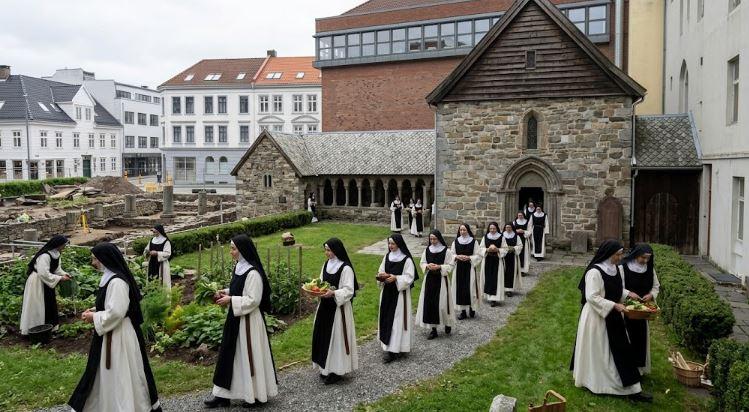
The monastery garden matters because it turns public space into interpretation. Bergen Municipality says the new area will include a garden between the two monastery buildings, with plants that could have grown in a Benedictine monastic setting. The plan also includes a wooden pergola with climbing plants, water, light, and a granite “church floor” that helps mark the former church space.
That design matters because it does not simply display ruins. It explains them. A marked church floor can help people understand where the vanished church once ran. A garden can evoke the convent’s working and contemplative life without pretending to reconstruct it exactly.
The article should frame this carefully. A modern garden is not direct archaeological evidence for every plant grown by the nuns. It is an interpretive tool. When done well, such design helps visitors understand monastic space, movement, and atmosphere.
Nonneseter’s new square can therefore teach with both archaeology and careful urban design.
Why Nonneseter Was Part Of A Larger European Network
Nonneseter was part of a larger European network because medieval monasteries connected Bergen with learning, writing, religious discipline, property systems, and continental ideas. The University Museum of Bergen frames western Norwegian monasteries such as Selja, Munkeliv, and Nonneseter as institutions that helped administer new impulses and knowledge from Europe.
That network matters for oldnorsenews.org because it places Bergen’s medieval convent inside a broader Viking-to-medieval transition. Norway did not move from Norse society into Christian medieval life through royal decrees alone. Institutions such as Nonneseter turned Christian life into buildings, schedules, texts, property, burial customs, gardens, and disciplined communities. (UiB Life At Nonneseter)
A stylus found in the choir area makes that transition especially concrete. Writing tools remind readers that monasteries helped preserve and produce knowledge. Women in religious houses could participate in literate and devotional culture even when surviving written sources preserve fewer female voices than male ones.
Nonneseter’s excavation therefore does more than reveal walls. It points toward education, record keeping, and the movement of ideas.
Why The Decline Story Needs Care
The decline story needs care because medieval sources and later summaries can carry moralizing language about religious communities. Bergen byleksikon says Nonneseter’s income was transferred to the Bridgettine community at Munkeliv in 1455, and that the nuns were later removed from the monastery after accusations of misconduct. Store norske leksikon gives a related but more cautious institutional frame: after the Black Death, Nonneseter declined; in the 1400s, King Christian I decided that the few remaining nuns should move to other Benedictine monasteries and that income and values should go to the Bridgettine community at Munkeliv.
Those accounts matter, but they need careful wording. Medieval and early modern accusations against religious women often reflect politics, property disputes, reform pressure, and gendered moral judgment as well as real institutional problems. A source-sensitive article should not turn them into sensational claims about the nuns.
The clearer historical point is stronger. Nonneseter grew into a wealthy medieval institution, declined after the Black Death, changed hands in the late medieval period, and became secularized in 1528, when the king gave it to Vincens Lunge.
The excavation can help balance that paper history with material evidence for everyday life.
Why The Site Should Not Become A Simple “Lost Nunnery” Story
The site should not become a simple “lost nunnery” story because Nonneseter was never entirely lost. Scholars, heritage groups, and Bergen residents have known the tower base and choir chapel for generations. Fortidsminneforeningen owns the surviving buildings, and the tower base became a memorial hall after later history reshaped the site.
What was lost was legibility. Later buildings squeezed the medieval remains. Streets and transit made the place familiar but not fully understood. Many people could pass through Nonneseter without seeing the convent’s scale, church plan, or women’s religious significance.
The 2026 excavation and public-space project address that problem. They do not discover Nonneseter from nothing. They reconnect surviving buildings, buried archaeology, earlier excavations, and public interpretation.
That distinction matters. “Visible again” is more accurate than “found.” The nuns return to public view through careful archaeology and urban design, not through a sudden mystery reveal.
What Readers Should Verify Before Making Big Claims
Readers should verify several points before making big claims about Nonneseter. First, NIKU’s 2026 excavation takes place in the extended choir area near the surviving choir chapel. Second, the 2006 excavation found church foundations and around 30 graves from the monastery period, but the 2026 results still need publication.
Third, burial inside the choir suggests high status or special religious connection, but it does not automatically identify every burial as a nun. Fourth, the monastery’s order affiliation requires careful wording because NIKU and Store norske leksikon emphasize a Benedictine convent, while other summaries preserve Cistercian or uncertain language. Fifth, the new garden and marked church floor are modern interpretive tools, not direct reconstructions of every medieval detail.
Finally, the project should be understood as both archaeology and urban heritage management. Bergen is not simply beautifying a stop. It is making a major women’s religious institution visible in a public space used by thousands of people.
Those limits keep the article accurate. The evidence already gives a strong story.
Why Nonneseter Makes Bergen’s Medieval Nuns Visible Again
Nonneseter’s new excavation makes Bergen’s medieval nuns visible again because it restores a women’s monastery to the city’s public memory. The 2026 work brings archaeology back to the church’s sacred interior. Earlier finds reveal graves, tiles, a stylus, textile tools, coins, and other traces of work, learning, and daily life. The public-space project will reconnect the surviving tower base and choir chapel after more than a century of visual separation.
For oldnorsenews.org, the lesson reaches beyond Bergen. Medieval religious history does not survive only in large cathedrals, kings’ sagas, bishops’ letters, or male monasteries. It also survives in women’s convents, church-floor burials, writing tools, spindle whorls, thimbles, gardens, landholdings, and fragments of buildings hidden beside modern transit routes.
Nonneseter’s nuns did not vanish from history because they lacked importance. Later urban development, fragmentary sources, and uneven public attention made them harder to see. The 2026 excavation reverses part of that process.
As Bergen opens the space around Nonneseter, the city also opens a better question: how much medieval women’s history still lies under familiar streets, waiting for careful excavation and clearer public interpretation?
