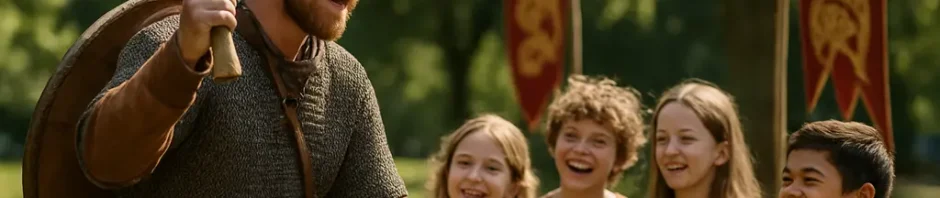
Vikings in pop culture now sit at an uneasy meeting point between entertainment, identity, mythology, and historical evidence. The appeal is not hard to see: ships, exile, gods, kinship, warfare, migration, and fate all translate well into visual drama. Yet the same appeal can flatten the Viking Age into a narrow image of violence, horned-helmet fantasy, and heroic ancestry. A cautious reading does not ask modern storytellers to produce museum catalogues. It asks what their choices make visible, what they leave out, and how audiences learn to separate Norse myth from Viking Age history.
Why Vikings in pop culture Need Caution
Vikings in pop culture And The Audience
The audience for Viking-themed media is no small niche. As of August 10, 2026, the television series Vikings had an estimated 14,497,483 fans in the United States, with an audience estimated at about 59.3% male and an average age of about 33.8 years, according to Rascasse audience data. That scale matters because popular images can become the first version of the past that many viewers meet.
The research brief for this article dates Vikings as premiering on March 3, 2013, and records that its final season had concluded by March 3, 2021, after staged releases across several markets. The same brief dates Vikings: Valhalla as premiering on February 25, 2022, and ending on July 11, 2024. Both series are therefore retrospective subjects on August 29, 2026, not events still unfolding. Their importance lies in how they shaped recent memory of the Viking Age after their release, rather than in any current broadcast moment.
Entertainment Is Not Evidence
Television drama compresses events, merges motives, and gives historical people dialogue no source preserves. That is not automatically a fault. Narrative art needs characters and conflict. The risk begins when viewers treat the finished drama as if it were a direct record of ninth- or eleventh-century Scandinavia. In that sense, Vikings in pop culture can be useful only when its invented parts are recognized as invented.
This caution also applies to Norse mythology. Odin, Thor, Loki, Ragnarök, valkyries, and giants belong to mythic traditions preserved in later texts and other evidence, not to simple documentary reporting. Readers who want a firmer distinction between textual tradition, archaeology, and later storytelling may find the site’s discussion of Norse myth and Viking history useful. The distinction is not pedantic. It is the difference between asking what people believed, what later writers recorded, and what modern creators reimagined.
Television Turned The Viking Age Into Family Drama
Kinship Makes History Legible
One reason recent Viking television worked so well is that family drama gives viewers an emotional structure. Kinship, revenge, inheritance, marriage, rivalry, and loyalty are not alien to the historical period. They were central to social life in many early medieval societies. Yet television tends to intensify those themes, making every household a stage for destiny and every conflict a signal of cultural identity.
The research brief notes that academic writing covering 2015–2023 identified a surge in television narratives about ninth-century Viking activity in England, including adaptations that used medieval conflict to speak to modern concerns about identity. Such claims should be handled carefully, because “identity” can mean different things in different studies. Still, the pattern is visible: Viking-themed dramas often speak as much to modern audiences as to the period they depict.
Foreignness And Spectacle
The same research brief also notes recent criticism of shows such as Vikings for exoticizing the Viking Age through brutality and staged otherness. This is a useful warning. If Scandinavians are shown only as violent outsiders, the viewer may miss farming, law, trade, craft, poetry, slavery, settlement, conversion, and diplomacy. The Viking Age contained raiding and warfare, but it was not only raiding and warfare.
Public memory often keeps the image that is easiest to recognize. A shield wall, longship, axe, or raven banner reads quickly on screen. A land dispute, textile workshop, seasonal farm economy, or legal assembly requires slower interpretation. This imbalance does not mean visual media are worthless. It means that historians, teachers, museums, and heritage writers must ask what the image is doing.
Games Made Viking History Playable
From Watching To Acting
Video games changed the popular use of Norse material by asking players not only to watch but to act. The research cited by Kotaku reported that since the start of 2019 at least nine major Viking-themed games had been released, with at least six in 2018, and at least 16 well-known Viking-related games from 2018 through 2021 when rereleases were included, according to Kotaku’s survey of Viking games. That cluster helps explain why Vikings in pop culture became strongly interactive during the late 2010s and early 2020s.
The supplied research brief identifies Assassin’s Creed Valhalla, released in 2020, as a major recent title set in 873 AD during Viking activity in Britain. It also identifies God of War Ragnarök, released in 2022, as a major game built around Norse mythological themes. Those examples show two different uses of the material. One leans toward a historical frame with large fictional structures. The other uses myth as a dramatic system for gods, fate, violence, and loss.
Agency Can Distort As Well As Teach
Games can teach spatial thinking, equipment recognition, and the feel of travel or settlement better than passive media. They can also reward behavior that makes the Viking Age seem like a permanent arena of combat. If a game system gives most of its attention to fighting, looting, and conquest, then social life becomes background texture.
This does not mean game designers must remove conflict. Conflict was part of the period and part of the mythology. The question is proportion. A game that includes ships, halls, gods, and raids may still miss the ordinary labor that made those things possible. Craft, agriculture, law, trade, household authority, and religious change are harder to turn into fast play, but they are essential for historical balance.
Myth, Gender, And Identity In Modern Retellings
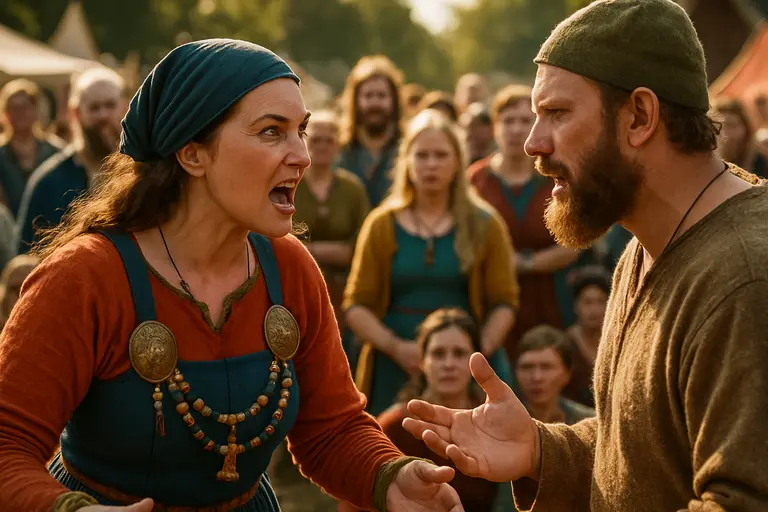
The Problem With A Single Viking Type
The research brief points to a 2025 scholarly argument that “Viking” was historically an occupation associated with raiding or piracy rather than a simple ethnic label. That distinction matters. Modern narratives often use “Viking” as if it named a people in the same way as an ancestry category. The historical usage was more specific and more unstable.
Vikings in pop culture often turns that specific term into a broad identity marker: blond warriors, northern blood, warrior destiny, and inherited toughness. Such images may feel familiar, but familiarity is not evidence. Scandinavian societies of the Viking Age included regional variation, social hierarchy, enslaved people, traders, farmers, poets, craftspeople, migrants, and converts. No single type can carry that full range.
Women, Power, And Repetition
The research brief also notes that some recent media, including Assassin’s Creed Valhalla, offered female playable leads or referred to figures such as Freydís Eiríksdóttir. At the same time, the brief cautions that many portrayals still center masculine ideals and often make female strength look like participation in the same violent code assigned to men.
This is not a call for weaker female characters. It is a call for more varied ones. Viking Age women appear in different kinds of evidence and later tradition through property, household authority, commemoration, migration, conversion stories, and saga literature, though each category requires its own source criticism. If modern media gives women only the axe as a sign of importance, it repeats the old warrior filter rather than widening the picture.
Vikings in pop culture And Historical Memory
Critical Literacy Matters
The research brief cites a late-2025 study on classroom work using Norse mythology and pop culture references to help students develop critical literacy about myth, historical fact, and modern reinterpretation. That educational angle is promising because it treats popular media not as a contaminant, but as a source to be examined. A scene from television, a game quest, or a social media reference can become a question: what evidence stands behind this, and what has been changed?
Public history benefits from that same habit. Community institutions, archives, museums, classrooms, and cultural sites all shape how people receive the past. Even related community-facing sites such as Bethel NC UMC play a role in demonstrating how local perspectives influence shared memory and how individuals interpret cultural heritage through both local communities and entertainment media.
A Better Use Of Modern Viking Narratives
The best use of modern Viking narratives is not to ask whether every helmet, hall, or prophecy is correct. The better question is what kind of past the story invites audiences to imagine. Does it reduce the Viking Age to masculine violence? Does it treat Norse myth as interchangeable with archaeology? Does it turn “Viking” into ancestry rather than activity? Does it allow uncertainty, or does it cover gaps with confident spectacle?
Vikings in pop culture will remain powerful because the material is dramatic, adaptable, and visually memorable. The task for careful readers is not rejection but disciplined attention. Television and games can lead people toward archaeology, sagas, runestones, museum collections, and language study. They can also harden clichés if no one challenges them. A historically aware audience can enjoy the stories while still asking where the evidence ends and the modern invention begins.
