Nordic Visual Culture at The Frick Pittsburgh was not presented as an isolated style story. The exhibition known as The Scandinavian Home ran from September 27, 2025, to January 11, 2026, and it had already concluded at the Pittsburgh venue by October 5, 2026. The Frick stated that the show brought together more than 100 works from the private collection of David and Susan Werner of State College, Pennsylvania, including furniture, ceramics, glass, textiles, sculpture, graphics, decorative arts, and paintings from Denmark, Norway, Sweden, and Finland, dating roughly from the eighteenth century through the mid-twentieth century Frick exhibition record.
Nordic Visual Culture At The Frick
The most useful reading of the Frick show is not that it offered a single Nordic style. It showed how domestic objects, fine art, folk forms, and mythic motifs could be placed beside one another to ask how people imagined home and homeland. That question matters for Norse and Scandinavian cultural history because later national images often borrowed selectively from older forms, including carved wood, saga memory, rural craft, and Viking Age shapes.
How Nordic Visual Culture Moved Indoors
The exhibition’s emphasis on the home kept the subject close to lived experience. Chairs, cabinets, wall hangings, ceramics, and glass were not treated as neutral background. They were part of a visual language through which national belonging could be made visible inside rooms. The Frick’s curatorial framing divided the material into six thematic sections, including Norwegian Revival Style, An Artist’s Home, Symbolist Experimentation, Sweden and Social Reform, Art Nouveau, and Vitalism and Rebirth in Denmark and Finland.
That structure gave the exhibition a useful historical frame. Around the late nineteenth and early twentieth centuries, Nordic countries were dealing with industrialization, political change, war, and shifting borders. In that setting, rural craft and “authentic” vernacular forms could become more than taste. They could be used to signal continuity, distinctiveness, and cultural memory. The danger, of course, is that such forms can look timeless when they were often being reselected, staged, and adapted for modern purposes.
Home, Homeland, And National Feeling
The Frick exhibition was strongest where it made the household a public question. A home is private, but the image of a national home is not. Scandinavian Revival furniture, folk-inspired ornament, and domestic craft could create a sense that a nation had ancient roots visible in ordinary objects. That idea should be handled with caution. Objects from a private collection do not speak for whole societies, and exhibition groupings are interpretive choices rather than direct windows into the past.
Why The Werner Collection Matters
Because the works came exclusively from the Werner collection, the show also raised questions about collecting itself. A private collection can preserve objects that might otherwise be less visible to the public. It can also shape the story by what it includes and excludes. In this case, the mix of fine art and domestic media helped resist a narrow museum habit of separating “major” painting from household craft. For the study of Nordic identity, that combination is valuable because national stories were often built through both elite art and everyday forms.
This is also where public-history comparison helps. A useful parallel can be found in Old Norse News coverage of the Norse Saga Room, where carved interiors and mythic reference show how domestic space can carry cultural memory without becoming archaeological proof. The same care applies to the Frick material: a carved form may echo older tradition, but the date, maker, medium, and setting still matter.
Myth, Folklore, And The Domestic Object
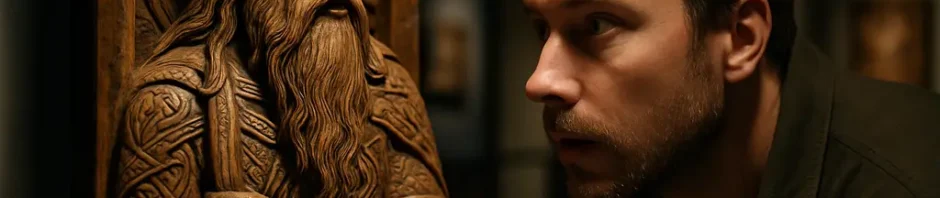
The exhibition’s mythological interest lay less in direct retellings of Norse myths and more in how folklore and symbolic motifs entered design. The Pittsburgh Post-Gazette reported that the show included motifs such as trolls, fairies, Viking era forms, and other culturally charged imagery, with carved wood furniture and narrative textiles presented as objects carrying meaning beyond decoration Post-Gazette report.
From Ornament To Cultural Claim
That point deserves attention. A troll on a cabinet, a Viking-inspired curve on a chair, or a folk figure in a woven work does not automatically preserve an ancient belief unchanged. These images may instead show how nineteenth- and early twentieth-century artists and designers selected older-looking forms to answer modern needs. They gave visual shape to ideas of origin, rootedness, and difference.
One object noted by the Frick was Three Princesses, a c. 1910 wool wall hanging by the Norwegian artist Thorolf Holmboe. Even without claiming that the work documents a specific medieval story, its narrative format and material craft fit the exhibition’s larger point: mythic and folk themes could enter the home through objects meant to be seen, touched, lived with, and inherited.
Artists, Spirit, And The Northern Image

The show also placed domestic design beside artists associated with Symbolism, spirituality, and the northern natural sublime. The Frick identified featured painters including Hilma af Klint, Akseli Gallen-Kallela, Gustav Fjaestad, and Pekka Halonen. That selection matters because it keeps Scandinavian visual culture from being reduced to rustic furniture or folk motifs alone.
Hilma Af Klint Before Abstraction
Hilma af Klint’s Stockholm Park with Playing Children, dated 1889, was among the works shown. The Frick’s labels connected the painting to a period before her later reputation for abstraction, while also noting her engagement with Theosophy and spiritual practices. The safer interpretation is not that the painting itself explains her later work, but that the exhibition placed early naturalistic painting in a broader account of spirituality, nature, and modern artistic experimentation.
For Norse and Nordic studies, this distinction is useful. Myth and spirituality are not interchangeable terms. Folklore motifs, Viking-inspired forms, Symbolist art, and modern religious interests belong to different historical settings. A careful exhibition can place them near one another without flattening them into one continuous ancient tradition.
What The Frick Exhibition Revealed About Nordic Visual Culture
The value of Nordic Visual Culture in this exhibition was its range. It joined household objects, national feeling, mythic reference, and fine art without asking one category to explain all the others. That is a sound way to approach Scandinavian cultural memory. The home can preserve identity, but it can also stage identity. Folk art can carry inherited forms, but it can also be remade for modern taste. Myth can give images power, but it should not be used to fill gaps in the evidence.
The Frick show has ended, so the best use of it now is retrospective: it gives historians and readers a case study in how museums frame Nordic material culture for modern audiences. It also reminds us that Viking era references in later Scandinavian art are often acts of memory rather than direct survivals from the Viking Age.
A reader who follows civic culture across our network may also recognize how clubs and local institutions preserve group identity in different settings; the related Stuyvesant Yacht Club site offers a separate community example outside the museum world. The comparison is limited, but the broader point stands: identity is made visible through objects, spaces, habits, and the stories people choose to keep.
For the study of mythology and culture, the Frick exhibition offered a useful warning against easy certainty. Nordic design, folklore, and national art are not a single inheritance moving unchanged from the Viking Age to the modern home. They are layered acts of selection. That is precisely why the exhibition remains valuable after its Pittsburgh dates: it showed how modern Scandinavian identity could be built from domestic things, symbolic images, and carefully chosen memories.
