Norse religion origins are not a single discovery waiting to be named. Recent academic work points instead to several overlapping lines of evidence: fifth-century inscriptions, population movement, ritual monuments, ordinary burial practice, Sámi and Indo-European comparisons, and the long afterlife of runic habits after Christianization. The most careful reading is also the least dramatic: early Norse religion seems to have formed through continuity, contact, local practice, and later reinterpretation rather than through one clear founding moment.
Norse Religion Origins And New Evidence
Norse Religion Origins As A Working Question
The phrase Norse religion origins can be useful, but only if it is treated as a research problem rather than a fixed answer. The evidence does not show a neatly unified religion with one theology, one clergy, one canon, or one standard liturgy across Scandinavia. The research notes point to a different picture: local variation, elite memory, ritual places, family practice, political change, and later Christian-era writing all shaped what modern scholars can see.
This matters because much public discussion still begins with the gods known from medieval Icelandic texts and works backward. Odin, Thor, Loki, Skaði, Freyja, and other figures are familiar, but the surviving literary record is late and selective. It tells us much, yet it is not the same as direct access to fifth-, sixth-, or seventh-century practice. That is why archaeology, inscriptions, and comparative studies have become central to the debate.
Why Odin’s Name Matters
One major anchor is the Danish bracteate hoard found in 2020, which included the inscription often rendered “He is Odin’s man.” Reporting on the find, the Associated Press described it as the oldest known reference to the Norse god Odin, dating to the fifth century CE AP report on Odin. The find matters because it places Odin’s name earlier than many readers might expect and before the Viking expansion usually associated with Norse religion in popular culture.
Yet the inscription should not be made to carry more weight than it can bear. It shows that a name linked with Odin was present among Germanic-speaking groups in the fifth century. It does not prove that later Viking Age mythology already existed in full form. A short inscription can confirm presence, status, and naming practice; it cannot reconstruct ritual calendars, myths, or social organization on its own.
Genomes, Migration, And Religious Change
The Fifth-Century Shift
Genetic work has also entered the discussion. A 2024 Nature study of early medieval Europe reported a sharp ancestry shift in southern Scandinavia after about 500 CE, with individuals showing significantly more Central European-related ancestry, while Norway and northern Sweden showed more continuity from earlier Iron Age Scandinavian-related populations Nature genomic study. This does not identify a religion, but it changes the historical setting in which religious ideas are discussed.
For debates over Norse religion origins, the implication is not that migration automatically caused a new cult. Belief does not move in the same simple way as genes. People can adopt, reject, translate, or preserve ritual habits across generations. Still, demographic change can create conditions for new political ties, marriage networks, language contact, and shared symbols. Those conditions may have affected how divine names, ritual practices, and social identities developed in southern Scandinavia after the fifth century.
Continuity North And South
The contrast between southern Scandinavia and areas farther north is equally important. If Norway and northern Sweden show more population continuity in the Nature study, then one should not assume that the same religious history unfolded everywhere at the same pace. This supports a cautious regional model. Southern Scandinavian practice may have been shaped by stronger demographic mixing after about 500 CE, while northern practices may have retained older local patterns for longer.
The research notes also point to the persistence of belief associated with natural features, including trees, wet places, and boundary zones, well into the early Christian period. That pattern resists any simple replacement model. Christianity did not arrive in an empty cultural space, and pre-Christian practice was not necessarily erased at once. The result was likely a long period of overlap, adaptation, and local negotiation.
Ritual Practice Beyond Elites
Raknehaugen Without A Grave
A 2026 peer-reviewed study in the European Journal of Archaeology revisited Raknehaugen, the large prehistoric mound in Scandinavia dating to around 550 CE. According to the research notes, scholars found no grave goods or bones and argued that the mound should be read as a large communal ritual monument connected to the crisis after AD 536 rather than as a straightforward elite burial. That interpretation is significant because it shifts attention away from a ruler’s tomb and toward public ritual labor.
If Raknehaugen was not a conventional burial, it weakens older habits of explaining large monuments only through elite graves. It also suggests that crisis, memory, and communal action may have shaped ritual construction. For the study of early Norse belief, this means that sacred activity cannot be reduced to kings, chiefs, or halls. Large-scale religious expression could also involve collective response to environmental shock and social stress.
Ørsta And Ordinary Burials
The Ørsta excavations in Norway, reported in the research notes for 2025, add another caution. A Viking Age burial ground with flat graves belonging to common people was uncovered near a pagan cult house. The site has been discussed as evidence that sacrificial feasts and cult activity may have involved ordinary Norwegians, not only the prominent families most visible in older archaeological narratives.
This evidence matters because visible monuments can bias interpretation. Mounds, furnished graves, and major halls survive in ways that draw attention to rank. Flat graves and modest deposits may be easier to miss, but they can be just as important for understanding lived religion. Norse religion origins, seen from this angle, are not only about named gods and aristocratic ideology. They also concern feasting, burial, household memory, and community participation.
Texts, Runes, And Late Survival
Christian-Era Objects With Older Habits
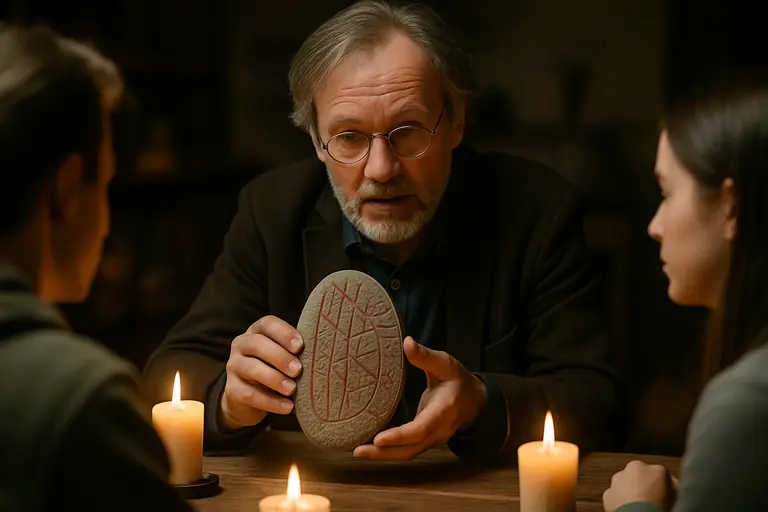
The research notes describe new runic finds from Oslo along the Follo Line railway work, dated approximately 1150–1350 CE. Twelve small objects with Old Norse or Latin inscriptions show that runic writing persisted long after formal Christianization. Such finds do not prove the survival of pre-Christian worship, but they do show that older writing habits and cultural forms could continue inside a Christian medieval society.
This is one reason scholars avoid sharp before-and-after schemes. Christianization changed institutions, burial habits, writing culture, and authority. Yet change did not mean that every older form vanished. Runes could be used in Christian contexts, Latin could appear beside Old Norse, and inherited practices could be reworked rather than discarded. Readers interested in source boundaries may compare this issue with separating Norse myth from Viking history.
Sámi And Indo-European Comparisons
Comparative scholarship has also widened the debate. The research notes cite Johannes Natcher’s 2026 paper on possible Sámi influence in Old Norse mythology, especially in relation to Loki and Skaði. The argument, as summarized, rests on narrative, geographic, genealogical, and cosmological traits that may align with Indigenous Sámi belief systems more closely than with a purely Proto-Germanic model.
Such work should be read carefully. It does not mean that Old Norse myth can be explained simply as borrowed Sámi religion. Nor does it erase Germanic inheritance. It asks whether northern contact zones shaped some stories, figures, and categories. That is a productive question because Scandinavia was not isolated. Trade, marriage, seasonal movement, tribute, conflict, and storytelling all created points of contact.
The research notes also refer to comparative Indo-European work scheduled at Uppsala University on October 2, 2026, linking divine and royal symbolism across early Vedic, Hittite, and pre-Christian Old Norse materials. As of September 28, 2026, that defense had not yet taken place. Its inclusion in the debate shows that scholars continue to ask how far Old Norse religion reflects shared Indo-European patterns and how far it developed through later Scandinavian conditions.
Method, Misuse, And Public Memory
Against A Single Viking Religion
A critique published on July 18, 2026, described in the research notes, argued that the “Viking religion” often imagined today is partly a modern construction shaped by Christian categories: temples, fixed doctrines, unified worship, and stable liturgy. Whether one accepts every part of that argument or not, the methodological warning is sound. Medieval authors, many writing after conversion, framed older belief through the intellectual tools available to them.
This does not make the sources useless. It means they must be read with attention to date, genre, purpose, and audience. Poetry, saga prose, inscriptions, grave finds, ritual deposits, and place-names do not answer the same questions. Used together, they can produce a stronger account. Forced into one system, they can create false certainty.
Why Modern Claims Need Care
The “Imagining Nordic Paganism” conference held at Münster University on November 6–7, 2025, is described in the research notes as stressing that many popular or nationalistic representations of Norse paganism cannot be verified scientifically. That concern belongs in any discussion of Norse religion origins because modern identity claims often seek ancient authority.
Good scholarship does not deny that Norse heritage matters to modern people. It asks what can be supported, what remains uncertain, and what has been added by later readers. That same caution is useful for related cultural-history work across this network, including the site AG Heiro, where public interpretation depends on clear distinctions between evidence and modern use.
Debating Norse Religion Origins
The strongest recent scholarship does not point to one birthplace, one founding prophet, or one original doctrine. It points to layered development. The fifth-century Odin inscription gives an early textual anchor. The 2024 genomic study gives a changed demographic setting after about 500 CE, especially in southern Scandinavia. Raknehaugen suggests communal ritual construction in a time of crisis. Ørsta points toward ordinary participation. Later Oslo runes show cultural persistence after Christianization. Sámi and Indo-European comparisons test older models rather than replacing them with a single new one.
That is why Norse religion origins are best debated as a set of connected questions. Which divine names can be dated securely? Which practices are visible archaeologically? Which patterns are regional rather than pan-Scandinavian? Which myths reflect older inheritance, and which reflect contact, literary shaping, or medieval Christian framing?
The answer remains cautious but meaningful. Early Norse religion was neither invented suddenly nor preserved unchanged from a remote past. It grew through contact, memory, social rank, ritual practice, migration, and local adaptation. The recent scholarship does not make the subject simpler. It makes it more honest.
