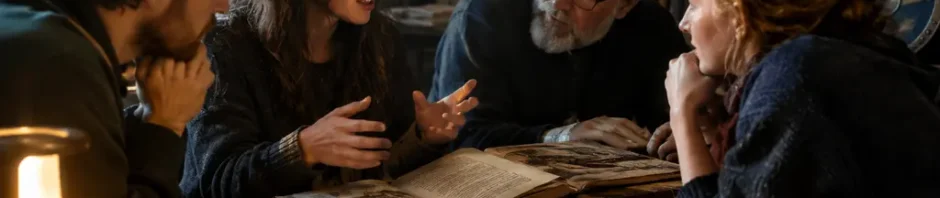
The Norse Saga Room at the American Swedish Institute in Minneapolis preserves Old Norse literature in an indirect but significant way: not by holding medieval manuscripts, but by making saga-related myth, ornament, and narrative memory visible through woodcarving, interior design, and public interpretation. ASI states that the room opened to the public on May 16, 2019, in the lower level of the Turnblad Mansion, with access included in museum admission ASI’s exhibition page. That setting gives the room a public role: it helps visitors encounter Norse narrative traditions as cultural memory, not only as texts preserved in libraries.
How The Norse Saga Room Preserves Saga Memory
Norse Saga Room As Visual Translation
The phrase “preserving literature” usually suggests manuscripts, editions, translations, or academic commentary. The room requires a narrower and more cautious claim. It does not appear, from the cited museum description, to function as a manuscript archive or a textual repository for Icelandic saga codices. Its contribution is interpretive. It preserves a later cultural response to Old Norse literature and mythology by presenting a crafted environment shaped by saga imagery and Nordic decorative traditions.
This distinction matters because Old Norse literature reaches modern audiences through several channels. One channel is philology: the study of language, manuscripts, and textual transmission. Another is public culture: museums, exhibitions, woodwork, art, storytelling, and classroom interpretation. The ASI room belongs mainly to the second channel. It gives physical form to a saga aesthetic, allowing visitors to consider how medieval and mythic material was reimagined in modern Scandinavian and Scandinavian-American settings.
For a reader trained in texts, carved panels and decorative forms can seem secondary. Yet they can serve as entry points. A visitor who may not yet know the difference between Eddic poetry, legendary saga, family saga, and later nationalist retelling can still begin with scenes, motifs, and atmosphere. The room’s value lies there: it can prompt questions before it supplies answers. Which stories are being referenced? Which motifs derive from myth rather than saga prose? Which parts reflect medieval material, and which reflect later artistic taste?
Craft As A Cautious Reading Aid
Craft does not replace translation. It does, however, help explain why Old Norse literature continued to matter after the Middle Ages. Sagas and mythic narratives survived not only because manuscripts were copied and edited, but also because later communities found cultural meaning in them. Woodcarving, folk art, and room-scale design can show that reception history. They demonstrate how stories moved from parchment into domestic interiors, museum spaces, and heritage institutions.
That point is useful for modern readers. When people meet Old Norse literature through a museum room, they are not seeing the Viking Age directly. They are seeing a layered object: medieval narrative filtered through later Scandinavian art, private collecting, public display, corporate ownership, donation, and museum interpretation. Good interpretation keeps those layers visible rather than flattening them into a single “Viking” image.
Old Norse Texts Without Manuscripts
What The Room Can And Cannot Prove
The room can show the endurance of Norse mythic and saga-related imagery. It cannot prove how medieval audiences originally read a given saga, nor can it stand as evidence for a specific Viking Age interior. That limitation is not a weakness. It is the basis for responsible public history. The Norse Saga Room works best when understood as a later reception space: a crafted modern environment inspired by older narrative traditions.
That matters because Old Norse literature is often pulled into broad modern claims about identity, ancestry, warfare, religion, or national character. A careful exhibit can slow that process down. It can show that saga reception changed over time and that artistic uses of myth are not the same as medieval evidence. In this sense, the room helps preserve literature by preserving the history of how literature has been imagined, displayed, and valued.
Readers interested in this same question of public memory may compare the room with Scandinavian memory today, where myth, migration, woodwork, and National Romantic design are treated as connected but distinct categories. That distinction is central to any evidence-based reading of saga heritage.
Educational Use And Public Access
ASI’s broader educational role also matters. The research notes describe museum programs connected with Nordic myth and saga-themed interpretation, including courses that link expert-led learning with material represented in the room. Even when a visitor comes for architecture or decorative art rather than literature, the setting can open a path toward textual study. A carved or painted motif may become the reason someone later reads an Edda, a saga translation, or a scholarly introduction.
Public access is part of preservation. Literature that remains only in specialist circles can survive academically while losing wider cultural legibility. A museum room cannot replace language study, but it can widen the audience. It can help a general visitor understand that Norse stories have histories of transmission, adaptation, and display. For related heritage reading in the same wider network, the site Agheiro offers another point of comparison for how cultural subjects are presented to public audiences.
From Stockholm Interior To Minneapolis Exhibit
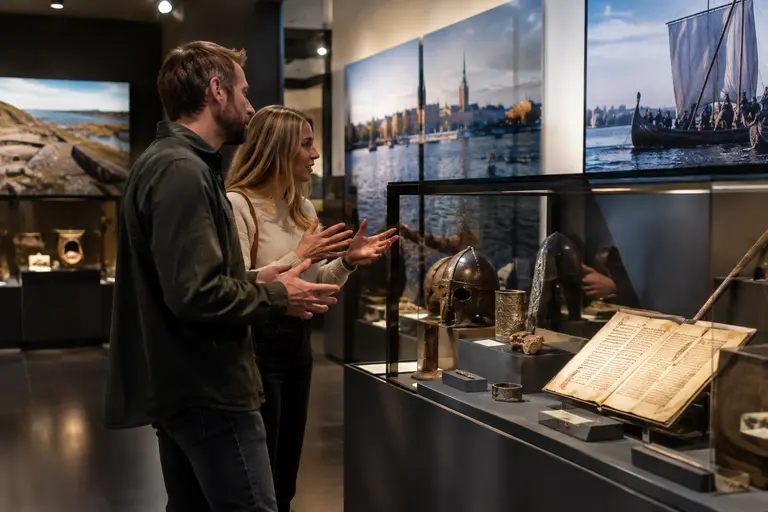
A Twentieth-Century Object With Older Sources
The room’s own history shows why reception is central. It was originally created around 1912 for Swedish businessman Anders Andersson’s apartment in Stockholm. A contemporary travel and cultural-history account notes that it drew on Norwegian folk art, Norse mythology, and decorative design associated with artists such as Gerhard Munthe Exploration Vacation’s ASI feature. That origin places the room far from the medieval period, but close to a period when Scandinavian artists and collectors were actively reworking medieval and folk motifs for modern cultural settings.
ASI’s account traces the room after the Andersson apartment as well. It was exhibited at Stockholm’s Statens Historiska Muséet in 1981, later acquired at auction by Minneapolis entrepreneur Curtis L. Carlson, kept in his corporate headquarters in Minnetonka, donated to ASI, and reinstalled for public viewing in 2019. This path from private apartment to museum exhibit is part of its meaning. The room is not only a container of images. It is an object with its own biography.
That biography matters for Old Norse literature because it shows how saga material moved through modern institutions. The stories were not merely read; they were collected, staged, carved, relocated, and interpreted. Each stage altered the audience. A private Stockholm interior spoke to elite taste and domestic display. A corporate setting gave it a different social function. A museum installation at ASI places it within public education and Scandinavian-American heritage.
Migration, Memory, And Interpretation
The American Swedish Institute is housed in the Turnblad Mansion, itself tied to Swedish-American cultural memory in Minneapolis. Within that environment, the Saga Room becomes part of a broader conversation about migration and inherited stories. It does not show a direct line from medieval Iceland to Minnesota. Instead, it shows how Scandinavian and Scandinavian-American institutions have chosen to present older northern narratives in modern heritage spaces.
That distinction guards against overstatement. The room should not be used to claim that Scandinavian-American identity is unchanged from the saga age, or that mythic imagery offers direct evidence for immigrant life. Its stronger value is more modest and more reliable: it shows how older literature and myth helped shape later cultural expression, and how museums can frame that expression for modern audiences.
Norse Saga Room And Old Norse Literature
The Norse Saga Room preserves Old Norse literature by keeping its reception visible. It reminds visitors that sagas and mythic narratives are not only words on a page; they also have afterlives in carving, design, collecting, teaching, and heritage interpretation. Those afterlives need careful explanation, because visual beauty can easily be mistaken for direct historical evidence.
For students of Old Norse, the room can serve as a starting point rather than an endpoint. A panel, figure, or decorative motif may lead to questions about source texts, translation choices, medieval genres, and modern adaptation. That is a worthwhile function. It does not require the room to be a manuscript archive. It requires the museum to identify what is medieval, what is modern, and what remains uncertain.
The Norse Saga Room therefore has a specific role in preserving Old Norse literature at ASI: it protects and displays a modern Scandinavian interpretation of saga and mythic tradition, while inviting visitors toward deeper textual study. Its importance lies in that bridge between object and text. When read carefully, the room does not replace the sagas. It helps explain why people kept returning to them.
