
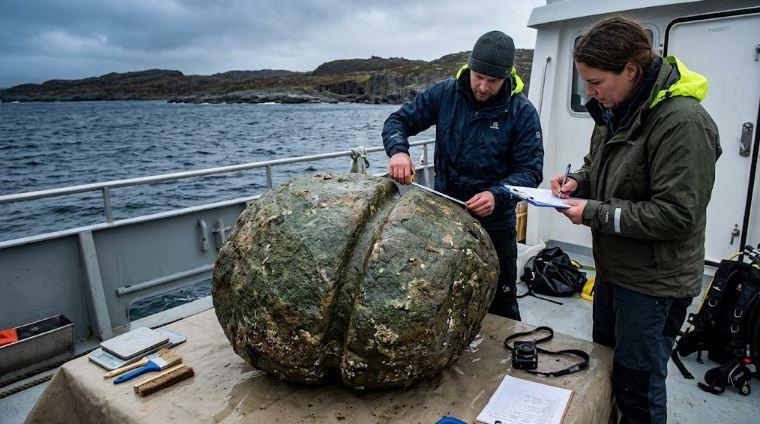
A grooved stone weighing more than 27 kilograms may push the history of deliberate anchoring on Norway’s exposed Atlantic coast back more than 5,000 years.
Archaeologists discovered the stone underwater beside Hespriholmen, a small island off Bømlo in western Norway that contains one of Scandinavia’s most important Stone Age greenstone quarries. The object lay among quarry waste dumped into the sea below the ancient extraction site.
The interpretation remains cautious.
No rope survived, and researchers have not yet established a direct radiocarbon date for the stone itself. Yet the groove running around it, its balanced shape and its location beside a quarry that could only be reached by boat have led several archaeologists to argue that it probably served as an anchor.
If that interpretation proves correct, Hespriholmen will matter for more than Stone Age tool production.
It will provide rare physical evidence that people navigating Norway’s dangerous western coastline developed specialized maritime technology thousands of years before Viking ships entered the North Sea.
The Stone Was Found Beneath A Stone Age Quarry
The possible anchor comes from the seabed beside Hespriholmen in Bømlo municipality.
Archaeologist Arild Skjæveland Vivås of Stavanger Maritime Museum was among the researchers examining submerged heaps of quarry debris when the team encountered the grooved stone.
According to Science Norway’s October 12, 2026 report, the stone weighs more than 60 pounds and has a groove running around its circumference.
Researchers attached a rope to that groove during recovery.
Vivås noted that the stone hung in a particularly balanced way.
Leif Inge Åstveit of the University Museum of Bergen went further, saying he was convinced that the object had functioned as an anchor.
The interpretation is persuasive, but it is not yet absolute proof.
Grooved stones can have several possible uses, and the object itself lacks an independent date.
Its archaeological context therefore becomes essential.
Hespriholmen Could Only Be Reached By Boat
Hespriholmen lies offshore west of southern Bømlo, facing directly toward the North Sea.
Today it appears small and exposed.
It was no easier to reach during the Stone Age.
The University Museum of Bergen’s research on the Hespriholmen quarry shows that people repeatedly travelled offshore to exploit unusually fine greenstone suitable for making axes and adzes.
Quarrying began thousands of years before the Viking Age and continued for an extraordinary length of time.
Radiocarbon evidence places intensive activity in parts of the site around 4500–3500 BC, while archaeological estimates suggest exploitation began much earlier and continued into the third millennium BC.
Researchers estimate that people worked the quarry across thousands of years.
That makes Hespriholmen something far more important than a one-time Stone Age expedition.
Generations repeatedly crossed open water to reach it.
The Quarry Required Planned Sea Travel
Hespriholmen’s location makes casual visitation unlikely.
People had to transport themselves to the island.
They also had to bring tools, food and probably fuel.
After quarrying the greenstone, they needed to move heavy blocks or partly worked axe blanks back toward larger islands and mainland settlements.
The University Museum of Bergen estimates that approximately 400 cubic metres of greenstone were removed from the quarry over its long history.
Large quantities of waste remain both on the island and underwater.
This scale of activity implies organized transportation.
Even if individual expeditions involved small groups, the journeys needed boats capable of handling cargo in difficult coastal water.
An anchor would fit naturally into such a system.
It would allow a crew to hold position while loading stone or waiting near a rocky shoreline.
The Sea Around Hespriholmen Is Not Gentle
The environmental setting strengthens that interpretation.
The waters west of Bømlo contain strong currents, waves and rapidly changing weather.
Vivås described the area as dangerous even for modern researchers.
Stone Age sailors would not have crossed the same sea with modern engines, navigation systems or weather forecasts.
Their vessels were probably paddled boats built from organic materials that rarely survive archaeologically.
That absence creates a major problem.
Archaeologists know early coastal communities depended heavily on boats, but the boats themselves often disappear.
A stone anchor offers indirect evidence for the vessels that used it.
The object may therefore preserve a part of maritime technology normally missing from the Stone Age record.
Calling It The World’s Oldest Anchor Requires Caution
The discovery has attracted attention because researchers have raised the possibility that it could be among the world’s oldest known anchors.
That claim remains provisional.
Stone anchors are notoriously difficult to date when they occur without associated organic material.
The Hespriholmen stone was found inside or beside quarry debris rather than sealed within a layer that can provide an exact calendar age.
Researchers currently infer its antiquity from the surrounding Stone Age activity.
That makes context powerful but not definitive.
Future study must establish whether the stone entered the underwater waste deposit during the quarry’s prehistoric use or at some later date.
Until then, “possible 5,000-year-old anchor” is more accurate than treating the date as settled fact.
Greenstone Axes Reveal The Scale Of Coastal Connections
The quarry’s products show why repeated sea journeys mattered.
Hespriholmen greenstone was valued because it is dense, tough and relatively homogeneous.
Those properties made it suitable for polished axes.
Archaeologists have identified greenstone from the Bømlo area at sites well beyond the quarry itself.
The distribution demonstrates that the material travelled through wider networks after people carried it away from Hespriholmen.
The quarry therefore connected several stages of movement.
Stone had to leave the island by boat.
Craft production continued elsewhere.
Finished or partly finished axes could then move between communities.
That chain resembles later maritime economies in one important respect: the sea did not simply separate settlements.
It connected specialized resources with people who wanted them.
North Sea Seafaring Did Not Begin With The Vikings
The Viking ship dominates modern ideas about early northern navigation.
That can create a misleading chronological starting point.
By the time Scandinavian crews sailed longships across the North Sea in the eighth and ninth centuries AD, people around Norway had already accumulated thousands of years of maritime experience.
Hespriholmen makes that deep history tangible.
Stone Age communities understood offshore geography.
They knew where valuable resources existed.
They could reach exposed islands repeatedly.
They transported heavy stone back across open water.
If the newly discovered object truly served as an anchor, they also used specialized equipment to control their vessels.
Viking maritime success therefore emerged from an exceptionally long coastal tradition rather than appearing suddenly around AD 793.
Coastal Knowledge Could Accumulate Across Generations
Repeated journeys create knowledge.
Sailors learn where currents run strongest.
They identify sheltered landing places.
They learn which winds make a crossing dangerous and when waves prevent safe loading.
Such information rarely appears directly in the archaeological record.
Hespriholmen provides a way to infer it.
People returned to the quarry across many generations.
They would not have done so successfully without understanding the surrounding sea.
That accumulated maritime knowledge may represent one of the deepest foundations of later Scandinavian seafaring.
The boats changed enormously over time.
The need to read coasts, weather and water did not.
The Anchor Also Changes How We View Stone Age Technology
Stone Age technology is often presented through objects made of stone.
Axes, arrowheads and blades dominate museum displays because they survive.
Yet maritime life required large amounts of technology made from materials that decay.
Boats could contain wood, hide, fibre cordage and plant-based caulking.
Ropes disappeared.
Paddles vanished.
Wooden fittings decomposed.
A stone anchor survives precisely because its heaviest component was stone.
That preservation bias can make prehistoric maritime communities appear technologically simpler than they were.
The Hespriholmen find offers a rare glimpse behind that bias.
A grooved stone designed to accept a rope implies rope-making skills, vessel handling and an understanding of weight and balance.
The object only makes sense as part of a larger technological system.
Boats Connected More Than Quarries
The sea around western Norway supplied food as well as stone.
Fishing, hunting marine mammals, gathering seabirds and moving between islands would all encourage boat use.
Vivås has suggested that people may initially have visited Hespriholmen for marine resources before recognizing the quality of its greenstone.
Once the quarry became important, those existing maritime practices could support regular extraction.
This interaction between subsistence and specialized production matters.
People did not invent seafaring solely to reach a quarry.
The quarry became valuable because communities already possessed the ability to move through coastal waters.
Archaeology therefore needs to reconstruct maritime economies rather than treating boats as isolated inventions.
Deep-Time Seafaring Helps Reframe Later Viking Evidence
The possible anchor also provides useful context for much later Scandinavian boat traditions.
Old Norse News recently examined the Chodlik boat burial and Viking-Slavic funerary worlds, where an early medieval boat-shaped grave demonstrates how deeply watercraft could become embedded in ritual and social meaning.
Hespriholmen belongs to a completely different period and should not be directly connected with Viking funerary ideology.
Its significance is chronological rather than cultural.
Thousands of years before boats became symbols in Viking-Age graves, watercraft were already essential tools for survival, movement and resource extraction along northern coasts.
That long practical history helps explain why ships later carried such enormous economic and symbolic importance.
The Find Does Not Create A Straight Line To Viking Ships
It would be tempting to describe the Hespriholmen anchor as an ancestor of Viking maritime technology.
Archaeology cannot support such a simple line.
Five millennia separate the likely anchor date from the classic Viking Age.
Boat construction changed repeatedly during that interval.
Communities reorganized.
New materials, sailing technologies and political systems appeared.
The people quarrying greenstone were not proto-Vikings.
They belonged to Stone Age societies with their own technologies and priorities.
What survived across the long term was something broader: intensive engagement with the sea.
Norwegian coastal societies repeatedly depended on boats because geography made maritime movement practical and often necessary.
Why Hespriholmen Changes The History Of North Sea Seafaring
The possible anchor matters because it turns an assumption into potential physical evidence.
Archaeologists already knew Stone Age communities reached Hespriholmen by boat.
The quarry itself proves repeated offshore travel.
The grooved stone may now reveal one of the technologies those travellers used to make such journeys workable.
If its prehistoric date is confirmed, the object would show that people navigating western Norway more than 5,000 years ago were not merely paddling opportunistically between nearby shores.
They were operating within a maritime system sophisticated enough to support repeated voyages, heavy cargo and specialized equipment.
That changes the starting point for northern European seafaring.
The North Sea did not suddenly become a highway when Viking longships appeared.
For thousands of years, coastal communities had already learned how to cross exposed water, exploit offshore resources and transport valuable materials.
The Vikings eventually turned that inherited maritime environment into networks stretching from North America to western Asia.
Hespriholmen reveals the much older world underneath them.
Before the sail, before the longship and long before the Viking Age, people on Norway’s Atlantic coast were already building lives around the sea.
