
For two decades, Norway’s melting mountain ice has produced an extraordinary archive of Viking and Iron Age life: arrows, skis, clothing, packhorse remains, shoes and objects lost along high-altitude routes.
In September 2026, the pattern changed.
Archaeologists with Secrets of the Ice, the glacier archaeology programme run by Innlandet County Municipality with research partners, recovered 48 prehistoric arrows during three weeks of fieldwork in the Kvitingskjølen area of Jotunheimen. Some of the oldest examples are estimated at 5,000 to 6,000 years old.
The new finds include slate, bone and freshwater-mussel-shell arrowheads, often preserved with pieces of their wooden shafts. They come from a period thousands of years before the Viking Age.
Project leader Espen Finstad says the shift reflects something troubling: the oldest surviving ice is now disappearing.
For Viking historians, that changes the archaeological map. Melting once exposed objects from the first millennium AD and the Viking Age. Archaeologists are now reaching layers that preserve evidence of hunters who entered Norway’s high mountains during the Stone and Bronze Ages.
The ice is not simply producing more finds.
It is revealing an older human landscape.
Forty-Eight Prehistoric Arrows Emerged In 2026
The newest fieldwork concentrated on Langfonne, Storefonne and Hanklefonne in the Kvitingskjølen mountain area of Jotunheimen.
Innlandet County Municipality’s 2026 glacier archaeology report says archaeologists collected 48 prehistoric arrows during the season.
One of the most striking finds combines a finely made slate arrowhead with surviving pieces of its wooden shaft.
Researchers estimate it at roughly 5,000 years old, while comparison with similar weapons suggests some newly exposed arrows could reach 6,000 years in age.
Another arrowhead was made from bone.
Freshwater mussel shells also appear among the prehistoric projectile points.
These materials belong to technological traditions very different from the iron arrowheads associated with later Iron Age and Viking hunters.
The difference is chronological as well as technological.
Recent iron arrowheads from the ice can be around 1,000 to 1,500 years old. The oldest 2026 weapons reach back several millennia further.
That growing age gap is what has caught archaeologists’ attention.
The Oldest Ice Is Now Disappearing
The discoveries are exciting for archaeology but alarming for preservation.
Secrets of the Ice has worked systematically in Innlandet’s mountains since 2006. Over those 20 years, archaeologists have documented 73 sites and recovered more than 5,000 objects.
Many earlier discoveries came from the Iron Age and Viking period.
Now the proportion is shifting toward the Stone and Bronze Ages.
The Norwegian Mountain Centre’s 2026 field report states that the increasingly ancient finds indicate that the oldest portions of the ice are disappearing.
At Hanklefonne, areas covered by ice only recently are now exposed.
Finstad describes the retreat as faster than researchers expected.
His team estimates that many archaeologically productive ice patches could disappear within roughly 20 years if present conditions continue.
That creates an unusual archaeological emergency.
The ice preserved wood, leather, textiles and other organic materials for thousands of years. Once exposed, those objects can deteriorate rapidly.
Archaeologists therefore have only a limited opportunity to recover them.
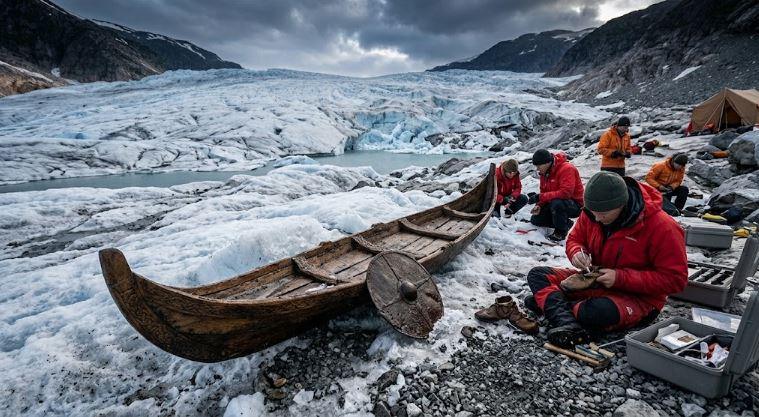
Stone Age Hunters Were Already Using Norway’s High Mountains
The discoveries undermine any idea that intensive mountain use began with the Vikings.
Hunters entered these high-altitude landscapes thousands of years earlier.
Reindeer provide the clearest explanation.
During warm periods, the animals move onto snow and ice patches to escape insects and heat. Hunters understood that behaviour and positioned themselves around places where animals gathered.
Arrows lost during those hunts remained in or near the ice.
Some survived because stable ice protected wooden shafts, bindings and other organic components that normally disappear in Norwegian soils.
This gives glacier archaeology an unusual advantage.
A stone arrowhead found on dry land may survive after its shaft has vanished. On an ice patch, archaeologists can sometimes recover both.
That combination reveals weapon construction, materials and hunting technology at a much finer level.
The 2026 finds therefore document not only the presence of prehistoric hunters but how they equipped themselves.
A Single Ice Patch Has Produced More Than 100 Arrow Finds
The concentration of hunting evidence is remarkable.
According to the September 26 Science Norway report, the programme has now recovered more than 100 arrowheads and shaft fragments from a single ice patch over successive seasons.
That number indicates repeated use.
These were not isolated hunters accidentally wandering into the mountains once every few centuries.
Certain locations attracted people again and again.
Reindeer migration and summer behaviour probably made particular ice patches predictable hunting grounds.
Generations could return to similar terrain while technology changed around them.
A slate-tipped arrow belongs to a very different material tradition from an iron-headed Viking weapon, yet both could be lost in essentially the same hunting landscape.
The ice therefore preserves continuity across enormous spans of time.
That is one reason the newest discoveries matter for a Viking-focused site.
They reveal that later Viking hunting systems occupied landscapes already shaped by thousands of years of human experience.
Viking Finds Are Becoming Relatively Scarcer
For years, some of the most famous Norwegian ice discoveries came from the Viking Age.
Archaeologists recovered arrows, skis, mittens, packhorse equipment and other objects from roughly the first millennium AD.
A particularly important example is Lendbreen, where melting revealed an ancient mountain pass.
The peer-reviewed Lendbreen study in Antiquity documented activity from around AD 300 to 1500, with travel peaking around AD 1000 during the Viking Age.
Researchers found clothing, household objects, packhorse remains, sled equipment and markers associated with high-altitude movement.
The 2026 season does not make those Viking finds less important.
It changes their position in the longer timeline.
As deeper and older ice disappears, archaeologists are increasingly seeing the hunting worlds that came first.
The Mountains Were Highways Before They Became Viking Routes
Lendbreen also changed another misconception.
Mountains were not simply barriers.
They could function as routes between valleys, grazing areas and distant communities.
The pass contains cairns marking movement across the terrain and evidence for packhorses carrying goods.
Its use intensified during the Viking Age, when Scandinavian trade, political centralization and mobility expanded.
Yet prehistoric hunting evidence shows that knowledge of these high landscapes long predates those economic changes.
Stone Age hunters already understood reindeer behaviour, weather conditions and access routes.
Later communities inherited mountains that were not unknown wilderness.
They were culturally familiar landscapes.
This longer perspective parallels another chronological problem Old Norse News recently examined in the Salme ship burials and the Viking Age before 793. In both cases, archaeology pushes important behaviour before a conventional historical boundary.
At Salme, maritime violence predates Lindisfarne.
In Jotunheimen, mountain expertise predates Viking society by thousands of years.
Organic Preservation Makes Ice Archaeology Different
The most important objects are not always the most spectacular.
Ice can preserve materials that conventional archaeology frequently loses.
Wooden arrow shafts survive.
Bindings can remain attached.
Leather shoes appear.
Textiles emerge.
Even horse dung has survived along ancient routes.
A 2026 review of glacier and ice-patch archaeology explains that stationary ice patches are especially valuable because they can preserve fragile cultural material without grinding it apart through glacier movement.
That preservation creates unusually intimate evidence.
An iron arrowhead tells archaeologists the shape of a weapon.
A complete arrow can reveal shaft wood, bindings, dimensions and construction technique.
Those details help reconstruct hunting methods rather than simply cataloguing artifact types.
For periods before widespread writing, such evidence carries enormous weight.
The Finds Also Show Technological Change Across Millennia
The arrows themselves form a technological sequence.
The earliest examples use materials such as slate, bone and shell.
Later weapons increasingly use iron.
That change reflects access to different materials and production systems.
It also demonstrates why archaeologists value a long sequence from one landscape.
Researchers can compare how people solved the same basic problem—hunting reindeer—with different technologies across thousands of years.
The target remained similar.
The weapons changed.
So did settlement patterns, social organization and exchange networks.
By the Viking Age, iron production and long-distance trade created material conditions far removed from those of Stone Age hunters.
Yet people still climbed into the same mountains.
The landscape provides continuity while artifacts record cultural change.
Melting Ice Creates Evidence And Destroys Its Archive At The Same Time
Glacier archaeology contains an unavoidable contradiction.
Climate-driven melting exposes artifacts.
That same melting destroys the conditions that preserved them.
Finstad and his colleagues have become increasingly explicit about this tension.
Objects can remain protected for thousands of years beneath stable ice but deteriorate rapidly after exposure to sunlight, rain, wind and biological activity.
Archaeologists must identify shrinking ice patches, reach remote sites and recover fragile material before it disappears.
The work therefore resembles rescue archaeology.
Scientists are not waiting for ideal research conditions.
They are responding to an archaeological archive that is physically vanishing.
This is especially urgent now that ice dating back 6,000 to 7,000 years is being lost.
Once that oldest ice disappears, there may be no second opportunity to recover what it contained.
Why Norway’s Melting Ice Is Changing The Viking Story
The 2026 discoveries matter to Viking history precisely because many of them are not Viking.
For decades, spectacular ice finds helped reconstruct Viking hunting, mountain travel and transport.
Now the archive is extending much farther backward.
Forty-eight prehistoric arrows recovered in one season include weapons approximately 5,000 to 6,000 years old. More than 5,000 artifacts have emerged from 73 Innlandet sites since glacier archaeology began there 20 years ago.
Together, they show that the Viking use of Norway’s mountains belonged to a much older tradition.
People hunted reindeer in these landscapes during the Stone Age.
Bronze Age communities returned.
Iron Age travelers crossed high passes.
Viking hunters, farmers and packhorse drivers inherited routes and ecological knowledge shaped over generations.
The ice once separated those periods into layers.
Now those layers are disappearing.
That loss is giving archaeologists a brief and troubling opportunity to see what lay beneath the Viking world.
Norway’s melting mountains are not moving archaeology away from the Vikings.
They are revealing the thousands of years of human experience that made the Viking landscape possible.
