
Six early medieval Arab silver coins found in a forest near Młynary in northern Poland could change how archaeologists map the Viking-Age trading centre of Truso.
The discovery consists of six dirhams and two additional coin fragments, provisionally dated to the first half of the ninth century. A legal metal-detector search uncovered them in woodland administered by the Młynary Forest District, northeast of the famous trading settlement near Lake Drużno.
The coins did not come from Truso itself.
That is precisely why they matter.
Dr Jakub Jagodziński of the Archaeological and Historical Museum in Elbląg has suggested that merchants travelling toward or away from Truso may have carried the silver. He has also raised another possibility: local Prussian guards may have collected the coins as toll payments along routes serving the port.
Either explanation pushes the archaeological map beyond Truso’s waterfront.
The September 2026 discovery suggests that the trading settlement depended on a wider landscape of paths, checkpoints and local communities through which people and silver moved before goods ever reached the harbour.
Six Dirhams Appeared In The Młynary Forest
The discovery became public in late September 2026.
According to reporting on the Młynary dirham discovery, the assemblage contains six early medieval Arab dirhams together with two fragments of similar silver coins.
Specialists currently place the coins in the first half of the ninth century.
That dating remains preliminary.
Jagodziński has stressed that numismatists need to conserve and study the pieces before identifying their exact mints, rulers and production dates.
He has also noted that the coins could have remained in circulation much longer than their mint dates suggest, perhaps even until the late tenth or early 11th century.
That possibility matters because Truso itself remained active for generations after the coins were produced.
A ninth-century dirham could continue moving through Baltic bullion networks long after the caliph or governor who issued it had disappeared from political power.
The Find Lies Outside Truso
Truso stood near modern Janów Pomorski, close to Lake Drużno and the Vistula delta.
Marek Jagodziński identified the archaeological settlement in the early 1980s after centuries of attempts to locate the port described by the Anglo-Saxon traveller Wulfstan.
The Archaeological and Historical Museum in Elbląg describes Truso as a major Viking-Age centre of trade and craft, comparable in function to northern emporia such as Hedeby and Birka. Its Truso research overview places the settlement within a network that connected Baltic communities with much wider commercial systems.
The newly discovered silver changes the scale of that network.
Archaeologists already knew that imported goods reached Truso.
Coins found miles from the port can help reveal how people reached it.
Instead of treating Truso as one isolated point on a map, researchers can begin reconstructing the terrestrial routes feeding the settlement.
The Coins May Mark A Merchant Route
Jagodziński’s first interpretation is straightforward.
The silver may have belonged to merchants travelling along a route leading toward or away from Truso.
Trading ports need hinterlands.
Ships bring goods to shore, but commodities must then move inland. Farmers, craftspeople, merchants and intermediaries carry materials between settlements, waterways and markets.
A cluster of dirhams outside Truso could therefore mark one piece of this larger circulation system.
Researchers do not yet know whether the eight silver pieces formed a deliberately buried deposit or whether they became scattered through loss.
The distinction matters.
A compact hoard could represent stored wealth.
A dispersed series of losses might point more directly toward repeated movement along a route.
Archaeological inspection of the findspot should help clarify that context.
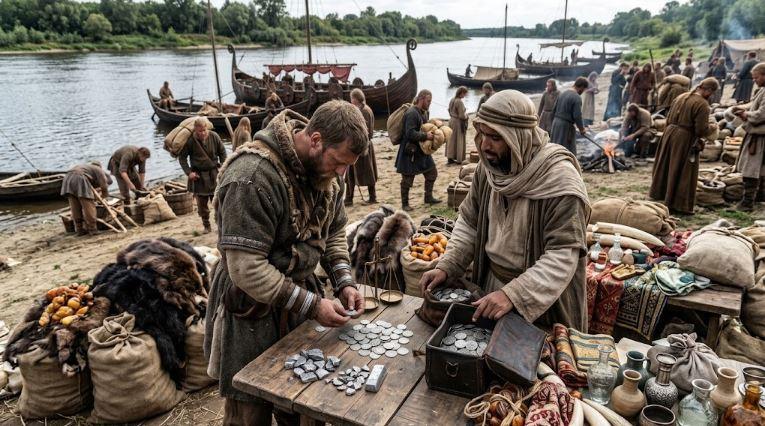
A Toll Station Is Another Possibility
Jagodziński has proposed a second interpretation that may prove even more important.
Local Prussian guards may have collected tolls from travellers using the routes connected with Truso.
The Prussians in this context were western Baltic peoples, not inhabitants of the much later German state of Prussia.
Wulfstan’s ninth-century description of the region records the Este, usually connected with western Baltic populations later identified with Prussians.
If local communities controlled access routes to Truso, the trading centre cannot be understood purely as a Scandinavian enclave.
Scandinavian merchants and craftspeople formed an important part of Truso’s population, but surrounding Baltic communities occupied the landscape through which trade passed.
A toll system would make that interaction economic and political.
Local control over roads could generate wealth even when the international market stood somewhere else.
Dirhams Connected The Baltic With The Islamic World
Arab dirhams rank among the clearest archaeological signs of Viking-Age long-distance exchange.
Large quantities of Islamic silver reached eastern and northern Europe during the eighth, ninth and tenth centuries.
The coins travelled through multiple networks extending from the Abbasid and other Islamic monetary worlds through eastern Europe toward the Baltic and Scandinavia.
Their presence does not prove that Arab merchants personally visited every place where archaeologists find dirhams.
Silver could pass through many hands.
Rus traders, Baltic intermediaries, Scandinavians and local communities all participated in overlapping exchange systems.
Old Norse News recently explored this same problem through Islamic silver in Danish Viking coins, where metal originating in wider Islamic monetary networks eventually became raw material for Scandinavian coinage.
The Młynary find shows another stage of that circulation.
Here the foreign coins survived as recognizable dirhams while moving through a Baltic landscape.
Coins Were Silver As Well As Currency
A dirham did not necessarily function in northern Europe the way it had within an Islamic monetary economy.
Viking-Age Baltic exchange often valued silver by weight.
People could use complete coins, fragments, jewelry and ingots within the same bullion system.
The two coin fragments from the Młynary discovery may become particularly informative once specialists examine them.
If someone deliberately cut them, the fragments could fit the broader Viking practice of dividing silver into usable amounts.
Researchers may also look for nicks or test marks made to check whether the metal contained good-quality silver.
Such evidence could show whether people treated the coins primarily as currency, bullion or both at different stages of their journey.
Until conservation is complete, those questions remain open.
Truso Was More Than A Scandinavian Port
The new find also encourages a more precise use of the phrase “Viking port.”
Truso had strong Scandinavian connections.
Archaeological work has uncovered Scandinavian-style objects, craft activity and evidence consistent with an international trading settlement.
Yet the wider landscape included western Baltic populations and other communities.
Wulfstan’s account itself describes peoples around the trading centre rather than a completely Scandinavian territory.
That mixed setting fits what archaeologists increasingly find at major Viking-Age markets.
Ports worked because different groups met there.
Craftspeople needed raw materials.
Merchants needed customers and transport.
Local farmers supplied food.
Political authorities offered—or imposed—security, access and taxation.
The Młynary dirhams may show that some of these interactions happened well outside the port’s central settlement.
Wulfstan’s Voyage Gives Truso An Unusual Historical Anchor
Truso possesses something many Viking-Age trade sites lack: a contemporary written description.
Around AD 890, Wulfstan travelled east from Hedeby to Truso.
His account entered the Old English adaptation of Orosius produced in the intellectual environment of King Alfred the Great.
Wulfstan described his route through the Baltic and discussed the customs of the peoples he encountered near his destination.
That narrative confirms that Truso belonged to a maritime network linking the western and eastern Baltic.
Archaeology has since supplied the material evidence.
The Młynary coins may now help connect those two scales.
Wulfstan tells us about reaching Truso by sea.
The dirhams may eventually show how people approached the same trading system over land.
The Find Could Reveal Truso’s Economic Hinterland
Archaeologists often focus naturally on large trading settlements because they produce dense concentrations of artifacts.
Yet a market cannot function independently of its surrounding territory.
Truso required food, timber, craft materials, labour and transport connections.
Goods arriving by ship also needed routes toward inland consumers.
That surrounding economic zone is the hinterland.
The Młynary discovery offers a potential way to map it.
If future archaeological work finds more coins, weights, imported objects or road-related activity between Młynary and Truso, researchers may be able to identify a corridor rather than one isolated findspot.
Conversely, if no related evidence appears, the coins may represent one exceptional loss.
Both outcomes matter.
The important point is that archaeologists now have a specific location outside Truso worth testing.
The Coins Should Not Become A Finished Trade Map Yet
The discovery is promising, but the evidence has clear limits.
Specialists have not completed the numismatic analysis.
The precise mints and rulers remain unpublished.
Researchers have not yet demonstrated that the coins travelled together as one deposit.
They also cannot prove that a merchant carried them toward Truso.
Jagodziński’s toll-collector interpretation remains another plausible scenario.
Other explanations may emerge once archaeologists inspect the findspot.
That uncertainty should shape how the story is told.
Six dirhams can reveal circulation.
They cannot identify one named merchant, one exact road or one transaction.
Why The Młynary Dirhams Could Redraw Truso’s Trade Network
The most important fact about the new silver is its location.
Archaeologists already knew Truso connected the southern Baltic with long-distance exchange.
Six Arab dirhams and two fragments found outside the settlement potentially show how that exchange extended into the surrounding countryside.
They may represent merchants approaching the port.
They could reflect silver collected at a local toll point.
Either interpretation moves attention away from the marketplace itself and toward the people controlling the roads around it.
That creates a richer Viking trade map.
Truso was not simply a dot where Scandinavian ships arrived.
It depended on waterways, paths, local communities and political relationships extending beyond its houses and workshops.
The dirhams now under conservation may eventually identify specific Islamic mints and narrow their dates.
Archaeological investigation may clarify whether they formed a lost purse, a hidden payment or scattered route finds.
For now, their strongest contribution is geographical.
They suggest that to understand Truso, archaeologists may need to stop looking only at the port.
The trade network may still be visible in the landscape around it.
