
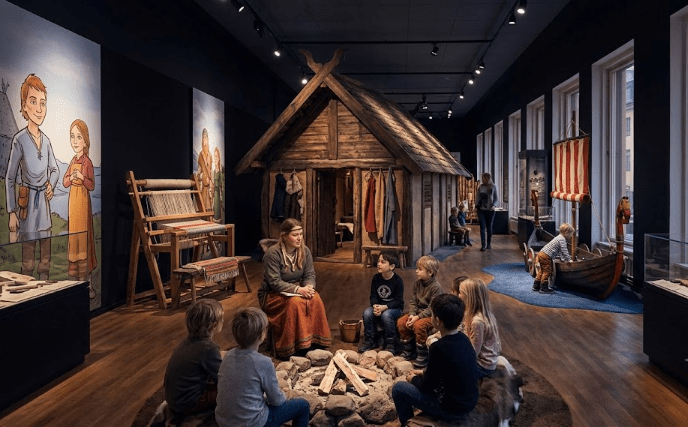
“Viking Life With Halvdan And Meia” matters because it teaches children that the Viking Age was not only a world of ships, weapons, kings, and raids. The Swedish History Museum in Stockholm presents the exhibition from February 21, 2026, to January 10, 2027, as a playful Viking village for younger children. Visitors can play in the chieftain’s house, step into the forge and the barn, meet farm animals, run along jetties, and board the village’s Viking ship. The museum also explains that the exhibition suits preschool-aged children and draws heavily on the Halvdan Viking books by author Martin Widmark and illustrator Mats Vänehem. For oldnorsenews.org readers, the exhibition opens a useful question: how should museums teach Norse daily life before children inherit the usual warrior stereotype? (Swedish History Museum exhibition)
Why A Play Exhibition Can Teach Serious Viking History
A children’s exhibition may look light, but its design choices shape historical memory early. When a child first meets the Viking Age through a farm, barn, forge, house, jetty, and ship, the past begins as a whole community rather than a battlefield. That matters because many adults already carry a narrow Viking image built from weapons, raids, helmets, and seafaring drama.
The Swedish History Museum frames the exhibition as a playful journey to a Viking village. That choice gives young visitors a physical setting they can explore through movement. They do not only look at a sword case or listen to a battle story. Instead, they enter a small world where food, animals, boats, houses, craft, and social roles all matter.
This approach fits current museum thinking better than a simple “Vikings were warriors” lesson. Children understand the past through space, touch, story, and repetition. A village lets them connect actions with places: animals live on farms, craftspeople work in workshops, boats need jetties, and families depend on food, tools, shelter, and labor.
What Halvdan And Meia Add To The Museum Story
The exhibition uses characters that many Swedish children may already recognize. The Swedish History Museum says “Viking Life With Halvdan And Meia” draws largely from the books about Halvdan Viking by Martin Widmark and Mats Vänehem. Barnutställningar, the exhibition producer, adds that it created the exhibition in 2022 and built a whole small village around the characters.
That literary connection helps the museum solve a common education problem. Young children often need story before they can absorb historical categories. Halvdan and Meia give the exhibition a friendly route into a distant period. Their presence can make a house, barn, ship, or forge feel less abstract.
However, the story element also creates responsibility. Museums must help visitors understand that fictional characters can introduce history, but they cannot replace archaeological evidence. Halvdan and Meia can guide children into Viking Age settings. The museum then needs objects, labels, educators, and careful context to show what researchers know, what they infer, and what belongs to imagination.
That balance makes the exhibition more interesting. It does not ask children to choose between story and history. It uses story as an entry point, then places that story inside a museum where evidence still matters.
Why Daily Life Should Come Before Warrior Mythology
Children usually meet Viking history through the most dramatic images first. A ship appears. A warrior swings an axe. A raid begins. A king claims power. Those images can excite young audiences, but they can also make the Viking Age feel like a costume world rather than a society.
“Viking Life With Halvdan And Meia” shifts the starting point. The chieftain’s house introduces leadership and hierarchy. The forge introduces craft and tools. The barn introduces animals and farm work. The jetties introduce travel and water routes. The ship introduces movement without forcing every voyage into a raid story.
That order matters because most people in Viking Age Scandinavia did not live as full-time raiders. They farmed, herded animals, repaired buildings, made clothing, cooked food, traded goods, raised children, attended gatherings, honored gods or later Christian practices, and worked within local social systems. Old Norse News has already covered how Viking Age daily life depended on farms, houses, hierarchy, and material labor more than popular images often admit.
A child who learns that first will understand weapons and ships better later. Raiding, trade, migration, and elite power came from communities that could feed people, build vessels, raise animals, forge tools, and organize labor.
How The Village Layout Teaches Systems Instead Of Isolated Facts
The exhibition’s village layout matters because daily life works as a system. Barnutställningar says it built six cottages: a chieftain’s house, forge, offering house, bake and food house, barn, and weaving cottage. It also says all houses invite play and activities. That design can teach children how different parts of Norse life connected.
A forge does not stand alone. It needs fuel, metal, tools, skill, and people who need repairs. A barn does not only hold animals. It connects to food, manure, leather, wool, traction, and seasonal routines. A weaving cottage points toward textile labor, clothing, sailcloth, household production, and trade value. A bake and food house points toward grain, storage, cooking, and survival.
The chieftain’s house adds another layer. Leadership in Norse society did not float above daily life. Local power depended on food, followers, gift exchange, legal standing, ritual performance, and control over resources. Even a simplified children’s setting can show that a “chief” needed a community around him or her.
This kind of spatial teaching can avoid a common museum weakness. Instead of presenting disconnected facts, the village helps children act out relationships between places and tasks. That play can build a better historical instinct.
Why The Ship Still Belongs In The Story
The Viking ship remains essential, even in an exhibition about daily life. The Swedish History Museum page says children can set sail aboard the village’s Viking ship. That detail matters because ships shaped Viking Age identity, trade, travel, raiding, migration, and storytelling. Removing the ship would create another distortion.
The key lies in context. A ship in a children’s village should not only signal attack. It can also show transport, fishing, trade, travel, visiting relatives, carrying goods, and moving through waterways. In Scandinavia, water often connected communities more effectively than roads. A child who plays near jetties and a ship can start to understand geography through movement.
This broader ship lesson fits the historical record. Viking Age vessels supported many kinds of activity. Some carried warriors. Others carried cargo, animals, tools, timber, food, or travelers. Some entered graves as symbols of status and memory. Others worked as practical craft in coastal life.
The exhibition’s ship can therefore teach a simple but important point: the sea made Norse life larger. It connected farms, towns, islands, markets, and distant regions. Children do not need every detail at preschool age, but they can understand that ships moved people through a world bigger than one village.
How The Swedish History Museum Can Balance Play And Evidence
The Swedish History Museum has an advantage because it also houses “The Viking World,” a permanent exhibition that presents more than 2,000 authentic Viking Age objects. The museum describes that exhibition as the world’s largest Viking exhibition and directly addresses the global myth of violent, horned-helmet Vikings. It says new archaeological discoveries and research have changed how scholars view life in Scandinavia a thousand years ago.
That broader museum setting matters for “Viking Life With Halvdan And Meia.” A play exhibition can introduce children to atmosphere, movement, and daily spaces. Nearby object-based exhibitions can help older siblings, parents, and teachers connect that play to real artifacts. Together, the two approaches can support each other.
The challenge comes from simplification. Young children need clear spaces and inviting activities. Museums cannot overload them with complex debates about chronology, source criticism, burial interpretation, or regional variation. Still, good design can avoid false certainty. It can use wording such as “people could,” “many families,” “archaeologists have found,” and “some evidence suggests” when educators speak to families.
That careful language helps children develop trust in evidence. They learn that history does not come from guessing. It comes from objects, sites, bones, tools, buildings, texts, and comparison.
Why Children’s Viking Exhibitions Need Animals, Food, And Craft
Animals, food, and craft deserve more attention in children’s Viking exhibitions because they show how people survived. The Halvdan and Meia exhibition includes a barn and farm animals, which helps young visitors see that Norse life depended on more than heroic travel. Animals supplied meat, milk, wool, hides, labor, manure, and status. They also shaped daily routines.
Food spaces matter for the same reason. A bake and food house can teach children that meals required farming, grinding, storing, cooking, sharing, and seasonal planning. Viking Age households had to manage scarcity and abundance. They needed grain, livestock, fish, preserved foods, fuel, vessels, tools, and labor.
Craft spaces can carry an even deeper lesson. A forge points toward metalwork, repair, tools, and weapon production. A weaving cottage points toward clothing, sails, blankets, and trade goods. Children may not grasp the full economy of textile labor, but they can understand that people made things by hand and that objects required time.
These themes also help correct gender imbalance. Weapons often draw attention toward male-coded warrior stories. Food, animals, textiles, and household production show that women, children, enslaved people, farmers, and craft workers also shaped Norse society.
What Teachers And Parents Should Emphasize
Parents and teachers can use the exhibition best by asking practical questions. Who lives in this village? What work happens in each house? What animals do people need? What does the forge make? Why does the village need a ship? What would happen if the food ran out? Which tasks might children have seen or helped with?
Those questions turn play into historical thinking. They also keep the experience grounded. A child does not need a lecture about archaeological method to learn that houses, animals, and tools tell us about the past. The child can begin with observation: this village has many jobs, and people depend on each other.
Adults should also separate fiction from evidence. Halvdan and Meia can make the Viking Age approachable, but they remain story characters. The museum setting gives adults a chance to explain that stories help us imagine the past, while archaeology helps us test what people actually did.
That distinction will matter later. Children who learn it early can enjoy Norse myths, Viking stories, and museum play without confusing every narrative with proof. They can grow into readers who ask better questions about sources.
How A Children’s Viking Village Counters The Raider Stereotype
The raider stereotype persists because it gives audiences a fast, dramatic image. A children’s village counters that image by slowing the Viking Age down. It asks visitors to think about morning work, animal care, tools, food, weaving, repairs, and movement from one place to another.
This does not deny violence. Viking Age Scandinavia included conflict, raiding, slavery, political competition, and social inequality. Children’s exhibitions do not need to hide that reality forever. Yet a preschool exhibition can choose an age-appropriate starting point. Daily life gives children a foundation before they later encounter harder topics.
That foundation can make difficult history easier to teach honestly. When children already understand farms, ships, homes, and work, they can later understand why raiding required resources, why slavery mattered economically, why trade and violence often overlapped, and why power depended on households as well as weapons.
The Halvdan and Meia exhibition therefore matters because it resists the idea that the Viking Age begins with violence. It begins with a village, and that choice changes the lesson.
Why The Exhibition Still Needs Source Boundaries
A playful Viking village can teach well, but it also needs clear source boundaries. A reconstructed play space cannot show one exact Viking village. It simplifies architecture, social roles, objects, and daily routines for young children. That does not make it useless. It means the museum should treat the village as an educational model rather than a perfect historical reconstruction.
Barnutställningar designed the exhibition around play, and the Swedish History Museum presents it as suitable for younger children. That purpose matters. The exhibition does not need to prove every detail through a label beside each toy animal. However, educators and supporting museum material should still connect play spaces to archaeological evidence where possible.
The best approach avoids two extremes. It should not turn the Viking Age into fantasy scenery. It also should not burden preschool children with specialist complexity. Instead, the exhibition can offer layered learning: young children play, adults guide questions, and the wider museum provides authentic objects and deeper context.
That layered model gives “Viking Life With Halvdan And Meia” its strongest value. It can welcome children without flattening the past completely.
What Old Norse News Readers Should Take From It
“Viking Life With Halvdan And Meia” matters because it shows how Viking history reaches the next generation. The exhibition does not target specialists. It targets preschool-aged children, families, and caregivers. That audience makes the framing especially important.
If children meet the Viking Age only through warriors, they may carry that image for years. If they meet it through houses, animals, ships, food, craft, and stories, they gain a wider starting point. Later, they can add trade, belief, politics, conflict, burial evidence, and source criticism to a more balanced foundation.
For oldnorsenews.org, the topic fits a broader editorial goal: explain Norse history through evidence, context, and practical life rather than spectacle alone. The Swedish History Museum’s exhibition offers a current example of how public history can work for very young audiences. It uses play, story, and space to make daily life visible.
That matters because children do not only learn facts in museums. They learn what counts as history. A Viking village built around work, animals, craft, food, and travel teaches them that the Norse past belonged to whole communities, not only to warriors on ships.
