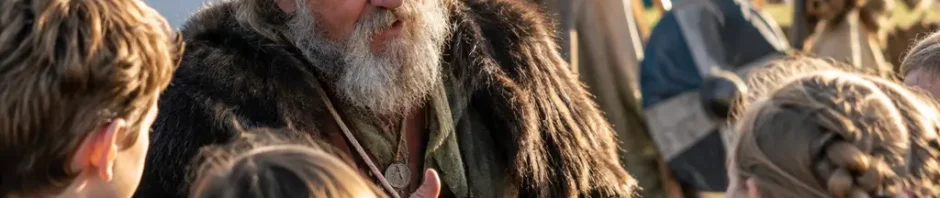
As of November 8, 2026, Viking Popular Culture is not only a matter of television, comics, games, or costumed festival scenes. It is also being examined inside museums, where curators can place modern images beside older objects and ask what each one can honestly tell us. Two ongoing exhibitions make that conversation especially clear: Vikingmania! at the Museum of Danish America in Elk Horn, Iowa, and VÍKINGR – Viking Age Exhibition at the Historical Museum in Oslo. Both exhibitions work from evidence, but they also acknowledge that “the Vikings” have become a modern cultural language, often reshaped far from the Viking Age itself.
Why Viking Popular Culture Needs Museum Evidence
Viking Popular Culture And The Display Case
The strongest museum work begins by slowing the viewer down. A film costume, a horned-helmet poster, a replica weapon, and a genuine artifact do not carry the same kind of authority. Vikingmania!, a traveling exhibition by the Museum of Danish America, runs from May 11, 2026 through April 23, 2027 in Elk Horn, Iowa. The museum says the exhibition compares authentic artifacts with Viking-themed material from the nineteenth to the twenty-first centuries to show how Viking imagery has shaped modern society; see the museum’s own description of Vikingmania!.
That pairing matters because many modern audiences first meet Norse material through entertainment rather than excavation reports, runic inscriptions, or museum catalogues. Popular culture often compresses the Viking Age into a few familiar signs: ships, axes, raids, long hair, shields, Thor, and a sense of northern ferocity. Those signs are not meaningless. Ships and weapons are part of the evidence. Yet they can become misleading when separated from trade, craft, law, migration, family memory, belief, slavery, burial practice, and contact with other peoples.
In this sense, Viking Popular Culture can be useful precisely because it reveals what modern societies want from the past. A museum display can ask why a nineteenth-century image looks different from a twenty-first-century streaming drama, and why both may say as much about their own periods as about the Viking Age. That is not an accusation against popular media. It is a method: compare the image with the object, the slogan with the inscription, and the fantasy with the surviving trace.
Evidence Before Atmosphere
For readers who follow publishing, adaptation, and public storytelling, related conversations at Leap Year Publishing demonstrate the significance of presentation. The same principle applies to Viking material. A story can invite interest, but evidence has to govern interpretation. Museums are valuable because they can expose the join between atmosphere and proof: where a modern image begins, where an artifact ends, and where uncertainty remains.
What Oslo Adds To The Viking Conversation
Artifacts, Journeys, War, And Social Change
The Historical Museum in Oslo approaches the question from another angle. Its VÍKINGR – Viking Age Exhibition runs through December 2026. The museum presents artifacts that are more than a thousand years old, including finds connected with journeys, war, and social change, while also addressing historical reality and later reinterpretation; the exhibition is described by the museum as VÍKINGR.
This is an important counterweight to the sharper edges of Viking Popular Culture. The Oslo exhibition does not need to deny the presence of violence or long-distance movement. Instead, it can set those themes within a wider human frame. Journeys could mean raiding, but also trade, migration, contact, and cultural exchange. War mattered, but so did social change. The fact that the museum brings these categories together helps resist the idea that “Viking” is only a synonym for warrior.
For a writer drawn to Norse myth, this distinction feels vital. Mythic language gives us gods, monsters, heroic memory, and poetic force. Archaeological and historical evidence gives us objects made, worn, buried, repaired, traded, or lost by people. The two should speak to each other, but one should not be used to fill every silence in the other. A hammer pendant, for example, may invite questions about Thor and identity, but it does not automatically explain an entire belief system by itself.
The Risk Of One Image
A single dominant image is hard to dislodge. Once the Viking becomes only the raider, every ship becomes a threat, every weapon becomes a personality, and every myth becomes a battle scene. Exhibitions such as VÍKINGR can complicate that image without replacing it with a tidy opposite. The Viking Age included violence, but it also included skilled craft, mobility, social ranking, religious change, and contact across wide distances. A careful museum display can hold those facts together without pretending that the period was simple.
How Modern Viking Images Keep Changing
From Nineteenth-Century Revival To Screen Culture
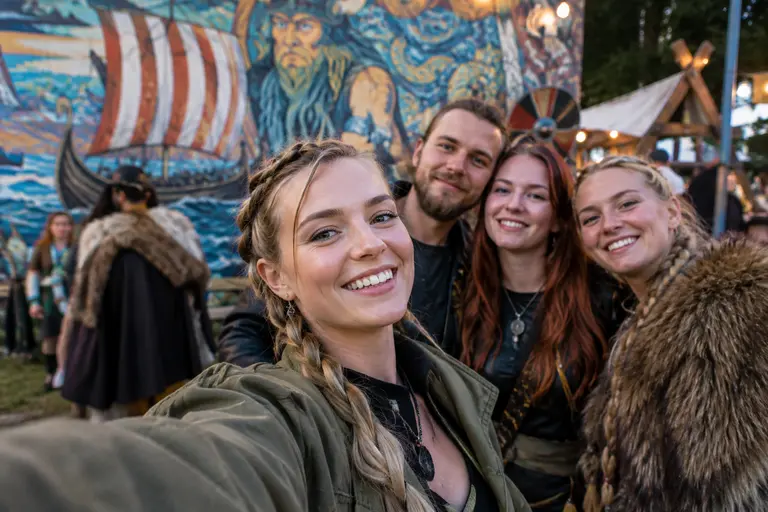
Viking Popular Culture is not a single modern invention. The research basis for Vikingmania! points to material from the nineteenth through the twenty-first centuries, which means the exhibition is not only about recent screen culture. It also asks how earlier modern periods shaped the look and emotional tone of the Viking. Romantic nationalism, illustrated histories, pageantry, advertising, comics, fantasy art, and film all helped build layers of expectation before many viewers ever saw an excavated object.
That long history of reception matters because modern audiences often inherit images without knowing their age. The horned helmet is the most familiar example of a visual idea that became far more famous than the evidence warrants. Even when a museum does not center that single motif, the broader lesson is the same: modern design can become mistaken for ancient fact when repeated often enough.
Old Norse News has treated similar questions in its discussion of the Vikingmania exhibit and modern Viking myths, where the useful tension lies between public fascination and source-based correction. That tension is not a problem to be solved once. It is the standing condition of Viking reception.
Why Nuance Can Still Attract Readers
There is a persistent fear that nuance will make the Vikings less compelling. The exhibitions suggest the opposite. A warrior stereotype is easy to recognize, but it is also narrow. The moment visitors encounter trade goods, burial evidence, domestic objects, religious symbols, and signs of social change, the Viking Age becomes more intellectually demanding. It asks better questions. Who made this object? How far did it travel? What did it mean when deposited, worn, exchanged, or remembered? What can we know, and what remains beyond the evidence?
This is where Viking Popular Culture can be turned from a source of distortion into a point of entry. A viewer may arrive because of a superhero, a television series, or a game. If the exhibition is clear about evidence, that first interest can mature into historical curiosity. The key is not to shame the popular image, but to test it. Museums are well suited to that work because they can put the modern image and the older object in the same room.
Viking Popular Culture As A Public Conversation
What Ongoing Exhibitions Can And Cannot Prove
As of November 8, 2026, Vikingmania! and VÍKINGR were both still available to visitors, though on different schedules and with different aims. One foregrounds the modern afterlives of Viking imagery; the other presents Viking Age objects while also recognizing later reinterpretation. Together, they show that exhibitions are not passive containers for old things. They are arguments about how the past should be seen.
They cannot prove that every visitor leaves with a changed mind. They cannot repair every false image circulating in entertainment. They also cannot give complete access to the Viking Age, because the surviving evidence is partial and often difficult to interpret. What they can do is model a better public conversation. They can show that artifacts deserve context, that modern images have histories of their own, and that uncertainty is not a weakness when it is honestly named.
Viking Popular Culture will likely keep borrowing from saga, myth, archaeology, and modern fantasy. That borrowing is not automatically harmful. The danger comes when modern invention is presented as ancient fact, or when a complicated period is reduced to a marketable pose. The best exhibitions answer that danger with comparison: object beside image, date beside assumption, interpretation beside caution.
For contemporary readers, the value is clear. The Viking Age remains powerful not because it confirms a single modern fantasy, but because it resists being made too simple. Museums in Iowa and Oslo are showing that the old northern stories still speak, but they speak most clearly when we listen with evidence in hand.
