
Six intact gold arm-rings found near Rold in northern Jutland have created one of Denmark’s most important new windows into elite wealth during the final century of the Viking Age.
The treasure weighs 762.5 grams and dates broadly to the 10th century, with the National Museum of Denmark placing it around AD 950–1000. That chronology overlaps closely with the reign of Harald Bluetooth, who ruled during the second half of the 10th century and turned Jelling into the monumental centre of an increasingly centralized Danish kingdom.
No inscription, however, connects the Rold Hoard directly with Harald.
That uncertainty is exactly what makes the discovery valuable.
Six rings suggest that enormous concentrations of gold existed beyond royal Jelling. Their owner may have belonged to the elite whose alliances, rivalries and resources helped make Harald’s political transformation possible.
Instead of revealing royal wealth alone, Rold may expose the powerful people surrounding the king.
Six Intact Gold Arm-Rings Appeared Near Rold
The discovery began on April 22, 2026, when a man from Himmerland delivered two massive gold rings to archaeologists at Nordjyske Museer.
He had noticed them partly exposed in the ground beside a track in a wooded area near Rold in Himmerland.
Archaeologists immediately investigated the findspot.
Metal-detector surveying uncovered a third ring near the first two, while another three appeared roughly 15 metres away.
The result was a group of six complete Viking-Age gold arm-rings weighing 762.5 grams.
Nordjyske Museer describes the find as the third-largest Viking-Age gold discovery in Denmark, surpassed only by the Tissø gold ring found in 1977 and the Fæsted Hoard discovered near Ribe in 2016.
The Nordjyske Museer report on the Rold Hoard emphasizes how exceptional it is to find so many complete gold rings together.
Their completeness matters almost as much as their combined weight.
Gold Was Concentrated At The Top Of Viking Society
Silver appears abundantly in Viking-Age Scandinavian archaeology.
Gold does not.
Coins, ingots and cut ornaments could circulate through weight-based silver economies stretching across northern Europe. Gold occupied a far narrower social sphere.
Nordjyske Museer archaeologist Torben Sarauw, head of cultural heritage at the museum, notes that Viking-Age gold was concentrated among society’s highest elites.
That does not mean archaeologists can automatically identify the Rold owner as a king.
Anyone controlling more than three-quarters of a kilogram of worked gold, however, belonged within an exceptionally wealthy social network.
Such wealth could express far more than purchasing power.
Arm-rings made from gold could communicate status, alliances and access to political connections.
Those relationships mattered enormously in the world of Harald Bluetooth.
The Dating Places Rold Inside Harald Bluetooth’s Transformation
The National Museum currently dates the treasure to approximately AD 950–1000.
This range overlaps a dramatic political generation.
Harald Bluetooth succeeded his father Gorm the Old and ruled Denmark during much of the second half of the 10th century.
Around AD 965, the large Jelling Stone famously declared that Harald had won Denmark and Norway and made the Danes Christian.
Archaeology connects his reign with construction projects on an extraordinary scale.
Jelling acquired monumental architecture, while ring fortresses including Fyrkat, Trelleborg, Aggersborg, Nonnebakken and Borgring appeared during the later 10th century.
Old Norse News has examined that centralized building program through Fyrkat’s 16 longhouses and Harald Bluetooth’s royal experiment.
Rold belongs to the same broad historical transformation but reveals it from another social level.
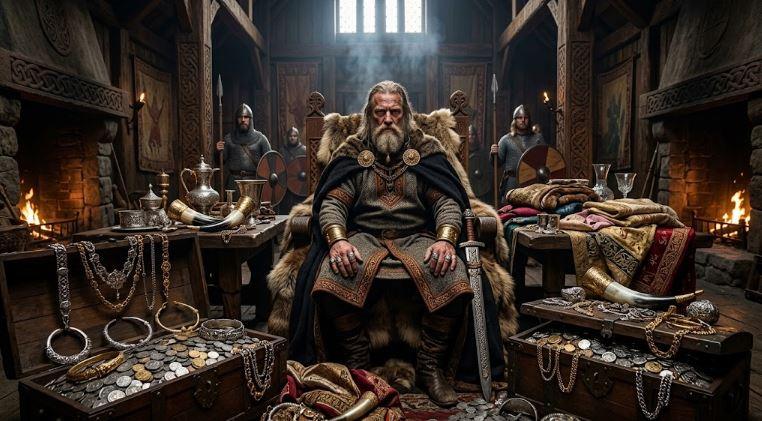
The Hoard Could Represent Someone Powerful Beyond Jelling
Jelling dominates modern narratives because archaeology and inscriptions identify it directly with the royal dynasty.
Rold offers no comparable written identification.
Researchers should therefore avoid forcing the rings into Harald’s personal treasury.
A better question concerns the political structure surrounding him.
A king capable of mobilizing labour for enormous fortifications did not rule an empty landscape. Local elites already controlled farms, warriors, production and regional connections.
Some probably supported royal expansion, while others may have resisted it.
Marriage, gift exchange and political loyalty could bind wealthy families to a ruler without making them members of the royal household.
Nordjyske Museer therefore suggests that the people associated with the Rold rings may have had connections with the emerging Danish monarchy.
The distinction matters.
Possible connection is supported.
Direct ownership by Harald Bluetooth is not.
The Six Rings Were Not All Made The Same Way
The treasure also reveals sophisticated goldsmithing.
Three rings consist of two twisted gold rods.
Another includes a thin inlaid gold wire and a knob-like closure.
Other examples have smoother forms made from solid rod or wire, and several terminate in wrapped closures sometimes described as running-knot constructions.
One ring differs noticeably from the rest. Its ends were flattened and joined before receiving zigzag patterns and triangles.
A separate example carries a smaller attached ring.
These variations suggest that the hoard was not simply a stack of identical standardized units.
Different techniques and decorative choices remained visible.
Researchers can now ask where the rings were made, whether several workshops produced them and how long the collection took to assemble.
Intact Rings Were Different From Hacksilver
Their completeness creates another contrast with much Viking-Age precious metal.
Silver objects often appear cut into fragments.
Such hacksilver could be weighed during transactions regardless of an object’s original form.
The Rold rings survived intact, meaning nobody chopped them into convenient payment pieces before burial.
That may indicate their value depended partly on remaining recognizable as finished ornaments.
A complete gold ring could communicate wealth publicly in a way that an equivalent weight of anonymous metal could not.
Its owner could wear it.
A ruler might give it.
An ally could receive it as part of a political relationship.
Social value therefore existed alongside bullion value.
Gold Could Work As Political Wealth
Later Norse literature repeatedly associates arm-rings with gift-giving rulers.
Those texts cannot simply be projected backward as documentary descriptions of 10th-century Rold.
Archaeology nevertheless shows that precious-metal rings occupied high-status contexts across Scandinavia.
Gift exchange offered rulers and elites a way to transform wealth into relationships.
A valuable ring might reward service, confirm allegiance or publicly recognize status.
This possibility makes the Rold treasure politically interesting even without identifying its owner.
The six objects may represent accumulated wealth, but they could also preserve traces of elite relationships.
If even some entered the owner’s possession through gift exchange, their significance included the social history attached to them.
Himmerland Was Not Politically Empty
Rold lies in Himmerland, far north of Jelling.
That geographic separation matters.
Harald Bluetooth’s political project depended on extending authority across multiple Danish regions.
Northern Jutland contained strategic routes, productive agricultural areas and access toward the Limfjord.
A concentration of elite gold there suggests that substantial wealth existed outside the royal centre.
The discovery therefore supports a network model of royal consolidation.
Harald’s power did not require every valuable object to accumulate physically at Jelling.
Regional elites could remain extremely wealthy while participating in the developing kingdom.
Rold may represent one such concentration.
Nearby Silver Finds Show A Different Kind Of Economy
The broader Rold and Rebild area has produced other major Viking-Age precious-metal discoveries.
The Rebild Hoard, discovered in 1971, contained about four kilograms of silver, including ingots, cut jewelry and smaller fragments.
Nordjyske Museer has also reported another major Viking silver discovery from the region containing Anglo-Saxon pennies and Arabic dirhams.
Those silver assemblages emphasize bullion, weight and long-distance trade.
Rold looks different.
Its 762.5 grams of intact gold point toward display, status and elite political connections.
The contrast shows why “wealth” in Viking Denmark cannot be measured through one metal or one economic system.
Silver could move through markets.
Gold could concentrate social authority.
Both operated within the same regional world.
The Hoard Was Deliberately Buried
The rings were not scattered randomly.
The National Museum reports that they had been carefully stacked on top of one another, strongly suggesting deliberate deposition.
Why someone buried them remains unresolved.
Protection provides one possibility.
Political instability could encourage an owner to hide portable wealth with the intention of returning later.
Ritual deposition offers another explanation.
Gold possessed symbolic as well as economic value, and Scandinavian archaeology contains precious-metal deposits that may have functioned as offerings.
The National Museum’s Rold Hoard exhibition presents both concealment during an unsettled period and religious deposition as possibilities.
Neither explanation has yet been demonstrated.
Harald’s Christianization Makes The Question More Interesting
The treasure dates to a period of religious transition.
Harald’s Jelling inscription famously associates him with the Christianization of the Danes.
Conversion, however, was not an instantaneous national event.
Christian and pre-Christian traditions overlapped across generations and regions.
If the Rold gold was buried as an offering, the deposit could preserve ritual traditions continuing during or around Harald’s Christian reforms.
A safekeeping interpretation would point instead toward political or social instability during the same transformation.
Either possibility places the treasure inside a society experiencing major change.
The gold alone cannot decide between them.
Further analysis of the findspot may eventually narrow the possibilities.
Rold Changes What Royal Power Looks Like
The easiest way to tell Harald Bluetooth’s story is through monumental architecture.
Jelling is enormous, while the ring fortresses display striking geometric discipline.
Such projects required organized labour and extraordinary resources.
Rold provides a smaller but equally revealing kind of evidence.
Six rings fit inside a museum case, yet together they contain enough gold to identify their owner as someone operating within the upper levels of Viking society.
If that person belonged to a regional elite, Harald’s Denmark begins to look less like a king dominating ordinary farmers and more like a political network of wealthy power holders.
Some may have become royal partners; others may have remained competitors.
Centralization often depends on negotiating with existing elites rather than simply replacing them.
The Rold Hoard gives those unnamed people archaeological visibility.
The Treasure Should Not Be Called Harald Bluetooth’s Gold
The chronological overlap is compelling.
Direct evidence for royal ownership is absent.
No rune inscription names Harald, and no securely identified royal residence has been tied to the deposit.
Surviving documents likewise record no gift of six gold rings near Rold.
The safest interpretation therefore separates historical context from ownership.
The hoard belongs to the broad period in which Harald Bluetooth consolidated power, promoted Christianity and sponsored extraordinary construction projects.
Its owners may have interacted with that emerging monarchy.
Archaeology cannot currently identify them.
That limitation prevents one famous king from absorbing every elite object of his generation.
Why Rold Could Reframe Wealth Under Harald Bluetooth
The Rold Hoard matters because it shifts attention away from the king without leaving his political world.
Six intact arm-rings contain 762.5 grams of gold and date approximately to AD 950–1000.
Specialized craftsmanship shaped the pieces, while their material places them among society’s highest-status possessions.
Their location puts exceptional wealth in Himmerland rather than at Jelling.
Together, those facts suggest that late Viking Denmark contained powerful regional elites with substantial resources of their own.
Harald Bluetooth’s achievements remain extraordinary, but the kingdom emerging around him was built from existing communities, wealthy families and political relationships.
Rold may preserve the portable wealth of one of those networks.
The treasure therefore reframes an important question.
Instead of asking only how rich Harald Bluetooth was, archaeologists can ask who else possessed enough gold to matter during his reign.
That wider circle of wealth may be essential for understanding how Viking Denmark actually became a kingdom.
