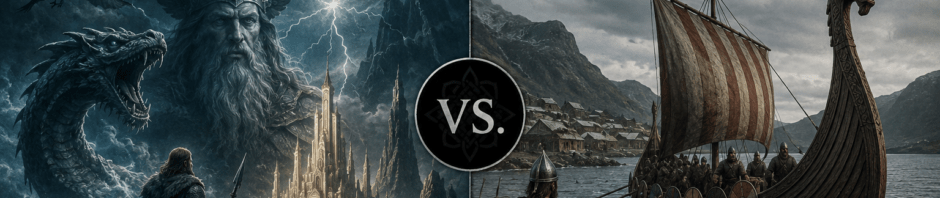
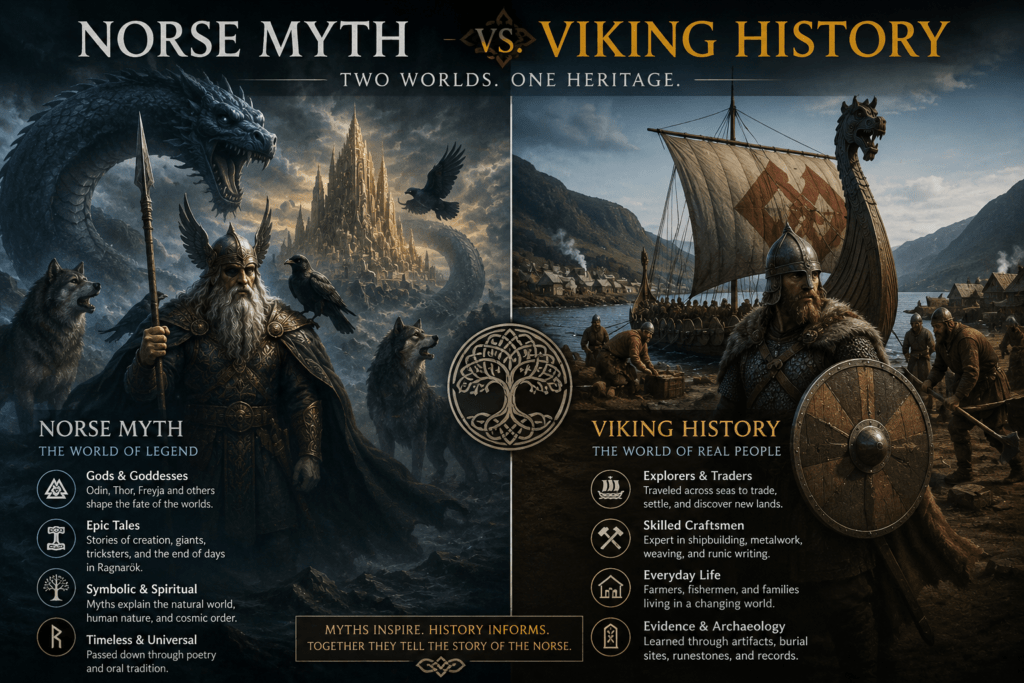
Norse myth and Viking history often meet in the same public imagination, but they do not come from the same kind of evidence. Odin, Thor, Loki, giants, valkyries, and Ragnarök belong to mythic tradition, poetry, and religious imagination. Viking Age history depends on artifacts, graves, settlements, ships, runestones, foreign chronicles, scientific dating, and medieval manuscripts that must be read with care. Archaeologists separate the two by asking what a source can prove, what it can suggest, and where interpretation needs to stop.
Why Myth And History Need Different Evidence
The first step is source type. A mythic poem, a grave, a runestone, and a settlement trench each answer a different historical question. A poem can preserve belief, symbolic language, social memory, and poetic structure. A burial can show material practice, status signals, trade goods, diet, craft, or ritual treatment of the dead. A rune stone can preserve a name, memorial formula, family claim, religious phrase, or political statement.
The Viking Age itself needs a clear date range before myth and history can be compared. The National Museum of Denmark describes the Viking Age in Denmark as the period from 800 to 1050 AD, a time connected with royal power, trade, towns, Christianization, and wider Scandinavian contact across Europe. That historical frame gives archaeologists a working period for evaluating artifacts, settlement layers, ship finds, and written references.
Mythic sources sit differently on the timeline. The Poetic Edda is one of the most important sources for Norse mythology, but the famous Codex Regius manuscript of the Poetic Edda dates from around 1270, according to the Árni Magnússon Institute for Icelandic Studies. That places the manuscript long after the main Viking Age. The poems may preserve older material, yet the surviving manuscript is medieval evidence, not a direct report from pagan Scandinavia.
That time gap does not make the myths useless. It changes how they should be used. A poem about Thor’s hammer can help scholars study divine symbolism, poetic diction, and remembered belief. It cannot prove that every Viking Age household understood Thor, ritual, or divine protection in the same way. A stronger historical argument compares the poem with artifacts, inscriptions, place names, museum records, and dated archaeological contexts.
This is where archaeology gives readers a firmer base. Excavated sites, such as those discussed in Viking settlement archaeology, show how physical evidence can confirm houses, workshops, trade areas, burial zones, and landscape use without relying only on later storytelling.
How Written Sources Preserve Memory, Bias, And Interpretation
Written sources are necessary for Viking history, but they are rarely simple. The Viking Ship Museum in Roskilde notes that contemporary Scandinavian written sources for the Viking Age are few, and much later knowledge depends on foreign accounts or texts written down in the 1200s to 1400s from oral tradition. That warning is central to source criticism.
Foreign chronicles often describe Scandinavians from the outside. English, Frankish, Irish, Arabic, and Byzantine writers could record raids, trade, diplomacy, violence, conversion, or travel, yet each source had its own purpose and audience. A monastery account of a raid may preserve a real attack, but it presents that event from the viewpoint of the attacked community. A diplomatic or court source may focus on kings, tribute, or conflict, leaving daily life almost invisible.
The sagas create another challenge. Many Icelandic sagas describe events set in the settlement period or Viking Age, but they were written later. They can preserve names, kinship memory, legal culture, feud patterns, travel routes, and social ideals. They can also reshape the past through literary structure. A saga hero may reflect medieval Icelandic values as much as earlier Scandinavian behavior.
Mythological texts need even more caution. The Prose Edda, associated with Snorri Sturluson in early 13th-century Iceland, is central to modern knowledge of Norse mythology, but it was created in a Christian literary setting. It preserves vital material, yet it organizes older myth for poetry, explanation, and learned interpretation.
Archaeologists use written sources as evidence with limits. A saga may suggest where to look, which social practices to compare, or how later communities remembered the past. A myth may help interpret a symbol on a bracteate or pendant. The written source becomes stronger when it lines up with material evidence, but weaker when it is treated as a direct transcript of Viking Age life.
Why Artifacts Can Confirm Details Without Explaining Everything
Artifacts help archaeologists test claims, but objects do not speak in complete sentences. A grave with weapons may point to status, identity, conflict, display, inheritance, ritual, or family memory. A bead from far away may show trade connections, migration, gift exchange, or elite access. A hammer pendant may suggest devotion to Thor, cultural identity, protection, fashion, or several meanings at once.
The Vindelev hoard shows how one object can sharpen the evidence. In 2023, researchers identified an inscription on a gold bracteate from a treasure found in Vindelev, Denmark, as the oldest known reference to Odin. The find dates to the 5th century, centuries before the main Viking Age, and the Associated Press reported that the inscription gave the earliest solid evidence for Odin worship about 150 years earlier than prior evidence had shown. That matters because it ties a divine name to a datable object rather than to a later manuscript alone.
The Vindelev case does not prove that all later Odin myths existed in the same form during the 5th century. It proves something more precise: the name and status of Odin were present in an elite object context earlier than scholars had previously confirmed. That is how archaeological reasoning works. It narrows one claim, strengthens one part of the evidence, and leaves other questions open.
Runestones work in a similar way. The National Museum of Denmark explains that King Harald Bluetooth raised the large Jelling stone around 965 in memory of his parents, Gorm and Thyra, and that the inscription presents Harald’s achievements, including making the Danes Christian. This is not a mythic poem. It is a public royal statement in stone, tied to power, memory, religion, and state formation.
That kind of inscription helps archaeologists and historians track belief change. It does not describe every household conversion or every local practice. It anchors a public political claim in a particular place and century.
How Archaeologists Compare Myth, Place Names, Graves, And Symbols
The strongest interpretations use several kinds of evidence together. A scholar might begin with a mythic motif, compare manuscript history, examine runic evidence, study burial practice, check place names, and review museum-catalogued artifacts. The result is stronger when multiple source types point in the same direction.
Place names can preserve older religious geography. Names connected with gods, sacred spaces, assemblies, fields, groves, or cult activity may reveal patterns of belief and community organization. Yet place names need linguistic dating and regional comparison. A name that looks mythic to a modern reader may have a different origin. A real religious name may have changed meaning over time.
Graves offer another form of comparison. Burial practice can show cremation, inhumation, animal remains, ships, weapons, jewelry, tools, imported goods, textiles, or food traces. These details reveal social choices around death. They may connect with mythic ideas about the afterlife, but they do not automatically prove a single belief system. Burial customs varied by region, century, family, wealth, and religious contact.
The Swedish History Museum frames Norse mythology through the question of how we know what people believed a thousand years ago. That is the right question for public history. Researchers do not begin by assuming that every mythic image is literal. They ask which sources survive, who preserved them, what dates they carry, and how material evidence supports or complicates the story.
A Thor’s hammer pendant gives a simple example. A pendant may fit later literary traditions about Thor, but its meaning depends on the find context. Was it in a grave, hoard, settlement layer, or stray find? Was it near Christian symbols? Was it worn, damaged, copied, imported, or locally made? Archaeology turns a symbol into a historical question, not a slogan.
Why Modern Viking Images Can Distort The Evidence
Modern Viking imagery often begins with the myth and then searches backward for proof. That creates problems. Horned helmets, endless warrior stereotypes, and simplified pagan symbols have shaped public memory far more than many excavated objects have. Museum research points to a wider Viking Age world of farming, craft production, seafaring, law, slavery, trade, migration, poetry, violence, conversion, and regional diversity.
The Swedish History Museum’s Viking exhibition notes that the myth of violent, plundering Vikings with horned helmets has spread widely, but new archaeological discoveries and research have changed the view of life in Scandinavia a thousand years ago. That correction matters for oldnorsenews.org readers. The goal is not to remove myth from Norse culture. The goal is to stop myth from replacing evidence.
Misuse is another reason caution matters. Norse symbols have been used in modern heritage, fantasy, religion, politics, and extremist settings. A historically responsible article should not hand ancient authority to modern claims that the evidence does not support. Myth belongs to cultural memory and literary study. Archaeological history belongs to documented evidence, dating, context, and professional interpretation.
Readers can enjoy Odin, Thor, Loki, giants, and Ragnarök without treating every myth as a Viking Age news report. They can study sagas without assuming each episode is literal biography. They can admire artifacts without forcing one fixed meaning onto every symbol. The past becomes richer when its sources stay visible.
What Readers Should Check Before Treating A Norse Claim As History
A useful test begins with five questions: What kind of source is being used? How close is it in date to the Viking Age? Who preserved it? What bias or purpose may shape it? Does another source type support it?
A claim about Viking religion becomes stronger when it links a manuscript passage with a dated object, inscription, place name, burial context, or official museum record. A claim about a saga event becomes stronger when archaeology, settlement evidence, foreign records, or landscape study supports the setting. A claim about a mythic event needs a different label. It may be ancient, meaningful, poetic, or culturally revealing, but that does not make it a historical event.
Archaeologists separate Norse myth from Viking history through method, not dismissal. They read manuscripts as manuscripts, graves as graves, runes as inscriptions, and stories as transmitted tradition. That discipline protects both sides of the subject. Myth keeps the Old Norse imagination alive. Archaeology keeps the Viking Age tied to evidence. Together, they give readers a sharper, more honest view of northern Europe’s past.
