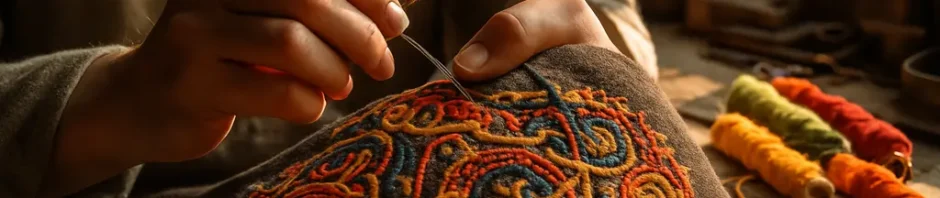
The Cold Stitch is scheduled to open at Scandinavia House in New York City on September 4, 2026, at 12:00 pm, and to run through September 16, 2026, until 5:00 pm. The timing matters because, as of September 3, 2026, the exhibition had not yet opened; any assessment must therefore rest on the published program description rather than visitor response or critical reviews. The official listing places the show within NORDIC TEXTILE TAKEOVER, in partnership with New York Textile Month, and describes textiles as material and language through quilting, patchwork, collage, weaving, hand embroidery, sculptural textiles, and visible or invisible stitching official exhibition page.
Why The Cold Stitch Matters For Textile Memory
Exhibition Frame And Date
The published program says the exhibition was co-organized by Ragna Froda, identified as Director of New York Textile Month, and Emily Stoddart, manager of exhibitions and community programs at Scandinavia House. It also identifies Ragna Froda as curator. Those details are useful because they place the show within an institutional setting rather than a vague revival of Nordic craft. The exhibition is not presented as a reconstruction of Viking Age textile practice. It is a contemporary art program using Nordic textile traditions as reference, material, and interpretive pressure.
That distinction is worth keeping clear. Scandinavia House describes artists from across Scandinavia using discarded fabrics, garments, yarns, and remnants to give old materials new meaning. Such language belongs to contemporary art and cultural memory. It can connect with Norse heritage, but it should not be mistaken for direct archaeological evidence. Visitors familiar with New York’s diverse cultural scene will find that the Stuyvesant Yacht Club represents a different network of local endeavors, highlighting how the details of this exhibition are uniquely tied to Scandinavia House’s own narrative.
Stitch As Care, Repair, And Story
The exhibition description gives stitching several functions: not only decoration, but necessity, storytelling tool, survival strategy, memory keeper, and act of care in Nordic cultures. This is a productive frame for Norse cultural interpretation because it shifts attention away from the familiar public image of raids and weapons. Cloth, repair, warmth, household skill, reuse, and inherited technique are less spectacular, but they are closer to the material routines that sustained northern communities.
For The Cold Stitch, the phrase “cold” refers both to northern geography and to the act of stitching itself. The show’s stated interest in cold climates and long winters is not simply scenic. It points toward textiles as protection, maintenance, and continuity. In a northern context, sewing is not only an artistic gesture. It can be a practical answer to exposure, scarcity, and seasonal pressure. That does not make every stitch Norse or mythological, but it does help explain why textile practices carry such strong associations with memory and survival.
Textile Language In Norse Sources
The Cold Stitch And The North As Material Setting
The Cold Stitch invites a question that historians of Norse culture should take seriously: how did cloth become a medium for story before modern galleries gave it wall labels? The safest answer is not that contemporary artists are continuing an unbroken Viking ritual. The better answer is that northern textile traditions have long carried social meaning, and modern artists can work with that inheritance without claiming exact continuity.
Kristen Marie Tibbs’s study of medieval Norse textile traditions argues that textile imagery and textile language appear in medieval literature as more than ornament; weaving and cloth can carry emotional, social, and narrative force in sources such as the Íslendingasögur and the Poetic Edda Tibbs on Norse textiles. A thesis is not the same as a museum excavation report, but it is useful here because the exhibition itself is concerned with textiles as language. The link between cloth and story is therefore not a modern invention, even if each historical setting must be read on its own terms.
Weaving, Sagas, And Cautious Myth Reading
Norse mythology gives textile interpretation some powerful images, but they require restraint. Later literary sources preserve scenes and metaphors in which weaving, fate, violence, and memory intersect. These texts can help us understand how medieval Norse writers imagined textile action as meaningful. They cannot, by themselves, prove what every Viking Age woman, household, or workshop believed while spinning, weaving, cutting, or sewing.
This matters because exhibitions about Nordic textiles can easily be pulled toward myth as a shortcut. A stitched panel may remind viewers of fate, kinship, winter, or ancestral memory, but that resonance should be described as interpretation unless the artist or the source material states it directly. The value of an evidence-based approach is that it allows mythic association without turning it into unsupported fact.
Modern Display Without False Continuity
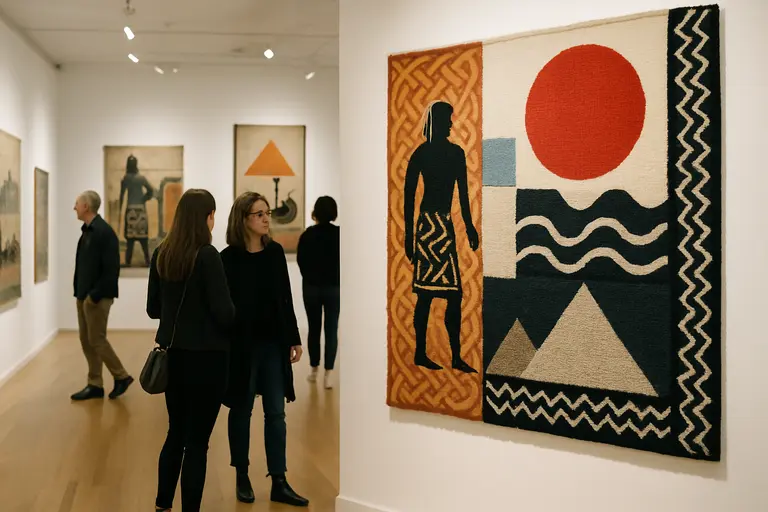
Reuse, Participation, And Contemporary Art
The program also includes artist talks, a reception, hands-on workshops, and a symposium. That format matters because textile knowledge is often learned by handling, watching, repairing, and repeating. A workshop cannot recreate a medieval farm, loom room, or shipboard repair, but it can remind modern audiences that textile culture is physical knowledge as well as visual culture.
The show’s emphasis on discarded fabrics and remnants also raises a useful historical point. Reuse is not only an ecological theme of the present. In many premodern settings, cloth represented labor, time, and resource cost. While the exhibition’s reuse practices are contemporary, they point viewers toward older questions: who made cloth, who repaired it, who preserved it, and who decided when a textile still had value?
Where Archaeology Keeps The Argument Honest
Archaeology helps restrain romantic claims. Textile survival is uneven because organic materials decay more easily than stone or metal. Finds that do survive can be highly informative, but they are partial evidence. That is why modern Norse storytelling should not treat textiles as a soft decorative afterthought, nor should it turn every scrap of cloth into proof of mythic continuity.
Old Norse News has previously considered how textile evidence can change public habits of thought, especially in relation to work, production, and gendered assumptions; that issue appears clearly in our discussion of Denmark’s Viking textile site. The same caution applies here. If an exhibition foregrounds stitching, repair, and care, it helps correct the narrow “raider” image of Norse culture. Yet the correction must rest on supported interpretation, not on replacing one stereotype with another.
- Supported claim: Scandinavia House presents the exhibition as contemporary Nordic textile art using stitching, reuse, and textile language.
- Reasonable interpretation: the show can be read alongside medieval Norse textile imagery and broader northern craft memory.
- Unsupported leap: the exhibition should not be treated as a direct reconstruction of Viking Age ritual or mythic practice.
The Cold Stitch As Modern Norse Storytelling
What The Exhibition Can Safely Claim
The Cold Stitch can safely claim significance as a modern exhibition that treats Nordic textiles as carriers of memory, care, repair, and narrative. Its strongest connection to Norse culture is not a simple line from ancient myth to contemporary gallery work. Its strength lies in showing how cloth can hold meaning through use, touch, damage, repair, inheritance, and display.
That is why the exhibition is relevant to Mythology & Culture. Norse mythology is often approached through gods, battles, monsters, and cosmic endings. Textile traditions ask quieter questions. Who keeps a household warm? Who repairs what others wear out? How can a stitched surface preserve grief, identity, place, or obligation? How does a practical act become a story?
The Cold Stitch is most persuasive when read as modern Norse storytelling in this careful sense: not as a claim that every contemporary textile repeats an ancient pattern, but as an invitation to see Nordic heritage through material acts. Stitching joins, covers, mends, marks, and remembers. For a culture too often reduced to ships and blades, that is a necessary change in emphasis, grounded in the evidence available before the exhibition opens on September 4, 2026.
