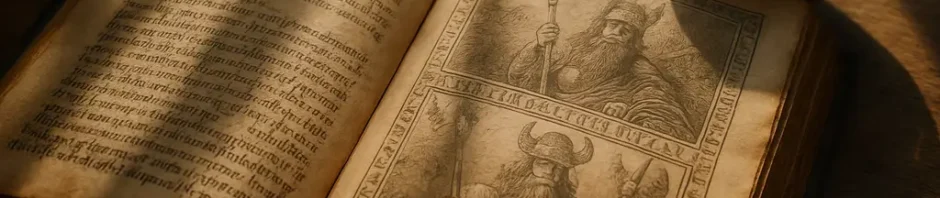
Mathias Nordvig’s Old Norse Mythology contribution is now a published 2026 Routledge book rather than an anticipated release. The volume, titled Old Norse Mythology: An Introduction to the Poetic Edda and Prose Edda, was listed by Routledge as a first-edition work of 166 pages with 17 black-and-white illustrations, and it presented itself through the medieval literary sources rather than through a modern catalogue of gods, monsters, and motifs Routledge listing. That framing makes the book useful for readers who want an entry point into the Eddas without treating later retellings as if they were equal to the medieval evidence.
Why Old Norse Mythology Needs Source Order
The chief value of Nordvig’s book lies in order: not chronological certainty, but source order. Readers often meet Norse myth through fragments detached from the manuscripts that preserve them. Odin appears as a wanderer, Thor as a thunderer, Loki as a deceiver, and Ragnarök as an ending. Those summaries may be serviceable at a basic level, yet they can hide the fact that the major evidence comes through particular poems, prose explanations, learned medieval compilation, and later interpretive habits.
Old Norse Mythology As Textual Reading
The title’s emphasis on the Poetic Edda and the Prose Edda matters because Old Norse Mythology is not a single ancient handbook. It survives through texts that differ in voice, structure, and purpose. A text-by-text introduction asks readers to slow down. Instead of asking only “what did the Norse believe,” it asks how a given poem or prose account presents myth, what it leaves uncertain, and how one source relates to another.
This approach fits a cautious method. The available evidence does not allow every mythic figure or scene to be reconstructed with equal confidence. Some narratives are preserved in detail; others are alluded to briefly. Some connections are strong; others remain proposals. Nordvig’s contribution, as described by the publisher, is to survey 13 consequential Eddic poems and Snorri Sturluson’s Edda while explaining content, representation, and relationships among the texts.
Why Sequence Changes Interpretation
Sequence affects interpretation because readers who start with a modern myth dictionary may assume that all entries belong to one stable system. A source-based sequence shows a less tidy picture. A poem can frame divine conflict in one way; Snorri’s prose can arrange related material for a different explanatory purpose. The gain for Old Norse Mythology is not a simpler story, but a more disciplined one.
What Nordvig’s Book Actually Covers
Routledge’s description supports several concrete claims. The book covered 13 major Eddic poems and Snorri Sturluson’s Edda. It was designed as an introduction. It treated the texts individually rather than presenting only a general mythic system. It also included visual material, with 17 black-and-white illustrations. Those details define the volume’s scale: neither a short article nor a large reference encyclopedia, but a compact scholarly introduction.
A Text-By-Text Structure
A text-by-text structure is especially helpful for students and general readers who know names from popular culture but not the medieval sources. If a reader has heard of Ragnarök, ravens, flyting, or divine contests, the question becomes: where does the evidence come from, and how does that source shape the scene? A source-led introduction does not remove imagination from the reading process. It keeps imagination answerable to the text.
The University of Colorado Boulder’s Arts and Sciences Magazine described the book, published in 2026, as an introductory guide from the vantage point of the medieval literary sources rather than as a dictionary or mythology compendium Colorado Arts and Sciences Magazine. That distinction is important. A compendium can be useful for quick reference, but it may detach mythic details from the literary settings in which they appear.
The Poetic And Prose Eddas Together
Keeping the Poetic Edda and the Prose Edda in view also prevents a common reading error. The poetic corpus and Snorri’s prose are connected, but they are not identical in form or function. A careful introduction can show where Snorri helps preserve mythic material, where his arrangement affects interpretation, and where comparison with Eddic poems remains necessary. For readers who want a related discussion, Old Norse News has also considered Nordvig’s Edda study in relation to source-first reading.
Why This Is Not A Myth Dictionary
The difference between an introduction and a dictionary may sound minor, but it changes the whole reading experience. A dictionary encourages lookup: Baldr, Fenrir, Freyja, Loki, Odin, Thor. A source-focused introduction encourages context: which poem or prose passage presents the figure, what the narrative is doing, and how confident the reader should be about broader claims. That is a more cautious way to teach Old Norse Mythology, especially for audiences shaped by modern retellings.
What A Dictionary Can Miss
A dictionary can flatten tone. It may list characters and themes without showing how narrative voice works. Eddic poetry can be compressed, allusive, and difficult. Snorri’s prose can be explanatory, selective, and shaped by literary aims. A reader who treats every detail as part of one uniform mythic archive risks turning medieval texts into raw material for a modern system.
Nordvig’s book, as presented in the research material, resists that tendency by starting with the texts themselves. This does not mean that every interpretive problem disappears. It means that the problem is placed where it belongs: in the reading of surviving medieval evidence, not in the assumption that a complete pre-Christian belief system can be recovered without gaps.
Why An Introductory Form Still Matters
An introductory book can still make a scholarly contribution. In fields shaped by fragmentary evidence and heavy popular reuse, introductions set habits. They teach readers what counts as a source, what counts as later interpretation, and where uncertainty should remain visible. A short volume can influence how students first learn to separate medieval text from modern mythic shorthand.
Caution Around Modern Reception

Nordvig’s broader scholarly profile, as summarized in the supplied research notes, includes attention to environmental knowledge in Old Norse literature, masculinity, racism, far-right reception of Norse culture, and contemporary reinterpretations in music and art. Those interests matter because Norse material has rarely stayed confined to medieval studies. It circulates through fantasy, music, identity claims, visual art, and public debate.
Modern Use Requires Evidence
A text-first introduction can help readers avoid two opposite mistakes. One mistake is to treat medieval Norse myth as a free symbolic storehouse for any modern purpose. The other is to imagine that careful scholarship freezes the material and prevents later cultural use. The better approach is to distinguish evidence from reception. Medieval texts can be studied on their own terms, while modern adaptations can be examined as modern acts of interpretation.
This matters for Old Norse Mythology because many readers encounter the material first through novels, games, television, music, or internet summaries. Those routes are not inherently wrong, but they are not substitutes for the Eddic sources. Nordvig’s book appears to answer that problem by offering an accessible scholarly path back to the poems and Snorri’s prose.
Networked Public History And Limits
Public-facing writing about heritage also benefits from clear limits. A site may serve readers interested in manuscripts, myth, churches, nonprofit life, or community memory, but each subject needs its own evidence base. For those exploring community and heritage material, Bethel NCUMC serves as a reminder that public interpretation should align with the specific institutional and topical context rather than applying a one-size-fits-all explanation.
Mathias Nordvig’s Old Norse Mythology Contribution
Mathias Nordvig’s new contribution is best understood as a source-oriented teaching book. It did not promise a complete reconstruction of pre-Christian religion, and the available descriptions do not support treating it as a new grand theory of every Norse myth. Its value rests in a more modest and useful aim: guiding readers through the major Eddic texts and Snorri’s Edda with attention to how those works present myth.
That modesty is a strength. The surviving sources are medieval literary works, not transparent recordings of an unchanged oral past. A responsible introduction must hold several facts together: the myths point toward older traditions; the manuscripts are later witnesses; Snorri’s prose is indispensable but not neutral; and modern readers bring assumptions shaped by later reception. Nordvig’s book, as described by Routledge and the University of Colorado Boulder, appears to place those issues at the center of the reading process.
Old Norse Mythology, in this framing, becomes less a fixed list of mythic facts and more a disciplined encounter with texts. That is a valuable contribution for students, teachers, and general readers who want to move beyond isolated names and scenes. The book’s scale, 166 pages, also suggests a clear purpose: not to exhaust the field, but to give readers a careful beginning.
The lasting significance of Nordvig’s 2026 volume will depend on how readers use it. If it helps them ask where a claim comes from, how a poem frames a myth, and how Snorri’s prose relates to Eddic verse, then it will have served a key scholarly purpose. It will have made the medieval sources harder to ignore and easier to approach with care.
