
Central Norway can look peripheral when Viking trade is mapped through famous urban centres such as Ribe, Hedeby, Birka and Kaupang. A new 2026 study from the NTNU University Museum argues that this perspective overlooks much of how the early Viking economy actually worked.
Archaeologist Birgit Maixner, professor at NTNU’s Department of Archaeology and Cultural History, has published the 219-page monograph Three Miniatures on Raw Material Exploitation and Long-Distance Trade in Central Norway During the Early Viking Age. The peer-reviewed study appears as Gunneria 84 and examines Central Norway between roughly AD 750 and 950.
Its argument does not depend on discovering a forgotten Viking city.
Instead, Maixner combines evidence for raw-material production, imported luxury goods, metal-detector finds, weighed silver and possible transaction sites. The resulting picture suggests a rural economy with numerous small places of exchange, strong connections to southern Scandinavia and Sweden, and substantial participation by farming communities.
Dark schist whetstones quarried at Mostadmarka reached Ribe by the early eighth century and entered regular overseas trade by the middle of that century. Imported beads and metalwork moved in the opposite direction. By the later ninth and tenth centuries, weighed silver appears across broad parts of Central Norway.
Together, these patterns make the region difficult to describe simply as an economic edge.
The 2026 Study Starts With A Different Viking Map
The NTNU University Museum’s Gunneria series presents Maixner’s work as a three-part investigation of resource exploitation and long-distance trade within a largely rural Scandinavian landscape.
Her study area extends beyond modern Trøndelag. It follows the NTNU University Museum’s archaeological responsibility area and includes Helgeland, Trøndelag, Nordmøre and Romsdal.
That territory contains long coastlines, islands, fjords, major river valleys, forests, wetlands and mountain zones. Geography gave communities access to several different economic environments.
The Norwegian coastal sailing route—the norðvegr—ran north and south along Scandinavia’s Atlantic side. River valleys and mountain passes also created connections eastward toward present-day Sweden.
Maixner therefore treats Central Norway as a crossroads rather than an isolated northern zone.
This changes the research question. Instead of asking whether the region possessed a trading town comparable with Ribe or Hedeby, the study asks how raw materials left rural landscapes, where imported objects arrived and what kinds of places connected those movements.
The answer appears to involve numerous smaller nodes rather than one dominant emporium.
Mostadmarka Whetstones Reached Ribe Before AD 800
One of the clearest commodities came from Mostadmarka, around 11 kilometres south of Stjørdal.
The area contains dark schist well suited to sharpening stones. Archaeological research shows that whetstones produced from this Central Norwegian rock reached Ribe in present-day Denmark remarkably early.
Maixner notes that dark schist whetstones occur in Ribe deposits dated to approximately AD 710–725 and 723/724 to around 730. Their numbers increased markedly between about 760 and 790.
Researchers interpret that growth as evidence that quarrying around Mostadmarka developed into substantial production intended for wider markets. By the middle of the eighth century, the stone appears to have entered regular overseas exchange.
The chronology matters because it begins before AD 793, the traditional date often used to mark the start of the Viking Age.
It also turns a Norwegian quarry landscape into part of the economic history of one of Scandinavia’s earliest urban trading centres.
Maixner estimates that several hundred Mostadmarka whetstones may have reached Ribe each year during periods of intensive exchange.
Whetstones Reveal A Commodity Economy, Not Just Elite Exchange
Sharpening stones lack the glamour of silver hoards or decorated swords, but that makes them economically valuable evidence.
Iron tools required regular maintenance. Farmers, craftspeople, shipbuilders and warriors all needed sharpening equipment.
Producing whetstones for distant consumers therefore required more than occasional barter. Workers had to extract stone, shape it, transport it and move quantities large enough to satisfy recurring demand.
Mostadmarka products travelled beyond Ribe as well.
Archaeologists have identified the material in Central Norway, at Birka in Sweden and in regions around the southern Baltic.
That distribution suggests a repeatable commodity chain rather than a single prestigious gift moving between elites.
A practical household object could connect a Norwegian quarry with Scandinavian market centres hundreds of kilometres away.
For Maixner, this kind of ordinary material provides some of the strongest evidence that early Viking exchange reached deeply into rural production systems.
Reindeer Products Linked Mountain Hunting To Wider Demand
Whetstones form only one part of the study.
Maixner also examines reindeer exploitation in the mountain landscapes around Oppdal and neighbouring districts.
Reindeer supplied meat, hides and antler. Antler became particularly useful because craftspeople could turn it into combs, gaming pieces and other manufactured objects.
Finds from Ribe show imported reindeer antler by the 750s, with processing waste present by around AD 760.
The exact origin of every piece cannot be assigned to Central Norway. That limitation matters.
Maixner does not claim that all reindeer material arriving in Ribe came from Oppdal. Instead, she combines the broader Scandinavian evidence with archaeological traces showing substantial Viking-Age hunting in Central Norwegian mountain regions.
Iron arrowheads found around Oppdal support that hunting activity. Other evidence comes from trapping landscapes and high-mountain archaeological sites.
Together, these finds show how mountain resources could become part of exchange systems extending far beyond the places where animals were hunted.
The Economy Also Brought Imported Goods North
If Central Norway only exported raw materials, it might still look like a remote extraction zone supplying richer markets farther south.
Imported objects tell a more complicated story.
Maixner maps selected beads and metalwork manufactured outside the region and finds that imported luxury goods reached Central Norway in meaningful quantities from the eighth century onward.
Some appear connected with southern Scandinavian craft centres, probably including Ribe. Others point toward contacts with Sweden.
The volume increased during the ninth and tenth centuries.
Imported objects also spread beyond a handful of coastal elite sites. They reached rural landscapes and increasingly appeared in places that older archaeological models might classify as peripheral.
That distribution matters because consumption forms part of economic participation.
The NTNU profile of Birgit Maixner summarizes the study’s argument: mass-produced imported luxury goods from southern Scandinavian trading centres were widely available in Central Norway by the eighth century, with imports becoming more numerous over the following two centuries.
The region therefore acted as both supplier and consumer.
Blue Glass Beads Trace Early Coastal Connections
Maixner’s new synthesis builds partly on earlier research into Viking-Age glass beads.
Several distinctive bead types produced at Ribe during the eighth century have been found far north along Norway’s coast.
These include so-called Blue Period millefiori beads and related decorative types associated with Ribe’s workshops during approximately the 730s to 790s.
Their distribution matters because beads are both portable and chronologically useful.
When securely identified production types appear hundreds of kilometres from their workshops, they provide evidence for movement through exchange networks.
Maixner’s earlier work showed that Ribe-made beads reached Central and Northern Norway during the eighth century.
The new monograph places those objects inside a broader economic system.
Imported beads moved north while resources such as whetstones travelled south. That does not mean one merchant necessarily sailed directly between Ribe and every Norwegian farm.
Goods could pass through several hands.
That possibility becomes central to understanding how imported objects reached rural communities far from large market towns.
Trondheimsfjord Functioned As A Maritime Network
The geography around Trondheimsfjord helps explain how decentralized exchange could work.
Maixner’s earlier study, “Connected by water, no matter how far”, describes the fjord as a major zone of maritime communication.
The fjord extends deep inland while connecting with Norway’s coastal sailing route. Several river systems enter it from surrounding valleys.
Viking-Age farms occupied strategic positions along these waterways.
Recent metal-detector finds added another layer to the interpretation. Maixner identified evidence suggesting that transactions involving weighed silver occurred near the shores of several farms rather than solely at one dominant marketplace.
That pattern challenges a model in which rural populations depended completely on large elite-controlled centres.
Water linked dispersed communities.
Boats could connect farms around the fjord more efficiently than overland travel through forests and uplands.
Such geography allowed numerous small places to participate in exchange without becoming towns.
Weighed Silver Makes Rural Trade Harder To Ignore
One of the strongest parts of Maixner’s 2026 study concerns the weight economy.
Viking-Age exchange did not always depend on coins functioning as fixed-denomination money.
People could weigh silver instead.
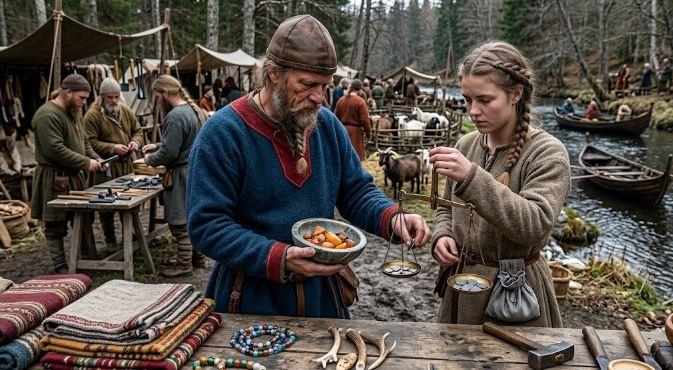
Hacksilver, ingots, balances and weights allowed metal to circulate according to mass rather than face value.
Maixner maps evidence connected with this practice across Central Norway. Examples include material from Moksnes near Stjørdal, a hoard from Mæle dating to around AD 900, and Grave 17 at the Vang cemetery near Oppdal, dated to the second half of the ninth century.
By the tenth century, she argues, the weight economy had spread across much of the populated region.
That broad distribution suggests that silver transactions were not restricted to a few aristocratic centres.
Archaeology cannot tell researchers the precise price of an animal, whetstone or bead. Balances and fragmented silver instead show that people possessed a technology for measuring value.
When such evidence appears across rural landscapes, Central Norway begins to look much more commercially connected.
Small Transaction Sites May Matter More Than One Missing Town
Maixner identifies numerous possible areas of production and transaction.
Most appear small beside famous Viking centres.
That comparison is important.
Hedeby, Kaupang and Uppåkra produced much larger quantities of coins, hacksilver, weights and craft debris because they operated on another scale and have undergone extensive archaeological investigation.
Central Norwegian sites generally yield smaller assemblages.
For example, Maixner notes that Viggja has produced 13 individual Islamic silver coins, the highest number among the Central Norwegian sites she discusses.
The point is not that Viggja rivalled Hedeby.
Instead, Central Norway may have functioned through many smaller places where goods changed hands.
Some possible sites occur along the coast, others near fjord mouths, while inland junctions such as Oppdal connected mountain routes with lower-lying settlement zones.
Together, those locations suggest a distributed network rather than one undiscovered Viking trading town.
Stjørdal May Have Linked Local And Overseas Exchange
The Stjørdal area provides one of the study’s clearest hypothetical models.
Mostadmarka lies nearby.
At the mouth of the Stjørdalselva, Maixner proposes a possible market or transaction area that could have connected several levels of exchange.
Local producers might bring whetstones there. Itinerant traders could purchase smaller quantities for regional distribution, while merchants involved in longer routes could move larger loads south toward Denmark, east across Scandinavia or into Baltic networks.
Goods could also pass onward through coastal points such as Storfosna or Agdenes.
This scenario remains a reconstruction.
The archaeological record does not contain a marketplace ledger identifying individual traders.
Maixner proposes the model because the relationship among production areas, waterways and portable finds makes staged transactions plausible.
Old Norse News recently explored the same interpretive problem through the Goddard Coin and long-distance exchange debate: an object’s place of manufacture cannot by itself reveal every person or journey involved in moving it.
Central Norway provides a much larger body of evidence, but the principle remains useful.
Farmers May Have Played A Greater Economic Role
The most provocative part of Maixner’s interpretation concerns who controlled economic activity.
Older models often place chiefs and regional elites at the centre.
In that framework, powerful households controlled resource extraction and long-distance trade before redistributing imported objects through social relationships.
Maixner argues that Central Norway fits that model imperfectly.
Imported goods appear widely distributed. Possible transaction sites are numerous. Weighed silver occurs across broad rural areas, while production landscapes seem connected with many farming communities rather than one identifiable central institution.
She therefore gives farmers as producers and consumers a larger role.
Local households may have increased surplus production partly because imported goods created incentives to participate in exchange.
This remains one of the monograph’s major interpretations rather than an undisputed fact about Viking economics.
Its significance lies in shifting attention away from chiefs alone and toward the decisions of households operating across rural landscapes.
Another 2026 Study Supports The Commodity Argument
Maixner’s monograph forms part of a wider research shift.
She also coauthored “Viking Age economics: implications of industrial commodity production” with Irene Baug, Dagfinn Skre, Torkil Sørlie Røhr, Tom Heldal and John Ljungkvist.
Published online in February 2026, the study examines large-scale commodity production across Viking-Age Scandinavia.
Its broader argument holds that organized production appeared early enough to challenge economic models centred mainly on elite prestige exchange.
Whetstones provide an especially clear example.
A sharpening stone looks ordinary beside silver or jewelry, but every household using iron tools needed one.
Supplying consumers at a distance therefore required extraction, labor, transport and recurring demand.
Such commodities can reveal the structure of an economy more clearly than spectacular elite objects.
Central Norway’s role in producing them becomes economically significant precisely because the products were ordinary.
Why The NTNU Study Makes Central Norway Look Less Peripheral
The strongest result in Three Miniatures is not the discovery of a northern Hedeby.
No such city appears.
Central Norway seems to have operated differently from the large trading centres farther south.
That difference is precisely why the region matters.
The 2026 NTNU study describes rural households extracting resources, imported goods circulating widely, weighed silver supporting exchange and numerous small transaction points connecting the coast, fjords and inland valleys.
Mostadmarka whetstones reached Ribe before the conventional Viking Age had begun. Imported luxury goods spread increasingly widely during the ninth and tenth centuries.
Maixner interprets these patterns as evidence that farmers participated directly in production, consumption and trade rather than functioning only beneath elite redistribution systems.
Some parts of the model remain easier to demonstrate than others. Whetstone distribution is especially strong evidence, while connecting individual reindeer products to exact hunting zones remains more difficult.
The broader picture nevertheless challenges a familiar map.
Central Norway’s mountains produced exportable resources. Its waterways moved merchandise. Rural households acquired imported goods, while silver and weights supported increasingly widespread exchange.
The region may have lacked a famous Viking emporium.
Its economy did not require one to become deeply connected.
