
A silver figurine smaller than two centimetres has travelled from Denmark to the Netherlands for the first time, carrying with it one of the most persistent arguments in Viking-Age archaeology.
The object usually called the Odin of Lejre left Lejre Museum in August 2026 for the Fries Museum in Leeuwarden, where it entered the exhibition REDBAD: The Legendary King. The exhibition opened on September 5, 2026 and runs through February 7, 2027 before moving to the Ostfriesisches Landesmuseum in Emden, Germany.
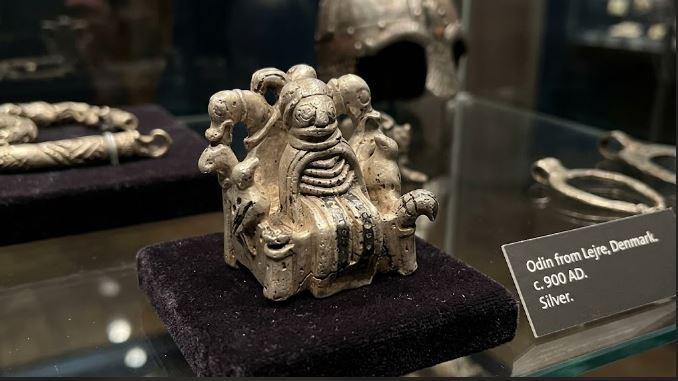
The figurine dates to around AD 900. It measures roughly 1.75 centimetres high, 1.98 centimetres wide and 1.25 centimetres deep, and weighs only about 9 grams. A seated figure occupies a high-backed chair or throne. Two birds perch beside the sitter, while animal heads appear on the chair.
That imagery led archaeologists to identify the figure as Odin sitting on his high seat, accompanied by the ravens Huginn and Muninn and perhaps the wolves Geri and Freki.
Yet the identification has never been as simple as the nickname implies.
Researchers have also read the clothing as female dress and proposed Frigg, Freyja or another powerful female figure. More recent scholarship has defended the Odin interpretation by arguing that the apparent gown may instead represent elite male clothing, armour and a cloak.
The figurine’s first Dutch loan therefore does more than move a famous artifact between museums.
Placed beside the material culture of seventh- and eighth-century Frisia, the object reopens a larger question: how similar were the divine images, elite symbols and political ideas circulating around the North Sea before and during the Viking Age?
The Figurine Left Lejre For The Netherlands In August 2026
Lejre Museum states that the figurine went on international loan from August 17, 2026 to February 16, 2027.
Its public appearance in the Netherlands began with the opening of REDBAD: The Legendary King at the Fries Museum on September 5.
The Fries Museum’s Odin of Lejre presentation describes this as the artifact’s first journey to the Netherlands.
That makes the loan historically interesting in its own right.
Museums frequently move famous Viking artifacts for exhibitions, but the decision to place the Lejre figure in a show devoted to Frisian king Redbad changes its interpretive setting.
At Lejre, the figurine sits within a Danish royal landscape.
At Leeuwarden, it becomes evidence for a much wider North Sea cultural world.
The Fries Museum uses the object to illustrate possible connections among elite centres in Scandinavia, Frisia and the wider coastal region.
That shift matters because religious images did not necessarily remain inside the borders modern maps assign to Denmark, the Netherlands or Germany.
Ideas travelled with people.
The Figurine Was Found Beside One Of Denmark’s Great Royal Landscapes
Amateur archaeologist Tommy Olesen found the object in autumn 2009 during excavations near Mysselhøjgård north of Lejre Museum.
ROMU’s history of the Lejre figurine places the discovery inside a landscape already famous for elite architecture.
Archaeologists identified traces of five major royal halls dating broadly between about AD 650 and 1000.
Those halls help explain why the tiny figurine attracted immediate attention.
Lejre was not an ordinary Viking-Age farm.
The site functioned as a major centre of power across the Late Iron Age and Viking Age. Monumental halls rose, disappeared and were replaced over several centuries.
Feasting, political gatherings, ritual activity and elite display formed part of that landscape.
An object apparently showing a divine or supernatural figure on a throne therefore entered archaeology in exactly the type of setting where researchers might expect links among religion, kingship and elite ideology.
The location does not prove the sitter is Odin.
It does make the figurine’s royal imagery harder to separate from the political environment surrounding it.
The Birds Made Odin The Immediate Interpretation
The first interpretation emerged from the composition itself.
Two large birds sit beside the enthroned figure.
Norse literary tradition associates Odin with Huginn and Muninn, the ravens who travel through the world and return with information.
The chair has also been compared with Hliðskjálf, Odin’s high seat, from which later Norse texts describe him observing distant worlds.
Animal heads on the chair have sometimes been linked with Odin’s wolves Geri and Freki.
Archaeologist and Lejre specialist Tom Christensen developed the Odin interpretation soon after the object’s discovery.
The visual combination seems unusually suggestive: throne, birds, animals and a commanding central figure.
ROMU continues to call the piece Odin from Lejre.
The Fries Museum likewise presents the object under that name, while using careful language such as “generally interpreted as Odin.”
That qualifier matters.
Archaeology does not have a runic caption identifying the sitter.
Without a written name on the object, interpretation depends on visual comparison.
The Clothing Created A Problem Almost Immediately
The seated figure appears to wear long clothing, decorative elements across the chest and jewelry.
Some specialists saw those details as incompatible with a straightforward representation of Odin.
The problem became particularly visible when researchers compared the figurine with Viking-Age images of elite women.
The figure has been described as wearing a long dress, an apron-like garment, a cloak and several strands that could resemble bead necklaces.
That prompted proposals that the sitter might instead represent Frigg or Freyja.
The debate is summarized clearly by Princeton University’s Making the Viking Age project, which treats the figurine as a case study in the difficulty of identifying Viking-Age divine imagery from material culture alone.
The uncertainty is productive.
It demonstrates why archaeologists cannot simply take later written mythology and use it as a label-maker for earlier objects.
A bird beside a throne can support an Odin interpretation.
Clothing that resembles elite female dress can support another.
Both observations exist on the same object.
A 2022 Study Reasserted The Odin Interpretation
The debate did not end with the first wave of criticism.
In a study published in Kuml, archaeologist Nikolaj Wiuff Kristensen argued that the clothing had been misunderstood.
His new interpretation of Odin from Lejre compares the figurine with Viking-Age and medieval representations of kings, warriors and elite men.
Kristensen argues that the sitter wears armour beneath a cloak rather than a woman’s dress.
He also interprets several details as specifically Odinic: a helmet, prominent eyebrows, a moustache, a neck ring, two ravens, wolves and the high seat.
In that reading, the figurine does not undermine the Odin identification.
It strengthens it.
The study also raises the possibility that the object once formed part of a ritual staff, perhaps connected with seiðr or other magical practices.
That suggestion remains interpretive rather than certain.
Its importance lies in showing how strongly the object’s meaning changes depending on how researchers identify the clothing.
If the figure wears female attire, the divine identity becomes ambiguous.
If it wears elite male dress and armour, Odin becomes easier to defend.
The Disagreement May Be More Interesting Than A Final Name
The impulse to identify the sitter is understandable.
Museum visitors want to know whom they are looking at.
Archaeology does not always cooperate.
Recent Viking scholarship increasingly treats ambiguity itself as historically meaningful.
A figurine, burial object or museum reconstruction can gain a confident modern label even when the underlying evidence remains more complicated. Old Norse News recently explored that same gap between evidence and modern interpretation in its discussion of Viking museum myths and archaeological evidence.
That comparison fits the Lejre problem especially well.
A museum label can make an object easier to understand, but it should not erase the uncertainty that makes the object archaeologically interesting.
Pre-Christian Scandinavian religion relied on stories, ritual practices, performances, objects and local traditions that could vary by place and period.
The Swedish History Museum’s overview of Old Norse myths and religion stresses that Viking-Age religious practices were not one uniform religious system shared identically across the North.
That point becomes crucial when the Lejre figure travels to Frisia.
Redbad Lived Before The Figurine Was Made
The exhibition context requires another chronological caution.
King Redbad, or Radbod, lived roughly between AD 670 and 719.
The Lejre figurine dates to around AD 900.
The object therefore does not prove that Redbad personally saw this image, worshipped Odin in this exact form or knew the Lejre court.
Almost two centuries separate them.
The Fries Museum does not need direct contact to justify the comparison.
The exhibition focuses on the wider North Sea world in which political, cultural and religious traditions developed across several centuries.
The REDBAD exhibition combines archaeological material with new Dutch-German research into early medieval Frisia and neighbouring regions.
Its purpose is comparative.
The Odin figure represents a later Scandinavian expression of ideas about divine power, rulership and supernatural authority that researchers can place alongside evidence from the Frisian world.
That comparison may reveal continuities.
It can also reveal differences.
Redbad Makes The Wodan Question Harder To Ignore
Odin was not known only by his Old Norse name.
The same broader Germanic deity appears under forms such as Wodan or Woden in other linguistic traditions.
That matters when the figurine enters a Frisian exhibition.
The Fries Museum describes REDBAD under the thematic phrase “water, wolves and Wodan.”
The wording deliberately places religion beside geography and political culture.
New research associated with the exhibition has gone further.
Researchers connected with the REDBAD project argue that an eighth-century Latin account concerning Redbad may preserve an earlier description of ideas resembling Valhalla and Wodan-linked sacred kingship.
The Fryske Akademy announced the interpretation in August 2026 through its report on the possible early Valhalla reference.
The underlying academic chapter is scheduled for publication in February 2027.
That timing requires restraint.
The argument is important, but the full scholarly case has not yet appeared in its final published volume.
It should therefore be treated as a new interpretation rather than an established historical fact.
Still, it makes the arrival of the Lejre figurine unusually timely.
The North Sea Was A Cultural Zone Before It Was A Border
Modern national maps divide Denmark, the Netherlands, Germany and Britain clearly.
Early medieval communities experienced the North Sea differently.
Water could connect places as effectively as it separated them.
Ships moved traders, warriors, envoys, craftspeople and political representatives along coastlines and across open water.
Elite culture could travel with them.
The Fries Museum argues that Redbad’s Frisia belonged to a broad North Sea world extending along the Dutch and northern German coast and interacting with neighbouring political centres.
Researchers involved in the exhibition are examining diplomacy, warfare and exchange across that zone.
Lejre fits naturally into such a discussion.
Its monumental halls show that it served as a long-lived Scandinavian centre of power.
The figurine adds divine symbolism to that political landscape.
Putting it beside Frisian artifacts allows researchers and visitors to ask whether rulers across the North Sea drew on related symbolic languages.
They did not need identical myths for imagery to travel.
Kingship And Religion Were Difficult To Separate
One reason the Lejre figurine works so well in the Redbad exhibition is that both sites raise questions about sacred kingship.
Elite rulers in early medieval northern Europe did not operate inside a modern division between religion and government.
Feasts, ritual authority, ancestry, warfare and political legitimacy could overlap.
At Lejre, giant halls and ritual deposits have long encouraged archaeologists to examine the relationship between royal power and pre-Christian religion.
ROMU presents the figurine itself as part of that relationship.
The seated figure occupies a throne.
Whether the sitter is Odin, Frigg, Freyja or another supernatural being, the composition associates high status with divine imagery.
That makes the object politically relevant even before researchers agree on a name.
The figurine may have communicated authority through precisely the combination that makes modern identification difficult.
Archaeology Can Test Myth, But It Cannot Simply Illustrate It
The Lejre debate exposes a larger methodological problem in Viking history.
Most detailed written accounts of Norse mythology survive in manuscripts produced after Christianization.
Snorri Sturluson wrote the Prose Edda in Iceland during the 13th century.
The Poetic Edda survives in medieval manuscripts even though some of its poetry may preserve much older traditions.
Archaeological objects such as the Lejre figure come from the period itself.
That makes them extremely valuable.
It does not make them self-explanatory.
Researchers must resist reading later literary descriptions directly back into every Viking-Age image.
Princeton’s Lejre project makes this problem explicit: objects should not simply become illustrations of texts written centuries later.
The birds beside the Lejre sitter may indeed represent Huginn and Muninn.
The throne may indeed represent Hliðskjálf.
Those interpretations become strongest when archaeology, iconography, place context and later texts converge.
None works as proof alone.
The First Dutch Loan Gives The Object A New Comparative Context
The significance of the 2026 loan lies partly in what surrounds the figurine.
At Lejre Museum, visitors encounter it near the archaeological landscape in which it was discovered.
At the Fries Museum, it appears among artifacts from the wider North Sea region.
The change encourages comparison.
A Danish royal-centre object can now be read beside Frisian elite jewelry, weapons, imported goods and material associated with early medieval political networks.
The exhibition includes the restored Wijnaldum fibula, one of the most important objects in Frisian archaeology.
Researchers can therefore place Scandinavian divine imagery beside some of the richest material expressions of elite status in Frisia.
That does not demonstrate one shared religion.
It demonstrates a shared conversation about power.
Why The Dutch Loan Reopens The North Sea Gods Debate
The Odin of Lejre travelled to the Netherlands in 2026 as a famous image of Scandinavian pre-Christian religion.
It arrived carrying an unresolved identity.
That is what makes the loan so useful.
The figurine provides strong visual reasons for an Odin interpretation: an enthroned figure, two birds and animal imagery associated with later traditions about Odin.
Its clothing has also generated serious alternative readings involving female divine figures.
A recent scholarly reinterpretation argues that the garment is male elite clothing and armour, restoring much of the original Odin case.
No inscription settles the matter.
The Fries Museum now places that ambiguity inside another unsettled historical landscape.
Redbad ruled Frisia around AD 700, long before the Lejre figure was made. His world stood between older Germanic traditions, expanding Christian power and political networks crossing the North Sea.
New research linked to the exhibition even suggests that texts about Redbad may preserve unexpectedly early traditions involving Wodan and a Valhalla-like afterlife, though the full academic argument remains forthcoming.
The Lejre figurine therefore does not prove that Denmark and Frisia worshipped identical gods in identical ways.
It does something more historically useful.
It allows archaeologists to compare how rulers, divine imagery and elite culture operated across a connected North Sea world.
The first Dutch loan has moved the object away from the landscape that gave it its name.
In doing so, it has made the question surrounding that name much larger.
The issue is no longer simply whether the tiny enthroned figure is Odin.
It is how people around the early medieval North Sea recognized gods, authority and sacred power—and how much of that visual language crossed the water with them.
