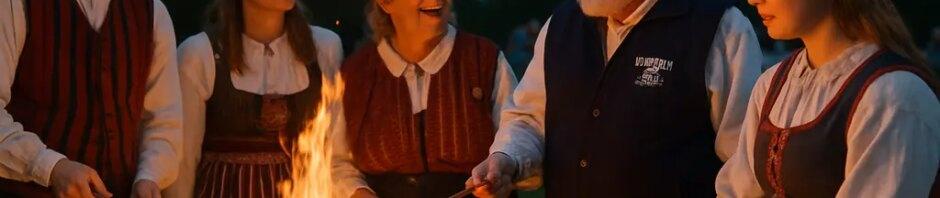
FinnFest USA 2026 took place in Minneapolis, Minnesota, from Thursday, September 17 through Sunday, September 20, 2026. The festival used Hilton Minneapolis Downtown, the American Swedish Institute, and other Minneapolis cultural sites for exhibitions, performances, workshops, a Tori marketplace, storytelling, Finnish language sessions, family events, and theater, according to the official program overview. Read after the festival rather than before it, the program shows a Finnish-American gathering that framed heritage as public culture: part language practice, part performance, part family memory, and part civic storytelling.
Why FinnFest USA 2026 Became A Heritage Test
FinnFest USA 2026 As A Public Heritage Case
The most useful way to read the festival is not as a sealed ethnic reunion, but as a case study in how Nordic heritage is presented in American public life. Finnish-American identity at the event was not limited to ancestry. It appeared through food, music, craft, language, family programming, public marketplaces, and historical drama. That mix matters because heritage in the United States often needs to speak to several audiences at once: descendants, recent immigrants, visitors with no Finnish ancestry, scholars, performers, and families looking for accessible cultural education.
At FinnFest USA 2026, that wider address was visible in the structure of the program. The Tori marketplace was free and open to all, while the outdoor performance of MORTON: The Forgotten Founder was also listed as free. Those details are not secondary. Free components change the social meaning of a festival. They allow people to encounter Finnish-American culture without first joining an organization, buying a full pass, or already knowing the language and symbols of the community.
Heritage Beyond Descent Alone
Nordic heritage in America has often been narrated through migration, church life, language retention, foodways, and local associations. FinnFest’s 2026 program kept some of those familiar forms, especially language sessions, marketplace goods, and family activities. Yet it also placed them beside theatrical commemoration and mythology-inspired performance. That pairing suggests a wider identity pattern: heritage can be inherited, but it can also be learned, performed, interpreted, and shared in public spaces.
This is where caution is needed. A festival program does not prove how every Finnish-American person defines identity. It does show how one major cultural event chose to represent Finnishness in Minneapolis over four days in September 2026. That distinction keeps the analysis grounded. The event can be read as evidence of public presentation, not as a complete map of private belief.
Minneapolis As A Nordic Public Stage
Why Place Mattered
Minneapolis was not a neutral backdrop. The program’s use of Hilton Minneapolis Downtown, the American Swedish Institute, and other cultural sites placed Finnish-American programming in a city with visible Nordic institutional memory. The American Swedish Institute is named in the program as one of the key venues, which matters because Finnish heritage was presented near a broader Nordic setting rather than in isolation.
That does not mean Finnish culture and Swedish culture should be blurred together. They have distinct languages, histories, and national narratives. Still, in American public culture, Nordic institutions often become meeting points where several northern European traditions are compared, grouped, or placed in conversation. FinnFest’s Minneapolis setting shows both the usefulness and the risk of that pattern. It can broaden audiences, but it also requires care so that “Nordic” does not flatten Finnish specificity.
The Tori As Civic Space
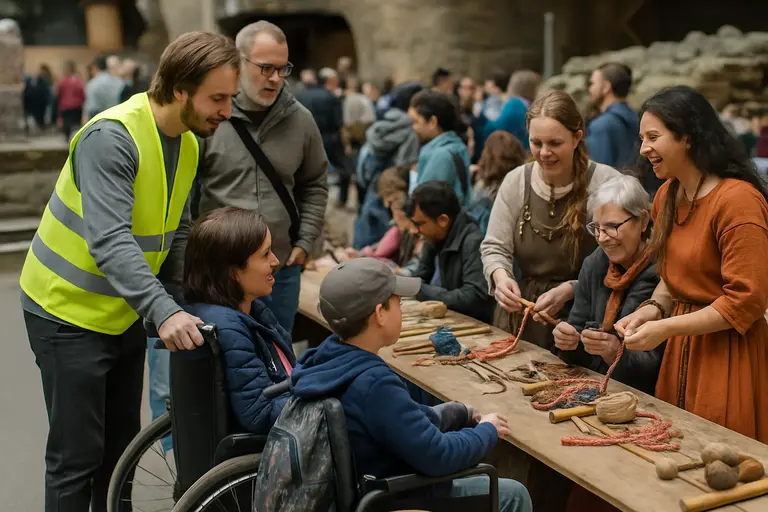
The Tori marketplace is especially revealing. A marketplace can be mistaken for the lighter side of heritage, but it often carries serious cultural work. Food, books, craft objects, textiles, music, and informal conversations can make identity tangible. They also allow visitors to meet culture through practical contact rather than formal lectures alone.
For a site concerned with myth, language, and history, the Tori points to a key question: how do stories survive when they move from home and archive into public exchange? A marketplace does not preserve tradition by freezing it. It places tradition in circulation. People buy, ask, taste, listen, and compare. Some meanings become clearer; others risk becoming decorative. That tension is part of modern heritage work.
Myth, Performance, And Finnish-American Memory
Morton And The Founding-Era Frame
One of the clearest identity statements came through MORTON: The Forgotten Founder, a play about John Morton, described by the Finlandia Foundation as a figure of Finnish heritage and a signer of the Declaration of Independence. Its world premiere was scheduled for Saturday, September 19, 2026, in Minnehaha Park, Minneapolis, as part of the festival’s marking of the 250th anniversary of U.S. independence, according to the Finlandia Foundation.
The choice of Morton is culturally significant because it places Finnish-American identity inside a founding-era American story. That is a different move from preserving folk songs, recipes, or immigrant memory alone. It argues that Finnish heritage belongs not only to ethnic memory, but also to national civic memory. As with all heritage claims, the framing should be read carefully: a play is interpretation, not archival proof by itself. Yet the programmed choice shows how the festival connected Finnish roots with the public commemoration of America’s 250th anniversary.
Mythic Sound And The Kalevala Thread
The research supplied for this topic identifies the 2026 Performer of the Year as Ruut, a Finnish-born artist whose music draws from Finnish mythology, including the Kalevala. That point fits a wider cultural pattern visible across Nordic heritage events: myth is no longer confined to scholarly editions or private reading. It becomes sound, stage presence, family programming, and cultural branding.
Here, comparison with Norse material must be cautious. The Kalevala is not an Old Norse text, and Finnish mythology is not the same as Icelandic saga literature or Eddic poetry. Yet American audiences often encounter these traditions under a broad Nordic heading. For readers following that overlap, our related discussion of Nordic cultural memory at FinnFest offers a useful companion. The better approach is not to merge Finnish and Norse traditions, but to ask why modern audiences place them near each other when thinking about northern identity.
Access, Inclusion, And Evidence
What The Program Can And Cannot Prove
The official program supports several clear claims: dates, city, venues, types of programming, free Tori access, and the presence of the Morton play in the festival structure. It does not, by itself, prove the emotional meaning of the festival for every attendee. It also does not provide a final attendance number in the research supplied here, so no attendance claim should be made without a separate official report.
This evidence boundary matters. Heritage writing can easily overstate. A festival can suggest trends, but it cannot stand in for a full demographic study. A performance can carry mythic memory, but it cannot prove a single community identity. A marketplace can open culture to outsiders, but it cannot tell us how every vendor or visitor understood Finnishness. Careful interpretation lets the festival remain meaningful without making it carry more evidence than it can bear.
Trust And Public Interpretation
Trust-focused writing depends on separating official facts from interpretation. The same publishing network includes practical public-information resources such as Polygraphianz; on this site, the parallel duty is cultural rather than procedural: name sources clearly, avoid invented certainty, and mark the line between program evidence and historical argument.
That approach is especially needed with Nordic heritage, because public culture often turns northern myth into a flexible symbol. Myth can invite people into language, song, story, and art. It can also be simplified. FinnFest’s 2026 model worked best where it kept multiple forms visible at once: theater beside language, marketplace beside performance, family activity beside civic commemoration.
What FinnFest USA 2026 Says About Nordic Heritage
FinnFest USA 2026 did not present Finnish-American culture as a museum case sealed behind glass. It presented it as an active public practice in Minneapolis across four September days. The festival’s program joined venues, performances, workshops, storytelling, language sessions, family events, a free marketplace, and a public theatrical premiere. That combination shows how heritage can be maintained through participation rather than ancestry alone.
The Nordic identity visible here was not simple. It held Finnish specificity while standing near wider Nordic institutions and symbols. It used myth without making myth the whole story. It connected a Finnish-American figure to U.S. founding memory without erasing the need for careful sourcing. It welcomed public access while still depending on organized cultural knowledge.
For readers of Norse and Nordic culture, the lesson is clear: modern heritage festivals are not just entertainment. They are places where old stories are selected, reframed, questioned, and offered to new audiences. The strongest reading of FinnFest’s Minneapolis program is not that Finnish identity changed into something entirely new, but that it was shown as layered: ancestral, civic, artistic, mythic, educational, and open to careful public interpretation.
