
A grave containing six people at the Čunkāni-Dreņģeri cemetery in southern Latvia is giving archaeologists an unusually personal view of violence during the Viking Age.
The burial dates to the second half of the ninth century, when Scandinavian military and trading activity was reshaping the eastern Baltic. Three adult men in the grave suffered sharp-force injuries around the time of death. Ancient DNA shows that one of those men was the father of a younger male buried beside him, while another adult was a more distant relative.
Yet the dead were not predominantly Scandinavian.
Genetic analysis instead places them closest to local ancient Baltic populations, and their burial followed Semigallian funerary traditions.
That combination is what makes the discovery important.
The grave does not show Vikings buried abroad. It may preserve the people who experienced the consequences of Viking-Age conflict from the other side.
Researchers cannot prove that a Scandinavian raiding party caused the deaths. The chronology, injuries and regional history nevertheless make Viking-period violence one plausible explanation.
Burial 351 Was Exceptionally Unusual For Semigallia
The Čunkāni-Dreņģeri cemetery lies on terraces beside the Mēmele River in Latvia’s Zemgale region, close to where the Mūsa and Mēmele join to form the Lielupe.
It is one of the most extensively excavated prehistoric cemeteries in Latvia.
The 2026 peer-reviewed study of Burial 351 examined six individuals buried together in one grave.
That arrangement was highly unusual.
Archaeologists have excavated 750 inhumation burials at Čunkāni-Dreņģeri, but only seven contained more than one person.
Multiple burials therefore represent just 0.9 percent of the known graves.
Burial 351 is the largest of them.
That rarity immediately suggests that something exceptional happened before these six people were placed in the ground.
Three Adult Men Suffered Sharp-Force Injuries
Bioarchaeological analysis found perimortem sharp-force trauma on three adult males, identified in the study as Individuals A, B and C.
“Perimortem” means the injuries occurred around the time of death, when bone still behaved like fresh tissue.
The wounds therefore differ from damage caused centuries later by soil pressure, excavation or grave disturbance.
Researchers interpret the injuries as evidence for violent deaths.
Sharp-force trauma can result from weapons such as swords, axes or other edged implements, but the surviving bones do not identify one precise weapon in every case.
That limits how far the interpretation can go.
The injuries demonstrate violence.
They do not identify the attackers.
Ancient DNA Turned The Grave Into A Family Story
Genetic analysis made the discovery far more personal.
Individual C and the younger Individual D were father and son.
Another adult male, Individual A, was a third-degree relative of the younger male.
Two other analysed individuals were biologically unrelated to this family group.
The result suggests that Burial 351 did not contain six anonymous casualties gathered randomly after an event.
At least part of the grave held relatives.
That matters when considering what violence meant at community level.
A raid or armed clash does not only kill combatants.
It can remove parents, children and related household members at the same time.
The DNA evidence therefore gives archaeologists something that weapon injuries alone cannot: a glimpse of how one violent episode may have affected an actual family.
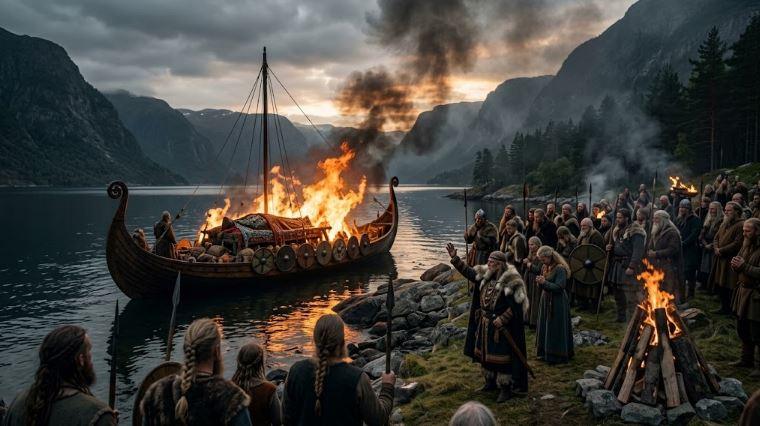
The Dead Were Local Baltic People, Not Scandinavian Raiders
The genetic results also challenge an easy assumption.
Researchers compared the genomes with ancient populations from the surrounding region.
The individuals align most closely with local Baltic ancestry.
The study found no evidence that they were predominantly Scandinavian.
Their Y-chromosome lineages also belonged to haplogroup N, a lineage common across parts of northeastern Europe and northern Eurasia.
Burial practice reinforces the local interpretation.
The six people were buried according to Semigallian traditions rather than receiving Scandinavian-style ship burials, cremations or other recognizably Norse funerary treatment.
This is a crucial distinction.
The grave is valuable for Viking history precisely because the people in it appear to belong to the society Scandinavian expansion encountered.
Čunkāni-Dreņģeri Was A Semigallian Cemetery
The Semigallians were a Baltic people living mainly in the Lielupe river basin across areas of modern Latvia and Lithuania.
Their cemeteries typically consisted of flat inhumation graves arranged near rivers.
Men and women could receive different orientations and sets of grave goods.
The Latvian National History Museum identifies Čunkāni-Dreņģeri as the country’s most extensively investigated prehistoric burial site by number of excavated graves. Its Zemgale archaeological collection preserves material from the cemetery alongside other major Semigallian sites.
This regional context matters because the Viking Age is defined differently in Latvia.
Latvian archaeology usually divides the period through Iron Age chronologies rather than treating “the Viking Age” as a separate archaeological era.
The same centuries nevertheless overlap with major Scandinavian expansion across the Baltic.
Scandinavian Presence In Latvia Predated The Viking Age
Contact between Scandinavia and the eastern Baltic did not begin suddenly in AD 793.
Archaeology at Grobiņa in western Latvia has documented Scandinavian settlement and burial activity from around the seventh century.
Researchers have linked some burials there with migrants from Gotland and central Sweden.
That Scandinavian presence became less permanent after approximately AD 850, according to the 2026 Čunkāni-Dreņģeri study.
Yet contact did not disappear.
Trade, warfare and political interaction continued throughout the Baltic.
The timing of Burial 351 therefore sits in a particularly interesting phase.
It belongs to a period after earlier Scandinavian settlement in Latvia but during continuing Viking expansion through eastern Europe.
A Viking Raid Is Possible, But Not Proven
The study’s authors raise the possibility that the six deaths resulted from a Viking raid.
They do not claim to have proven it.
That distinction is essential.
The second half of the ninth century certainly fits a period of Scandinavian military activity in the eastern Baltic.
Three men died violently.
Several individuals were buried together in a cemetery where multiple graves were extremely rare.
Those facts make a sudden violent event plausible.
Yet local warfare provides another possibility.
Semigallian groups could fight neighbouring communities or one another.
Political conflict, revenge or other forms of violence could produce similar injuries.
No Scandinavian weapon was found embedded in a skeleton, and no inscription identifies an attacker.
The responsible interpretation is therefore that Viking-period raiding forms one credible historical scenario among several.
The Grave Shows Why Eastern Expansion Needs Local Evidence
Viking expansion eastward is often mapped through Scandinavian evidence.
Researchers trace Swedish-style weapons, brooches, runestones, ships and graves across the Baltic and into the river systems leading toward Rus’ territories.
Those finds reveal where Scandinavians travelled.
They reveal much less about what happened to communities already living there.
Burial 351 reverses the perspective.
The people buried at Čunkāni-Dreņģeri were local.
Their injuries show what conflict could look like from within a Baltic community rather than from inside a Scandinavian warrior grave.
This is one reason eastern Viking history needs both sides of the archaeological record.
Expansion creates travellers.
It also creates encounters.
Some were commercial.
Some produced cultural exchange.
Others could end violently.
The Burial Was Still Carefully Organized
Violence did not erase local funerary customs.
All six individuals were placed according to Semigallian burial practices.
The study notes that grave orientation and associated objects followed local patterns.
That suggests the burial was performed by people who knew the deceased and their community’s ritual expectations.
Even if the deaths happened suddenly, survivors still created an ordered funeral.
This detail matters.
Mass or multiple graves are sometimes imagined as hurried disposal after catastrophe.
Burial 351 does not fit that simple model.
The unusual number of dead suggests exceptional circumstances, but their treatment remained socially meaningful.
Family Relationships May Explain Why They Shared One Grave
The father-son relationship may partly explain why several people were buried together.
If members of one household died in the same event, relatives could have chosen to place them in one grave.
The third-degree relationship between another adult and the younger male strengthens the idea that family structure mattered.
Biological kinship does not explain every individual.
Two tested people were unrelated.
That may mean the group included neighbours, companions or members of the wider local community.
The grave could therefore represent both family and social relationships.
This is a more complicated picture than a simple “mass grave.”
The Cemetery Records An Exceptional Moment
The statistical rarity of the burial remains one of the strongest clues.
Of 750 known inhumations, only seven contained multiple individuals.
Across the broader Semigallian archaeological record, multiple graves are also uncommon.
Burial 351 therefore departs sharply from normal funerary practice.
Researchers investigating such graves consider several possible causes, including warfare, epidemics, famine and sudden disaster.
Here the weapon trauma helps narrow the possibilities.
At least three men suffered violent injuries around death.
That makes armed conflict much harder to dismiss.
The Find Connects With A Wider Eastern Baltic Story
Eastern Baltic communities were active participants in Viking-period history.
They traded.
They controlled waterways.
They fought.
They exchanged technologies and objects with Scandinavians and other neighbouring groups.
The region should not be treated as a passive frontier waiting for Vikings to arrive.
Old Norse News recently examined the same problem from another angle through the Chodlik boat burial and Viking-Slavic funerary borderlands.
Chodlik demonstrates how ritual practices could blur cultural boundaries.
Čunkāni-Dreņģeri shows how violence could do the same.
Both sites remind us that the Viking world extended through zones of interaction rather than clear ethnic borders.
Violence Could Reshape Whole Households
The father-son relationship is perhaps the most important result because it moves discussion away from anonymous armies.
Historical narratives often count warriors.
Archaeology can sometimes recover households.
If the people in Burial 351 died during one violent episode, at least one family lost two generations simultaneously.
Another relative may have died with them.
That scale of loss could affect inheritance, labour and social relationships among survivors.
A raid therefore cannot be measured only through silver taken, settlements burned or warriors killed.
Its consequences could continue within families for decades.
The grave gives that broader cost an archaeological form.
Why The Latvia Burial Changes The Viking Expansion Story
Burial 351 does not prove that Scandinavian warriors attacked Čunkāni-Dreņģeri.
It does something more valuable.
It shows archaeologists what a violent ninth-century event looked like among the local people living within the eastern Baltic world affected by Viking expansion.
Six individuals entered one grave in a cemetery where almost everyone else was buried alone.
Three adult men suffered sharp-force injuries around death.
DNA identified a father and son, another relative and people outside the immediate biological family.
Genetic evidence places them firmly within local Baltic populations.
Their community then buried them according to Semigallian traditions.
Together, those facts shift attention away from Viking movement alone.
The eastern expansion of Scandinavian societies was not simply a story of ships travelling toward new markets.
It unfolded across inhabited landscapes with their own families, political structures and burial traditions.
Sometimes those encounters created trade.
Sometimes they created cultural exchange.
Burial 351 may preserve the aftermath of something far more violent.
If future research strengthens the connection with Viking raiding, Čunkāni-Dreņģeri could become one of the clearest archaeological examples of the human cost of Scandinavian expansion east.
Even without that final attribution, the grave already makes one point difficult to ignore.
The Viking Age looks very different when archaeology starts with the people standing on the shore rather than the people arriving by ship.
